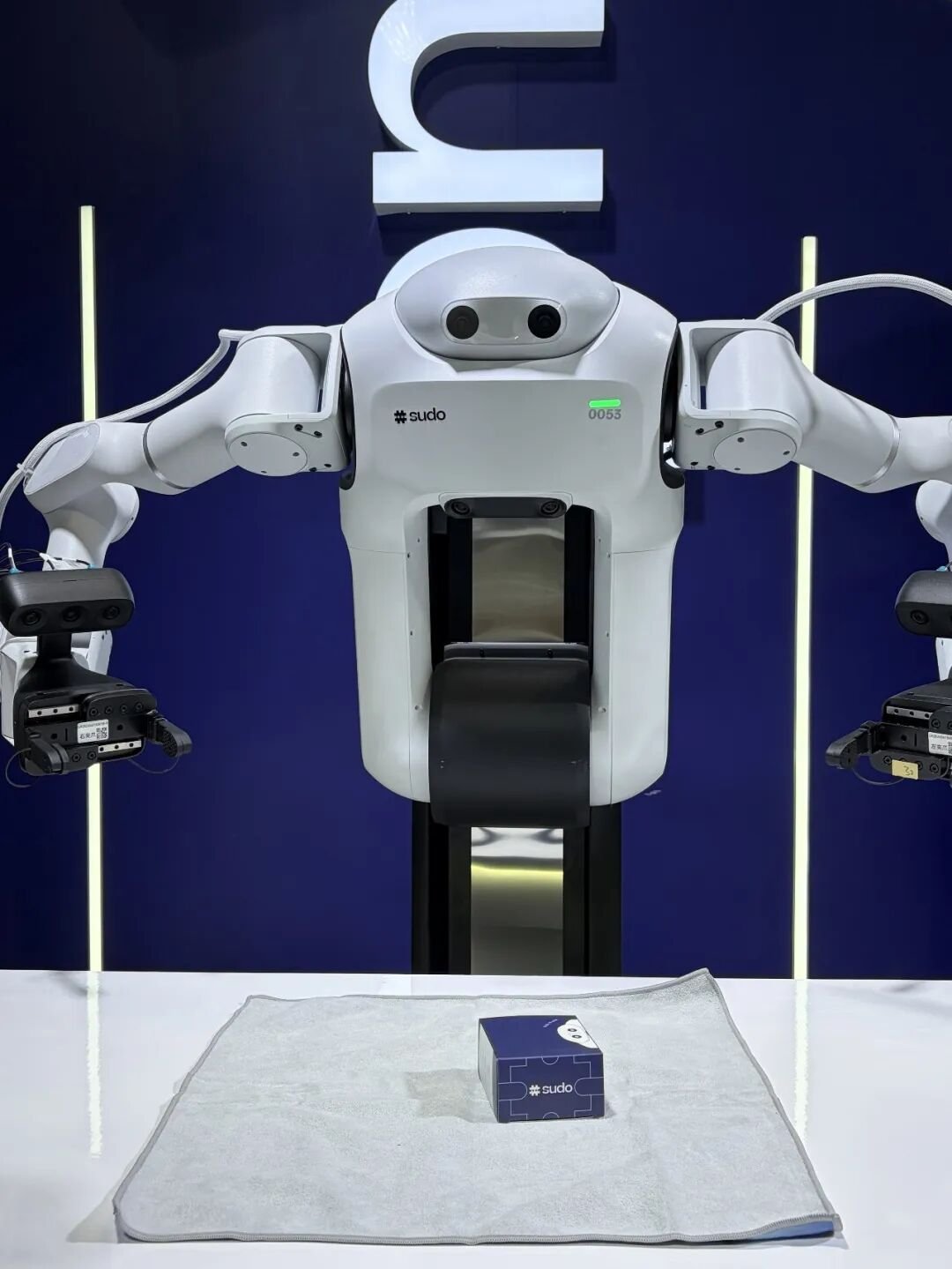
Sudo, a robotics startup barely a year old and already carrying a valuation around 20 billion yuan, used its WAIC debut to argue that the path to general-purpose physical intelligence is not more isolated demos but accumulating atomic skills. On the booth, more than ten capabilities ran at once, grasping unseen objects, two-hand cloth wrapping, peg insertion, mobile picking, autonomous navigation, spanning living rooms and factory lines.
The founder is Su Hao, a Fudan professor and founding director of the Institute for General Physical Intelligence, known for ShapeNet and PointNet, the datasets and networks that shaped 3D vision, and for building robot simulation platforms SAPIEN and ManiSkill.
Skills, not scripts
Sudo defines the robot’s basic units of competence as atomic abilities and treats capability growth like human learning: accumulate fundamentals, then compose them for long-horizon tasks. A gift-wrapping task decomposes into recognition, grasping, posture adjustment, precise placement and two-hand coordination, skills that also transfer to assembly, sorting and packing.
The harder infrastructure problem is data. Sudo chose an unusual route: let robots accumulate experience first in simulation, then bake in real-world data. Its engine generates million-scale samples daily, and the team blends large-scale simulation with targeted real-robot data so the machine gets both the “exposure” of simulation and the “touch” of reality.
A hand that thinks about nails
Tucked in a corner of the booth was a self-developed 22-degree-of-freedom direct-drive dexterous hand. The thumb and pinky each carry five degrees of freedom, the other three fingers four. Rather than copy the human hand, Sudo redesigned it for robot tasks, adding a self-spinning thumb, a stronger adducting pinky, and a fingernail-like structure at the fingertip so the hand can make precise point contacts, pinching a needle or popping a can tab, jobs soft fingertips fumble.
For Western observers, Sudo is a useful data point: China’s embodied-AI startups are no longer just cloning arms, they are vertically integrating models, simulation, hardware and data pipelines, and they are hiring world-class research pedigree to do it.
Read the original report (LeiPhone)
Translated and adapted from LeiPhone (leiphone.com).