Gasgoo Research used its annual industry report to make ten calls about China’s car industry, and the most useful one for outsiders is a definition. The Chinese formula, according to vice president Wang Xianbin, is fast, good and cheap, and its foundation is scale rather than subsidy.
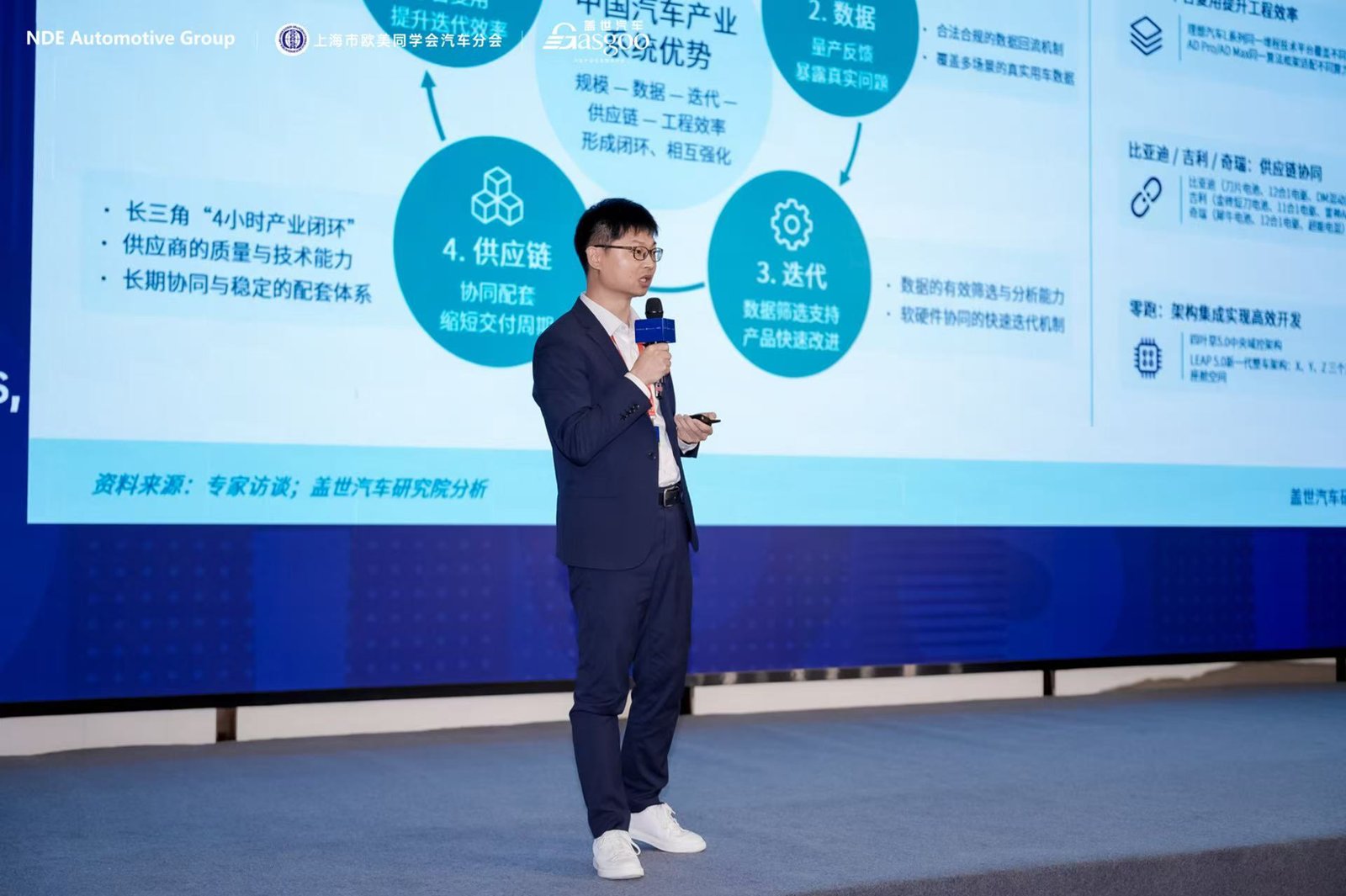
Wang presented the 2026 China Automotive Industry Innovation Report at the 14th Automotive and Environment Innovation Forum and the eighth Golden Panel Awards in Shanghai on 23 October. The mechanism he described is unglamorous: large data volumes and fast iteration, combined with a complete supply chain and an engineering talent pool, produce an engineering efficiency advantage that shows up as cost and speed at the same time.
Where competition is converging
Competition, in his reading, is narrowing onto four things: scale, closed-loop capability, cost and compliance. The logic of going abroad is shifting from market access to supply chain security and localisation in each region.
On artificial intelligence he was direct: the ChatGPT moment has arrived for cars, and applications have already spread through cockpits, driver assistance, manufacturing and marketing. The driver assistance field will converge toward a structure he summarised as one plus four plus two N, with the leaders widening their advantage. Cockpit homogenisation is pushing cross-sector technology fusion, and high-end chips are breaking through in cockpit domain controllers and driver assistance.
The hardware calls
Intelligent chassis has entered the mass-production window for electro-mechanical braking and steer-by-wire, and is likely to become the execution layer for L3 and L4 driving. Efficient powertrains and energy management remain a shared global problem rather than a solved Chinese one. And the supply chains of cars and embodied AI already overlap by roughly 60 to 70 per cent, which makes mobile physical AI a plausible second growth curve for carmakers and their suppliers.
The uncomfortable part
Wang’s conclusion is the sentence European buyers should read twice. The core of the Chinese formula’s global value, he said, lies in localisation and compliance adaptation, converting technology, talent and supply chain into a scaled customer base in each market, with regulation, data localisation and organisational capability all handled locally.
The report is published by an arm of Gasgoo, a Chinese industry data provider, so the framing is not neutral. Even allowing for that, the emphasis is telling. The industry’s own analysts now describe compliance as the binding constraint on going global, not manufacturing capability.
Editor’s note: This is an adapted translation of the original Gasgoo report. It has been trimmed and restructured for readability for an international business audience. The full original (in Chinese) is at https://auto.gasgoo.com/news/202610/23I70475744C108.shtml.