In March 2026 Iran struck Qatar’s Ras Laffan LNG facility, raising broad concern over helium supply, since helium is a byproduct of LNG production. Around the same time Iran blocked the Strait of Hormuz, and by April more than 600 ships, including 325 tankers, were stranded near the strait, many believed to carry helium and naphtha, a consumable in semiconductor equipment and the raw material for photoresist. The spectre of fabs halted by a triple hit of helium, naphtha and photoresist shortages has become a real worry.
Why helium is the acute risk
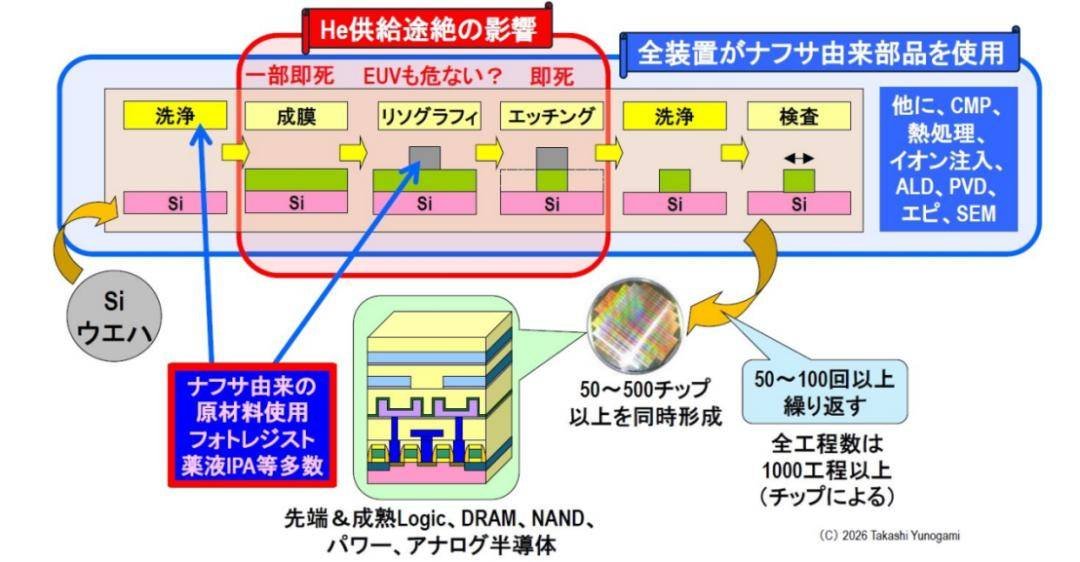
In front-end processing, steps including cleaning, film deposition, lithography, dry etching and inspection repeat 50 to 100 times or more per silicon wafer, sometimes over 1,000 steps in total. Helium and naphtha are the two materials a fab cannot do without. In dry etching, intense heat passes from plasma to the wafer, so a chuck circulates coolant near minus 60 Celsius, but the chuck contacts the wafer at essentially one point. One to two kilopascal of helium is injected into the gap because helium, a light monoatomic molecule, moves fast and carries heat to the chuck efficiently. Without helium there is no temperature control and the etch cannot run at all, an instant failure, and this applies to every dry-etch step including the deep holes in 3D NAND.
Why naphtha is the quiet risk
All semiconductor equipment consumables use naphtha-derived parts and materials: high-performance resins, rubber and elastomers such as O-rings, plasma- and chemical-resistant fluoropolymers, fluid parts like pipes and valves, and cables. When stocks run out, tools stop and the fab stops. Photoresist is worse: its chain is naphtha to propylene to PGME to PGMEA to photoresist, and five Japanese firms, Tokyo Ohka, JSR, Shin-Etsu, Fujifilm and Sumitomo, hold over 90 per cent of the global photoresist market, almost all buying PGME and PGMEA from Daicel. Any break in that chain stops fabs worldwide.
Why the lights are still on
The reason fabs have not closed is structure. Only a fraction of 1 per cent of the world’s roughly 1bn tonnes of annual naphtha goes to semiconductor materials, so photoresist supply is protected. Helium is different: global output is about 190m cubic metres a year, with the US at 42.6 per cent and Qatar at 33.2 per cent, so a Qatari outage removes a third of supply, and the semiconductor industry uses 21 to 24 per cent of all helium, more than Qatar’s entire 63m cubic metres a year. Three buffers help: gas producers hold reserves, TSMC and Samsung run helium recycling, and a priority rule cuts balloons and general industry before semiconductors. But helium cannot be stored long, boiling off about 1 per cent a day below minus 269 Celsius, and fab stocks last only days to weeks, so a sustained stop is a matter of months, not years. The helium crisis is not resolved.
Read the original report (Sohu IT)
Translated and adapted from Sohu IT (it.sohu.com).