Li Zexiang is best known outside China as the mentor who discovered Wang Tao, the founder of DJI. Inside the Greater Bay Area, he is something closer to an institution. The article, a reporter’s notebook from Shenzhen News, says his Songshan Lake XbotPark robot base has incubated 287 companies, including 13 unicorns or near-unicorns with a combined valuation above 50 billion dollars.
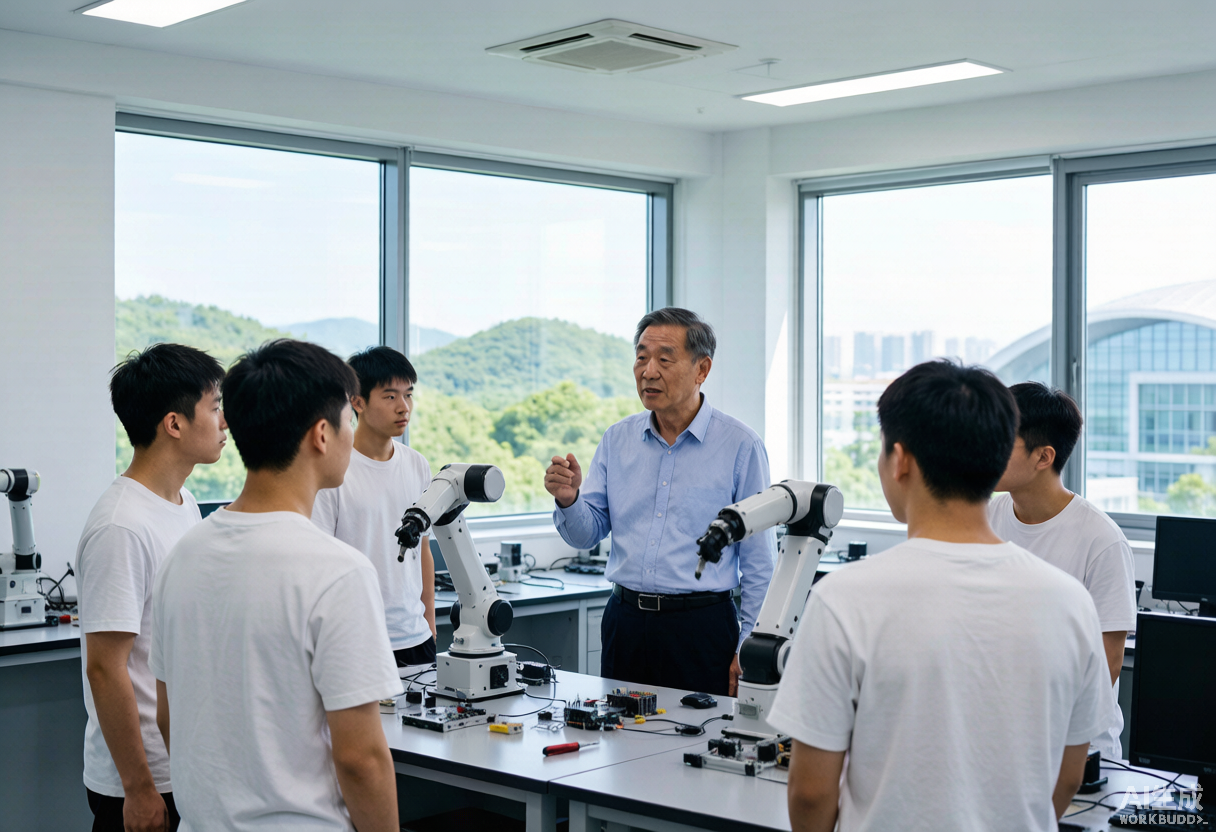
The profile focuses on three ideas: new engineering education, investment philosophy, and the relationship between talent scouts and founders.
Finding problems before finding solutions
Li’s educational philosophy treats problem definition as more important than analysis. During a tour of XbotPark, the reporter met two students, one in engineering and one in fine arts, who started a company to automate pet-bird feeding. The project sounds trivial, but Li presents it as the right kind of starting point: small, specific and rooted in a real user pain point. He argues that consumer markets are better for young founders than industrial markets because experience can be a liability when the goal is to invent a product that does not yet exist.
The article cites ChuJing, a desktop dishwasher company Li backed when its founder had no team, no capital and no factory. Sales rose from 18,000 units in the second half of last year to 220,000 units so far this year. Li’s explanation is blunt: pick the right person, then use the incubator’s evaluation and enablement system to reduce the mortality rate of what is normally a nine-deaths-in-ten gamble.
A replicable model, not a cult of personality
Li has tried to turn individual success into a system. The formula is “one local government plus one or more universities plus one platform plus one industrial park.” Stacked on top of the Greater Bay Area’s manufacturing network, it gives startups access to suppliers, factories and engineering talent within a short drive. The article claims product iteration speed in the Bay Area is ten to thirty times faster than in Silicon Valley, at one-tenth the cost.
That ecosystem position matters for embodied intelligence. Guangdong province already accounts for nearly 80 per cent of national sales revenue in embodied intelligence, according to the article. Li predicts the sector will be one of the most important convergence points of the next ten to thirty years.
The reporter ends by asking whether Li himself can be replicated. His answer avoids a simple yes or no. Entrepreneurship, he says, is lifelong learning. Even failure is acceptable because science and technology entrepreneurship always produce surprises.
Editor’s note: This is an adapted translation of the original Shenzhen News report. It has been trimmed and restructured for readability for an international business audience.