On 28 July 2026, the United States Federal Communications Commission added advanced foreign-made robots to its restricted-equipment list. The practical effect was to block new Chinese humanoid robots from entering the US market. The gap between the rule and reality is now being filled by rolling suitcases in Shenzhen.
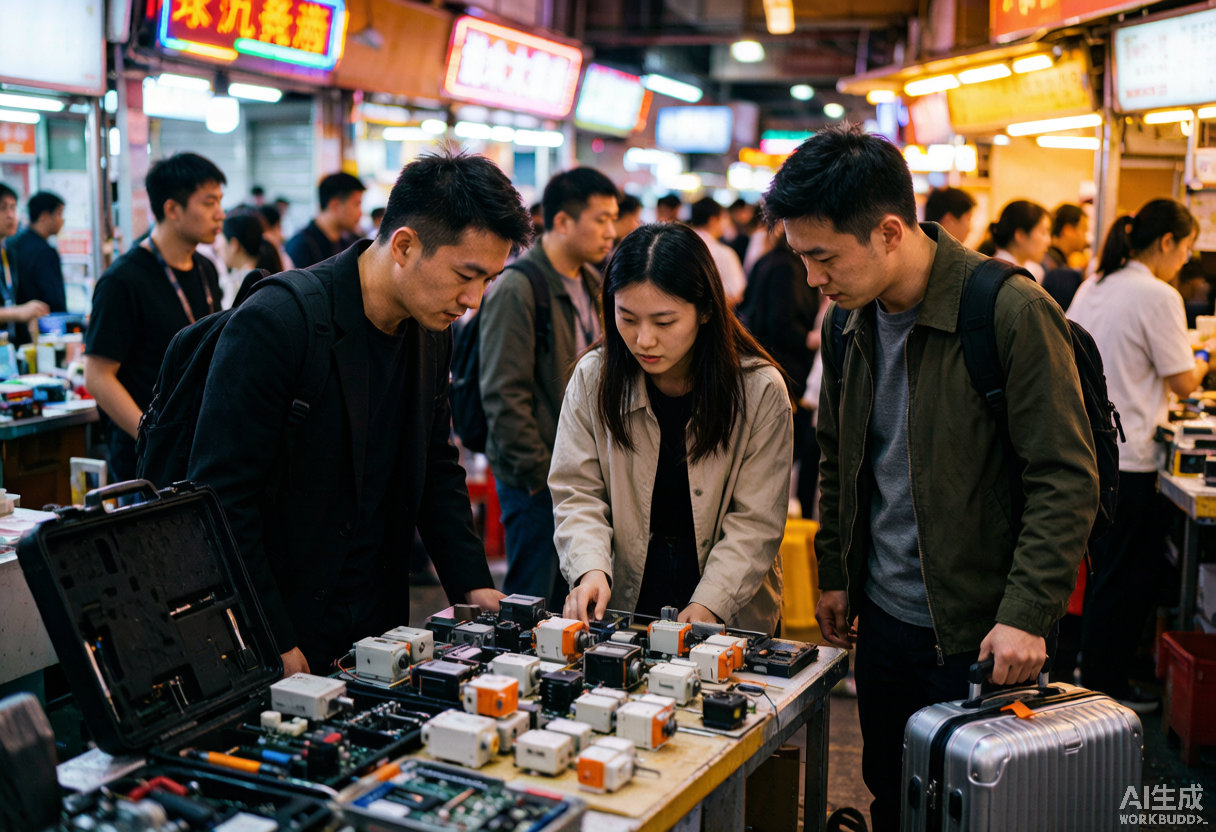
According to a report by The Information cited by Shenzhen News, American entrepreneurs and investors are increasingly travelling to Huaqiangbei, the dense electronics market in Shenzhen, to buy servomotors, sensors, controllers and gimbals. Some purchase complete Unitree or Zhiyuan robots, disassemble them on site, split the parts among several suitcases and carry them onto commercial flights back to the United States.
Why the parts still flow
The FCC order covers finished robots, not components. That distinction matters because the United States does not have a complete humanoid-robot supply chain, and Chinese companies dominate roughly 63 per cent of the global market by Morgan Stanley’s estimate. The same bank’s 2025 report found that Chinese suppliers account for about 70 per cent of the core components in Tesla’s Optimus. Removing those parts would lift Optimus’s unit cost from 46,000 dollars to 131,000 dollars, far above Tesla’s 20,000 dollar target.
China’s share of key components has risen to 75 to 90 per cent in reducers, servo systems and controllers. Rare-earth permanent magnets, essential for servo and joint motors, are even harder to replace because China controls the bulk of processing capacity. During last year’s tariff fight, Elon Musk said Optimus production was being affected by Chinese rare-earth export controls and that Tesla was working with Beijing on export licences.
A supply chain that cannot be walled off
The article says a new class of Silicon Valley middlemen has emerged. They aggregate small American orders into volumes worth manufacturing, then use Chinese e-commerce platforms such as Taobao and WeChat to source parts. Some Chinese contract manufacturers overproduce components and declare the surplus as defective scrap, routing it to these intermediaries. Others ship from warehouses in California after handling battery-import certification and paperwork.
A Chinese-American founder who moved from California to Shanghai told the publication that iterating on a camera module in China takes half a day because suppliers are a 15-minute bike ride away. In California, the same loop could take a month of calls and sample shipments. Another executive at Muka Robotics, a general-purpose robot company, said hardware support teams can arrive on site in under ten minutes in China.
The article quotes Apptronik chief executive Jeff Cardenas saying the United States needs an American Shenzhen, a regional manufacturing base where suppliers are within driving distance. The problem, it argues, is that decades of manufacturing consolidation, engineering talent concentration and supplier clustering cannot be replicated by executive order. In 2025, China’s industrial robot exports reached 8.03 billion dollars, surpassing Germany to become the world’s second-largest exporter.
Editor’s note: This is an adapted translation of the original Shenzhen News report. It has been trimmed and restructured for readability for an international business audience.