The first dexterous hand that can take a pulse, from a company that only does touch
Embodied intelligence has remained one of the most watched early-stage sectors in 2026. Competition across bodies, models, scenarios and applications keeps intensifying, and the upstream sensor layer has heated up along with it.
Tactile sensing is one of the first places along that chain to get crowded. In the past two years 25 companies have entered the field, and data-collection rigs and data gloves have become near-standard equipment. The dominant narrative is consistent. Embodied intelligence lacks tactile data, and whoever accumulates it first holds the fuel of the future.
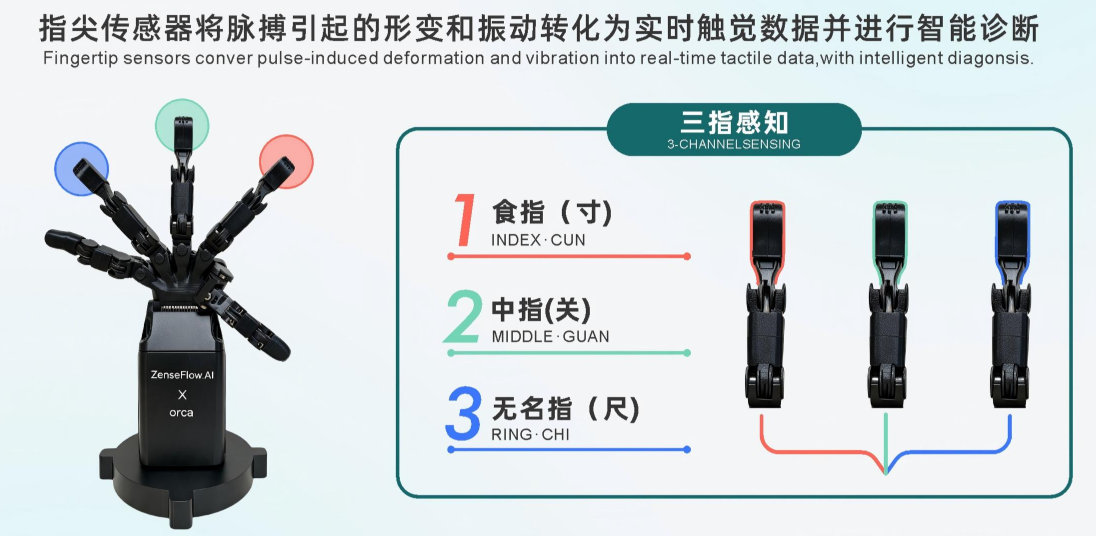
One company looks slightly different. Founded less than a year ago with a team of about 20 and still at angel stage, it started from the sensor and solution layer and used the hardest scenario in human touch to demonstrate what its technology could reach. At WRC 2026 it gave the first public showing anywhere of a robot dexterous hand that takes a pulse.
The company is Youren Intelligence. On 3 September its founder and chief executive Zhang Zhen laid out the technology and the strategic logic behind the hand in a conversation with Leiphone. In his view the industry has never lacked data volume. It lacks data credibility, and that judgement is the main thing separating Youren from its peers.
A robot hand on a human pulse
At the WRC 2026 stand, the dedicated pulse-taking hand made its debut. Three fingers settle on the wrist at the cun, guan and chi positions in sequence, applying pressure at three levels in rotation. Pulse analysis runs on-device, with further diagnosis in the cloud. The system currently resolves 28 pulse types and draws on traditional Chinese medicine knowledge to give advice.
Why choose pulse diagnosis? Zhang’s explanation has a product philosophy to it. From the first day the company has been looking for the limit of human touch, with one goal, to build a sensor that matches it. When the team realised that pulse diagnosis is the highest expression of human tactile ability, it made the problem an internal research brief.

What makes pulse reading hard is that it is not one measurement. The traditional technique is called three positions and nine indicators. Three positions at cun, guan and chi, three force levels, and perception that depends on position, rate, shape and force before an experienced practitioner interprets the result. At the tactile level this is four receptor classes working in parallel. Meissner corpuscles read low-frequency vibration and slip, Merkel discs handle static pressure and texture, Pacinian corpuscles catch high-frequency vibration, and Ruffini endings sense sustained stretch and shear. A pulse is a three-dimensional signal woven from pressure, time and space.
Zhang offered an analogy. Every fingertip carries ten very high-precision probes, which can be thought of as ten ultrasound heads. Traditional Chinese medicine is China’s ultrasound, delivered through the touch of a fingertip.
Behind the analogy sits a fact about the industry. Of the 25 tactile companies, none claims its sensor can take a pulse. The reason is that peers almost all take a single route, choosing capacitance, piezoresistance, piezoelectric, magnetic induction or vision-based touch. A single mechanism cannot reproduce the coordination of four receptor classes, so pulse analysis is necessarily missing dimensions.
On the data side, Youren is running collection work at a traditional Chinese medicine hospital and working with a traditional medicine large model company to keep improving diagnostic accuracy. Zhang acknowledges that pulse diagnosis began as a technical demonstration of doing the hardest form of touch. After large numbers of visitors pressed the team on diagnostic accuracy, it was upgraded into a separate business plan aimed at hospital triage, general wellness channels and eventually home pulse diagnosis.
Why tactile data is blocked on credibility first
On the choice of route, Zhang is explicit. The current tactile bottleneck in embodied intelligence is not only data volume but the supply of high-quality data. If the data is not credible, more of it does not enter the training pipeline.
That contrasts sharply with the mainstream narrative. Over the past two years the whole industry rushed at data-collection hardware on the shared judgement that there was too little data. Youren sees the opposite. What blocks the industry is that the data is not credible.
Zhang offers two lines of evidence. Touch is itself a complex system of four receptor classes working together, and no industry standard has yet defined it clearly. On the model side there is no consensus on how to invoke touch. A T-REX paper co-authored by Fei-Fei Li in the first half of the year pointed out directly that adding tactile data to a vision-language-action model made manipulation performance worse rather than better.
The judgement comes from a redefinition of what touch is. Touch is the only sensor that straddles two domains. It is a sense, and it also forms the physical body boundary of an embodied agent. It handles low-frequency perception and participates in high-frequency force control. Run a vision-language-action model with touch on the perception side and 30 hertz sampling is enough. Put it inside the control loop as feedback and it has to reach 100 to 500 hertz or higher.
The two requirements fight at the material level. To be sensitive, the material must be soft, and soft means hysteresis and slower response. To be fast, it must be hard, and hard loses conformity and sensitivity. Zhang cites a real failure. In precision board-to-board connector insertion with a six-axis arm, a flexible piezoresistive sensor had enough sensitivity but could not keep up dynamically, producing oscillation at 10 to 20 hertz and bending the pins outright.
Seen that way, the difficulty in tactile data is never only measuring. It is whether the AI dares to use what was measured. That is the core problem Youren chose to attack.
Skin rather than a patch
Zhang sums up the route in one line. Touch is a systems engineering problem of coordinated mechanisms, and a single route is necessarily incomplete. Youren wants sensors that reproduce the four receptor architecture of human skin rather than pushing one mechanism to its limit.
To that end the fingertip sensor is built as a heterogeneous fusion of three mechanisms. Capacitance handles static pressure and distribution imaging, piezoresistance handles wide-range deep pressure and overload resistance, and piezoelectric handles vibration, slip and transient impact, corresponding to the slow-adapting and fast-adapting receptors in human skin. The mechanical structure adds a modulus gradient so the surface is soft and the base is stiff, gaining sensitivity and overload resistance at the same time, while microstructure design lifts sensitivity and bandwidth together.
The manufacturing base is free-form printing. Screen printing, direct ink writing and inkjet printing form multiple materials in one process and can conform to arbitrary curved surfaces. In the team’s own words, what they make is skin rather than a patch. That also answers two weaknesses of the vision-based touch route. Optical methods identify indirectly, so the signal is not the true original signal, and they generally work only on flat surfaces and at larger sizes, while touch naturally has to deal with curved and irregular surfaces.
In a competitive frame the picture is clearer. Capacitive is strong at low frequency and weak at high, piezoresistive is weak at high frequency, piezoelectric is weak at low, magnetic induction leans towards control and vision-based touch leans towards perception. Every single route is incomplete, and only multi-material heterogeneous fusion covers both domains.
The thinking consolidates into a framework called CrediTac. Sensor data quality contributes 90 per cent of credibility, algorithm design 9 per cent, and system implementation 0.9 per cent, targeting delivery of tactile data at 99.9 per cent credibility. Zhang puts it this way. The industry competes on who measures more accurately, while we compete on whether the AI dares to use it.
Engineering in the bones
How far a company can go is usually decided by the background of its founding team, and Youren’s can be summarised as engineers grown out of devices. Zhang graduated from Harbin Institute of Technology and has 20 years of product engineering and market management experience in semiconductors and sensors, and previously took a flexible sensing technology to mass production in consumer electronics at a company supplying the Apple supply chain. The core team comes from tier-one international firms.
Zhang points out that many academic teams lean towards the model end or the materials end and their understanding of manufacturing is not deep. His team came out of making sensor devices, with engineering and manufacturing as the base, so it understands cost, device consistency and reliability more deeply. Others talk about touch starting from parameters and models. Youren talks about process, yield and whether something can be made reliably at all. The team has built full-chain capability in sensor systems engineering, from sensor design and advanced manufacturing to precision testing and on-device computing, holding every link itself.
The point
For a while the embodied intelligence industry focused on whether large models can generalise and whether bodies can get cheaper, because those are easier things to discuss. More practitioners now recognise that what decides whether a robot can truly reach out, touch something and hold it steadily is the unremarkable layer of skin, and whether the data coming back through that skin is credible.
In that sense the value of Youren is not that it built a robot that takes a pulse. It is that it is trying to solve the most fundamental and most engineering-heavy problem in tactile perception, how to turn every contact in the physical world into a signal an AI is willing to consume directly. That does not steal the show at a launch event, and it cannot be avoided on a production line.
If the real dividing line in embodied intelligence comes not from one model release but from the maturity of the whole chain of perception, decision and control, then credible touch may only now be entering the period where its value becomes visible.
Editor’s note: This is an adapted translation of the original Leiphone report. It has been trimmed and restructured for readability for an international business audience. The full original (in Chinese) is at https://www.leiphone.com/category/robot/nDORMeqWgd7ZV76p.html.