Huang Xuejie is one of China’s most senior lithium battery scientists, convener of the energy storage direction at the Chinese Academy of Sciences Physical Institute and lead expert on the national power battery roadmap. Speaking at a semi-solid battery forum in Shenzhen, he made a blunt call: 2026 is the mass-production year for semi-solid cells, and full solid-state will not ‘flip the table’ before 2035.
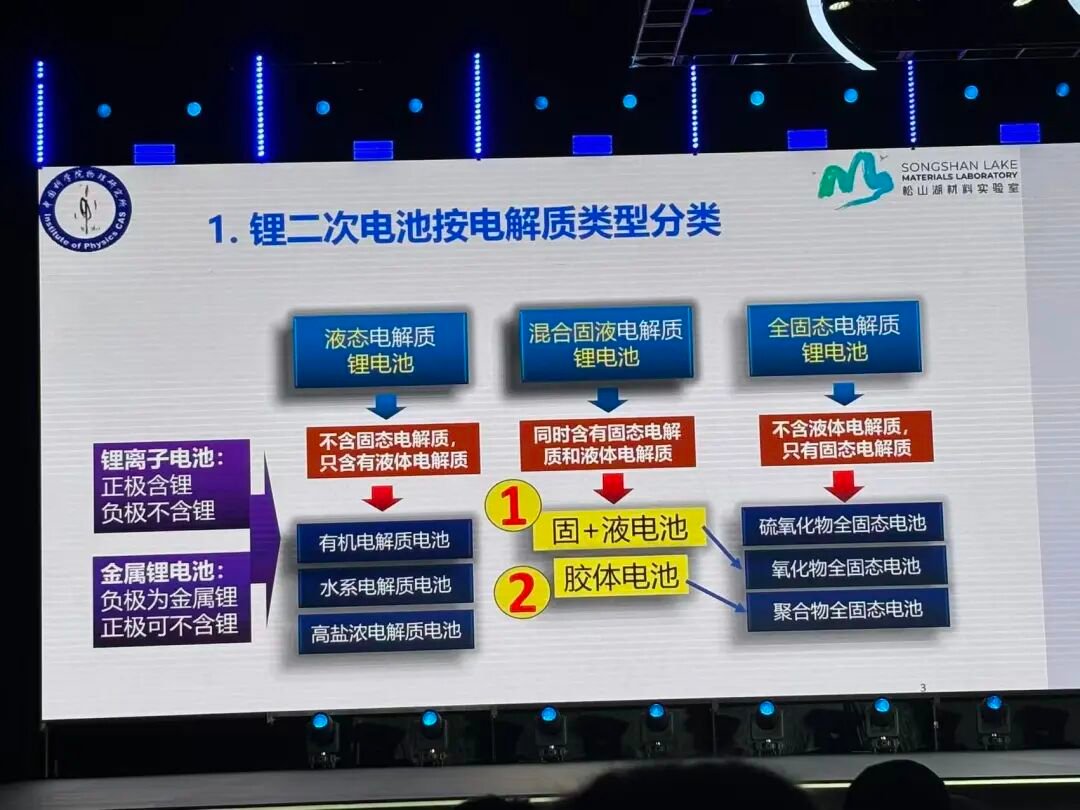
The new national standard, effective this July, splits batteries into three classes by electrolyte: liquid, semi-solid, and solid. Semi-solid is also called half-solid. Solid is full solid-state.
Huang’s case for the middle step is practical. Today’s liquid battery lines need almost no change to build semi-solid cells, with over 90 per cent compatibility. China’s lithium industry has already sunk more than 1 trillion yuan into fixed assets, so a disruptive swap would waste that base. Semi-solid also lifts energy density while cutting thermal-runaway risk.
The chemistry he describes is specific. On the cathode, replacing cobalt with nickel brings cost down while holding energy up, targeting cobalt under 1 per cent and nickel above 95 per cent. On the anode, pairing silicon-based and tin-based alloys lifts specific energy and speeds charging, because tin pushes ion movement more than 100 times faster.
His team spent eight years at its Songshan Lake lab turning this into a dense electrode: a cathode with only about 1 per cent cobalt and over 95 per cent nickel, built to take far higher pressure without cracking, reaching 220 mAh per gram at 1C with long life.
The roadmap is now clear. Semi-solid enters mass production in 2026. Full solid-state sees small-batch use around 2030. By 2035, some cars will be able to afford the next-generation solid cell. Until then, the pragmatic bet is the step in between.
Editor’s note: This is an adapted translation of the original Lei Feng Network report. It has been trimmed and restructured for readability for an international business audience. Source: Lei Feng Network.