Huawei’s Noah’s Ark Lab has published RoboHarness, a system built to solve a problem the robot field keeps hitting: it has plenty of capable models and almost no way to make them cooperate. RoboHarness wraps VLA, world-action, reinforcement-learning and task-and-motion-planning policies in a coding agent that decides which one should act.
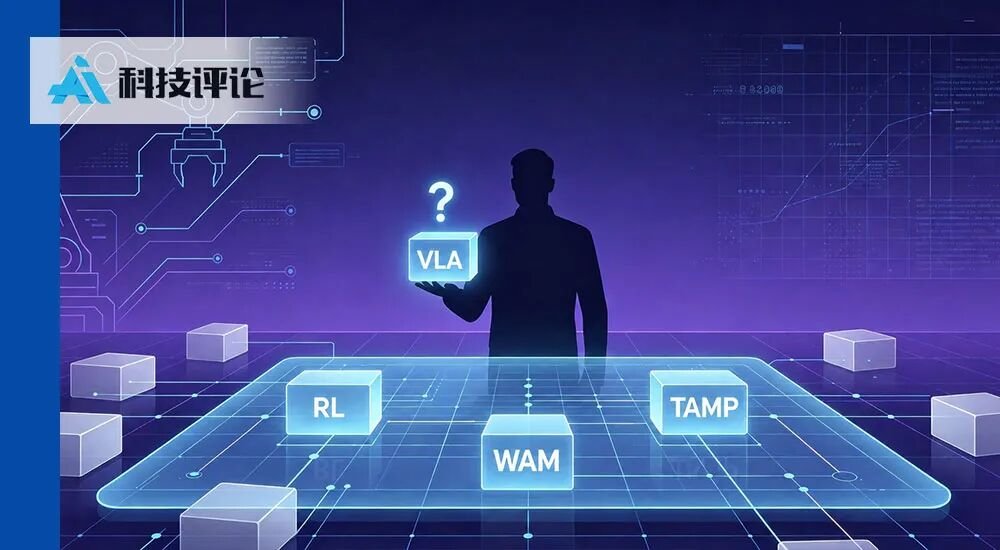
The design leaves every underlying policy untouched. Each keeps its own implementation, action space and training data; RoboHarness only adds a layer of organisation on top. That matters because the gap between models is the real wall. A VLA understands open language and generalises to new rooms but loses consistency on long tasks. A reinforcement-learning policy is stable inside its training distribution and brittle outside it. Task-and-motion planning reasons about geometry but stalls on vague goals. No single model spans all of them yet.
Three helper skills feed the dispatcher. Understanding skills turn raw input into hard numbers such as how similar the current scene is to each policy’s training distribution. Memory skills retrieve past executions and, through a module called Memory Bridge, fix the mismatch when one policy hands control to another. Evolution skills update each policy’s metadata from live feedback so the system learns from every run instead of starting cold.
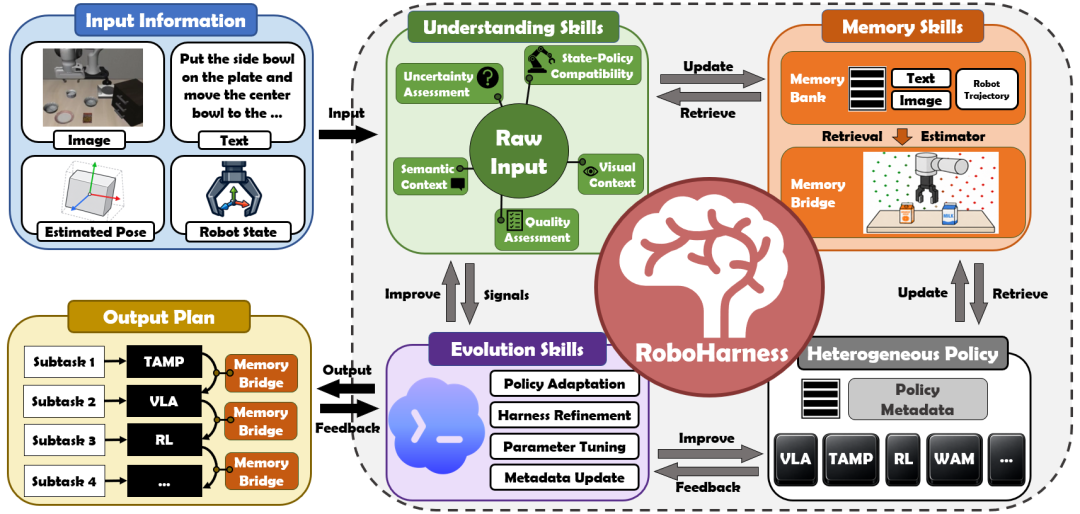
The handoff is the hardest part. Two policies trained apart live in different state distributions, so the spot where one stops can land outside what the next one can start from. Removing Memory Bridge in an ablation cut full-task success from 86.0 per cent to 60.4 per cent, even though task progress fell only modestly. Most failures happened at the final step, when an incompatible handoff broke an otherwise finished job.
Two lineages, one convergence
The authors sit in the North American and Canadian tradition of hierarchical architecture and symbolic planning, the counterweight to the West Coast scaling camp. This summer that split started to blur: Physical Intelligence pushed controllability and skill composition to the centre of its pi series, while Nvidia shipped more hierarchical robot-agent systems. Foundation-model scaling and agentic hierarchy are becoming complementary parts of the same machine.
RoboHarness has limits. It can only schedule policies that already exist, and Memory Bridge needs enough historical data to trust a newcomer early. But the deeper shift is in how the field competes, from hunting the strongest single model to organising the right capabilities. Heterogeneous orchestration and the unified model may be two ridges of the same climb, both pointing at a more general, more reliable robot.
More from the original report

Editor’s note: This is an adapted translation of the original Leiphone report. It has been trimmed and restructured for readability for an international business audience. The full original (in Chinese) is at https://www.leiphone.com/category/ai/vE6z6buPMecczPrc.html.