India’s artificial-intelligence ambition has run into an uncomfortable truth. Two years after Delhi launched its India AI Mission and hosted what it called the largest-ever AI impact summit, the country still has no frontier model of its own and little local AI infrastructure.
That leaves Indian firms dependent on American GPUs and, increasingly, on cheaper Chinese open-weight models. Two researchers at the Takshashila Institution, Pranay Kotasthane and Bharath Reddy, argued in the Hindustan Times on 22 July that leaning on both China and the US is the practical path to Indian technological sovereignty.
The Indian government is not standing still. The electronics ministry says it has backed 20 local foundation-model projects, approved 237 AI projects with subsidised compute, and cleared 12 semiconductor manufacturing projects with a committed 1.64 trillion rupees, about 116 billion yuan, in investment. The 2024 India AI Mission planned roughly 104 billion rupees over five years.
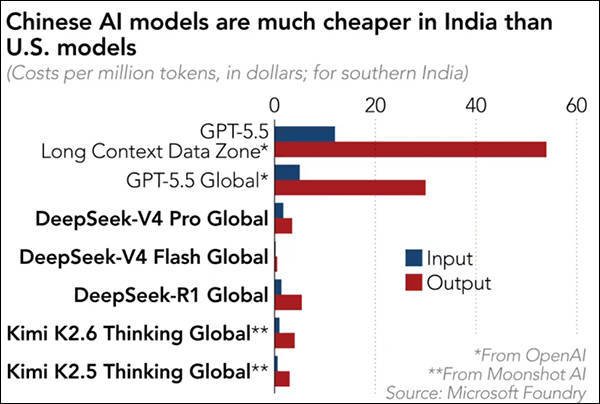
The pull toward Chinese models is price. Mirae Asset’s India chief told Nikkei Asia that since mid-2025, multiple Indian consumer-tech startups have adopted Chinese open-weight models, cutting costs by roughly tenfold. Fortune India reported Microsoft’s Foundry platform prices DeepSeek in India at 0.19 to 1.74 US dollars per million input tokens and 0.51 to 5.4 for output. Kimi runs up to 0.95 in and 4 out. OpenAI’s GPT-5.5 sits at 5 to 12 in and 30 to 54 out.
As one investor put it, American models are expensive and many basic tasks do not need them. It is like driving a sports car through a crowded city. Open-weight models let a firm download the parameters and run them on its own hardware, with no revocable API.
The sovereignty argument cuts deeper. If an Indian bank runs a Chinese open-weight model on Indian GPUs in an Indian data centre, the data never leaves the country and there is no company that can switch access off. A US proprietary model, by contrast, processes every query inside a firm under US jurisdiction, exposed to export controls and sanctions.
The researchers concede latent-agent and Trojan risks exist in any neural network, but note open weights are just static parameters with no back door. If China later restricts exports, already-released weights cannot be recalled, so the real task is building local inference capacity now.
That points to four moves: build multiple local inference providers rather than one national cloud, regulate at the deployment layer by watching data flow and who controls compute, act now because local compute takes months to stand up, and stay close to Washington through initiatives like Pax Silica because every GPU still comes from the US.
The conclusion is blunt. India’s sovereign AI is, for now, one more field where Delhi must balance between China and the US, and the road to real autonomy is long.
Editor’s note: This is a translated adaptation of a Chinese-language report from Sohu Tech (sohu.com). Figures, dates and direct quotations are reproduced as published.