Kepler has rebuilt its humanoid development around Nvidia’s physical AI stack, combining the chipmaker’s simulation, foundation model and world model tools with its own industrial hardware, plant data and embodied models.
The significance is less about a single vendor deal than about where the training loop now sits. Kepler is an industrial humanoid maker selling into factory work, and it has outsourced the layer that generates its training data.
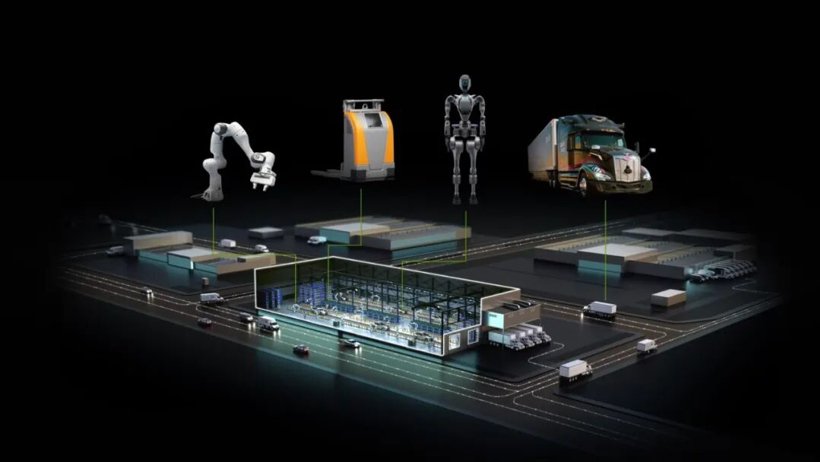
The stack, layer by layer
For simulation and model training, Kepler uses Isaac Lab to construct high-fidelity environments covering both the robot body and the industrial task, then runs reinforcement learning and sim-to-real transfer there. The point is to cut the cost of trial and error on real machines.
For manipulation, it trains embodied models with Isaac GR00T, aiming to move machines from motion capability towards task understanding and complex operation.
For data, it uses Cosmos to train world models on industrial scenes and to generate synthetic data, so that real and synthesised samples can be iterated together.
For deployment, Omniverse turns real factory floors into trainable digital spaces, Jetson Thor provides on-robot compute for perception, inference and control, and Nvidia GPU training infrastructure sits underneath as the shared base.
Why an industrial humanoid needs this
Chen Yutao, a senior embodied intelligence engineer at Kepler, said the company is combining its foundation model work with advantages in planetary roller screws, joint actuators, industrial humanoid bodies and real industrial scenarios.
The problem being solved is specific. A humanoid in a showroom only has to walk and gesture. A humanoid on a production line has to handle complex dynamics, contact-rich operation, process constraints, abnormal conditions and long-horizon task execution.
Each of those failure modes is expensive to discover on a live line. Simulation is how the industry is trying to pay for discovery somewhere other than the customer’s factory.
The part that stays unresolved
Sim-to-real gaps are the standing risk in this approach. Every vendor claims fidelity, and almost none publish the transfer rate from simulated manipulation to the same task at production cycle times.
Kepler’s bet is that the industrial scenario data it already holds is the scarce input, and that Nvidia’s tooling is the cheapest way to multiply it. Whether that produces a humanoid that holds a takt time on a real line is a question for the next twelve months, not for a press release.
Editor’s note: This is an adapted translation of the original Gasgoo report. It has been trimmed and restructured for readability for an international business audience. The full original (in Chinese) is at https://www.gasgoo.com/apps/e060bad9eca91db7f01403fc7120041f/robot/news/70476946-%E5%BC%80%E6%99%AE%E5%8B%92%E9%87%87%E7%94%A8nvidia%E7%89%A9%E7%90%86ai%E5%85%A8%E6%A0%88%E5%B9%B3%E5%8F%B0%E6%89%93%E9%80%9A%E4%BB%BF%E7%9C%9F%E5%88%B0/.