A US software company that has never shipped a robot took three months to build a working humanoid. It did not build it in California. It built it in Shanghai, with a partner that already knew how.
Meta worked with Fourier Intelligence, the Chinese robotics firm best known for rehabilitation exoskeletons and its GR series of humanoids, to produce a prototype internally called Max. The Information first reported the programme. A second generation, Max 2, went into development in September.
What the machine actually is
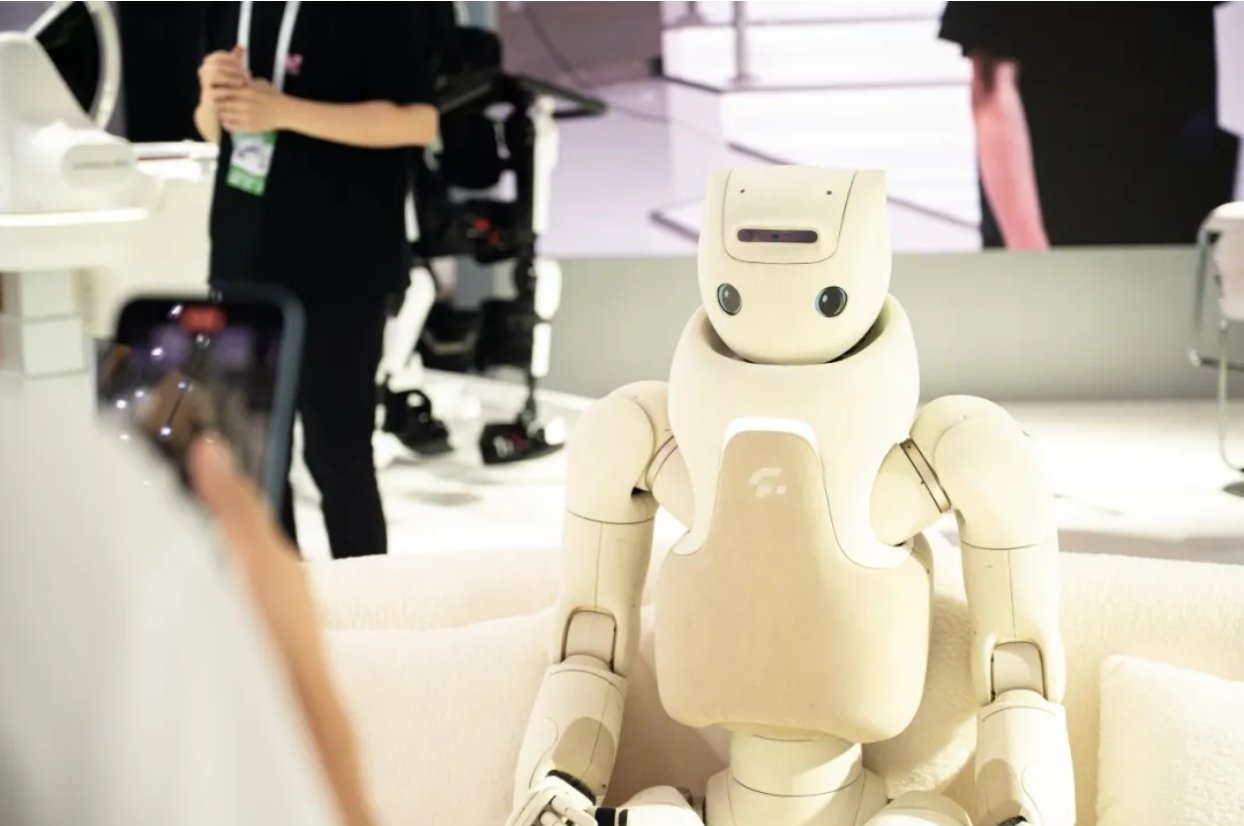
Max stands about 1.5 metres and weighs 48 kilograms. It runs on Nvidia’s Jetson Thor compute platform, carries a five-fingered dexterous hand, two speakers in the chest and a display in the head that can mimic facial expression. Meta’s design brief asks it to recognise a voice at five metres, a wave at three metres, and to hold eye contact while signalling through expression whether it is listening, thinking, speaking or uncertain.
Those are requirements, not verified results. But they describe a different machine from the factory arms that dominate deployment today. An industrial robot needs to finish a task. A household robot needs to be tolerable to live with.
Meta did not simply rebadge a GR-3. Its engineers reworked body proportions, head structure, display, cameras and hands, and added new components. Li-Chen Miller, Meta’s vice president of robotics product, spent close to two months inside Fourier’s Shanghai plant working alongside the Chinese engineering team. Max 2 is scheduled to get a redesigned torso and hands, a projector and sensors to help it manage stairs.
Muse needs somewhere to stand
Meta’s CTO Andrew Bosworth has described the humanoid internally as the physical embodiment of Muse, the personal agent Meta launched in September. Muse runs in a dedicated cloud virtual machine, drives a browser, calls software tools, holds memory of user preferences and keeps working on tasks after the app is closed.
The gap is obvious once you watch it work. Ask Muse to organise a dinner and it can plan a menu around a guest’s diet, order ingredients and book a service. On the day, somebody still has to unpack the shopping, lay the table and clear it afterwards. Browsers do not have hands.
The strategic logic follows. If the agent becomes the brain and the robot becomes the body, Meta does not need to win the hardware market. It needs its agent to be the thing other people’s hardware runs on.
The Android argument, again
Meta set up Meta Robotics Studio inside Reality Labs in February 2025 with exactly that framing. Bosworth’s stated ambition was to become the Android of robotics, licensing AI, sensors and software to other manufacturers while Llama and Muse supply the intelligence layer. In May this year Meta acquired Assured Robot Intelligence, a startup working on foundation models that predict and adapt to human behaviour.
The hardware, though, is not a licensing business yet. It is a manufacturing problem, and manufacturing competence for humanoids currently sits in one country.
Why the body came from China
Omdia put 2025 global humanoid shipments at roughly 13,300 units. The top six vendors by volume were all Chinese: AgiBot, Unitree, UBTech, Leju, EngineAI and Fourier. Definitions differ between research houses and the absolute numbers are soft, but the direction is not contested. China builds and delivers humanoids at volumes nobody else approaches.
The deeper advantage is the supplier base. Joint actuators, reducers, dexterous hands, structural parts, assembly and tuning all sit within a few hours’ drive of each other, which lets a team iterate a prototype in weeks rather than quarters. Meta’s three-month schedule is a demonstration of that density as much as of Meta’s own engineering.
Meta is now hiring robotics product design and supplier development staff in both Shanghai and Shenzhen, with some roles covering the path from prototype to volume production. That is not the hiring pattern of a company planning to keep this in a lab.
A Meta spokesperson says the partnership is focused on internal research and there are no plans to sell the prototypes. Read that carefully. Every platform play starts as an internal experiment, and the company that wrote it has also said, on the record, that it wants to be the Android of this industry. Building the reference hardware in Shanghai while hiring a supply chain team in Shenzhen is how you learn what an Android would have to run on.
Editor’s note: This is an adapted translation of the original OFweek report. It has been trimmed and restructured for readability for an international business audience. The full original (in Chinese) is at https://robot.ofweek.com/2026-11/ART-8321203-8110-30709964.html.