Momenta listed on the Hong Kong Stock Exchange on 8 July 2026, raising HK$5.89 billion in its initial public offering. Fourteen cornerstone investors, including Singapore’s GIC, Fidelity, Mercedes-Benz and BYD, took up nearly half the shares on offer, an unusual line-up that put a German luxury brand, a Chinese EV leader and a sovereign fund on the same subscription list.

The offering priced 19.938 million shares at HK$295.6 each, with cornerstone investors taking 9.96 million shares, or 4.23 per cent of total equity. That valued Momenta at roughly HK$69.6 billion (RMB 60.2 billion, US$8.87 billion). The label attached to the deal was “first physical-AI stock”.
Why physical AI is different from digital AI
Digital AI is built on compute and corpus: the internet accumulated vast text, and with enough hardware any competent team can train a chatty model. Physical AI is built on the physical world. The internet never logged real braking distances, road friction or a human driver’s emergency reflexes. That data only comes from production cars driving kilometre after kilometre.
Momenta’s destination, in its own telling, is the “Qinghai-Tibet plateau” of physical AI, a decade-long climb. The thesis: if it can prove physical AI is not just a rebrand of driver assistance but a base capability that generalises to robotaxis, robovans and embodied intelligence, then today’s price is only a starting point.
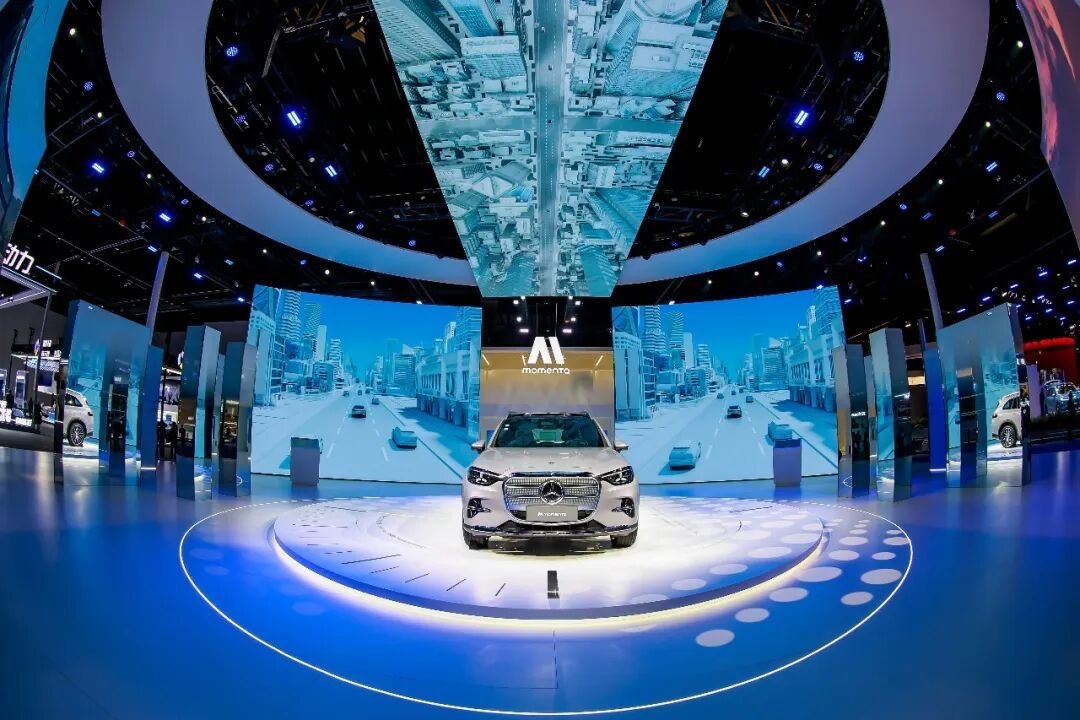
Three moves that built the moat
First, a shift from selling engineering hours to selling software. Licence revenue, charged per vehicle after a model enters production, rose from RMB 23 million in 2023 to RMB 968 million in 2025, a 42-fold increase, and now makes up 40.1 per cent of revenue. Gross margin climbed from 17.5 per cent to 49.0 per cent to 71.6 per cent across 2023 to 2025.
Second, moving from algorithm supplier to integrated hardware and software. Momenta co-developed a custom system-on-chip, the X7, with Xinchip, now fitted to SAIC Volkswagen’s ID.ERA 9X, with plans to reach SAIC’s IM, SAIC passenger cars, SAIC-GM, Mercedes-Benz and Chery.
Third, the R7 world model released in April 2026. Its “all-in-one platform” logic aims to cover passenger cars, robotaxis, robovans, robotrucks and future embodied agents with one underlying architecture, lowering the marginal cost of entering each new scenario.
The data flywheel
Momenta’s data barrier rests on 12 billion kilometres of real vehicle mileage and over 100 million curated data segments, drawn from 24 carmakers and more than 100 production models. That diversity, the company argues, is itself a moat in a field where data quality decides outcomes.
Momenta has delivered more than 100 models, passed 1 million assisted-driving installations, holds over 210 nominated models, and claims 65 per cent of the city-NOA market among independent third-party suppliers. Nine of the world’s top ten carmakers now work with it.
The open questions
At a price-to-sales multiple near 25x, the valuation prices in scarcity. Analysts note that if 2026 to 2027 revenue growth cannot hold at 50 to 70 per cent, the premium looks fragile. Momenta still runs a net loss even as licence revenue compounds, and the undertow of in-house development by its own customers has not disappeared. The plateau is climbed, but standing on it is a different test.
Editor’s note: This is an adapted translation of the original LeiFeng Network report. It has been trimmed and restructured for readability for an international business audience.