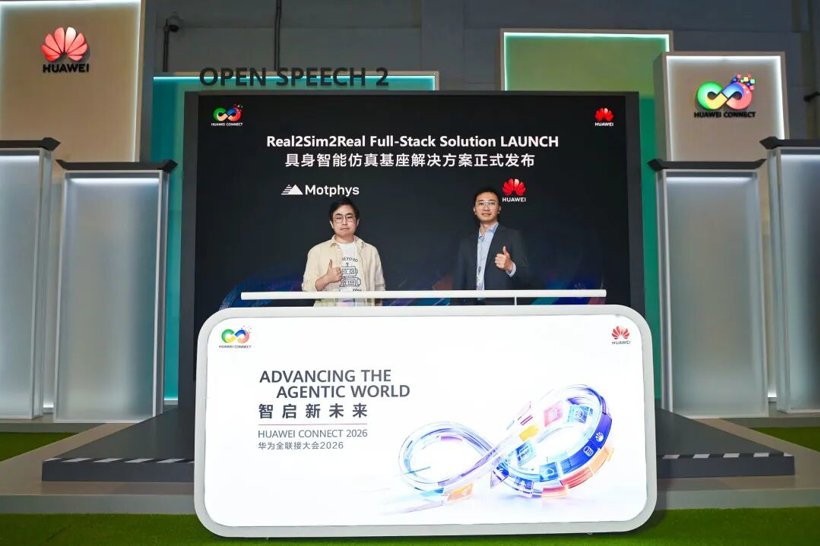
At the 11th Huawei Connect, Beijing Mouxianfei Technology and Huawei jointly released an embodied-intelligence simulation-foundation solution built on Mouxianfei’s MotrixSim physics engine and MotrixLab training platform, covering the full path from simulation and reinforcement-learning training to real-machine deployment.
The partnership runs on Huawei’s Kunpeng and Ascend compute ecosystem. Mouxianfei took its MotrixSim engine v0.6.0 through joint validation with Kunpeng spanning code building, pipeline integration, performance tuning and commercial release, and on 3 April earned both the Kunpeng COMPATIBLE mark and the Kunpeng NATIVE same-track development certification.
Under the hood, MotrixSim does not lean on external physics libraries, and its Rust compiler back end gives native support to the AArch64 instruction set. On Kunpeng, tuned to the same configuration, throughput rose 103.3 per cent over the original baseline, reaching 362,202 steps per second at best instantaneous setting and holding 345,335 steps per second in steady long-run configuration.
Chief architect Sun Jiaqi argued that the real bottleneck in scaling embodied intelligence is training infrastructure. The solution follows a Real2Sim2Real path, closing the loop from physics engine and training framework to data engine so that robots can train inside a virtual world and then transfer the policy to a real machine with zero-shot validation.
The approach has already been validated across arm grasping, dexterous-hand manipulation and robot-dog walking, all trained with zero real-machine data. The basic walking policy for the robot dog was trained on a laptop in just 12 seconds.
The solution is now part of Huawei’s ecosystem-partner programme. Mouxianfei has built a virtual-real integrated embodied-intelligence training base in Wuhan, and its physics-simulation research was published at the RSS 2026 conference.
For European industrial-digitalisation programmes, attention should turn to the cost curve. A simulation base that trains policies with no real-machine data, on a sovereign stack, is the infrastructure European factories need to de-risk automation, and Huawei is packaging it as a turnkey, exportable platform rather than a loose collection of tools.
Editor’s note: This is an adapted translation of the original Gasgoo report. It has been trimmed and restructured for readability for an international business audience. The full original (in Chinese) is at https://www.gasgoo.com/apps/50640d4b55d5cba175fb84f15d679f19/robot/news/70472962-%E8%B0%8B%E5%85%88%E9%A3%9E%E8%81%94%E5%90%88%E5%8D%8E%E4%B8%BA%E5%8F%91%E5%B8%83%E5%85%B7%E8%BA%AB%E6%99%BA%E8%83%BD%E4%BB%BF%E7%9C%9F%E5%9F%BA%E5%BA%A7%E8%A7%A3%E5%86%B3%E6%96%B9%E6%A1%88/.