At the Baron Investment Conference on 6 November, someone asked Elon Musk whether Optimus would be rented or sold. His answer ran to four words. He thinks Tesla will probably rent them.
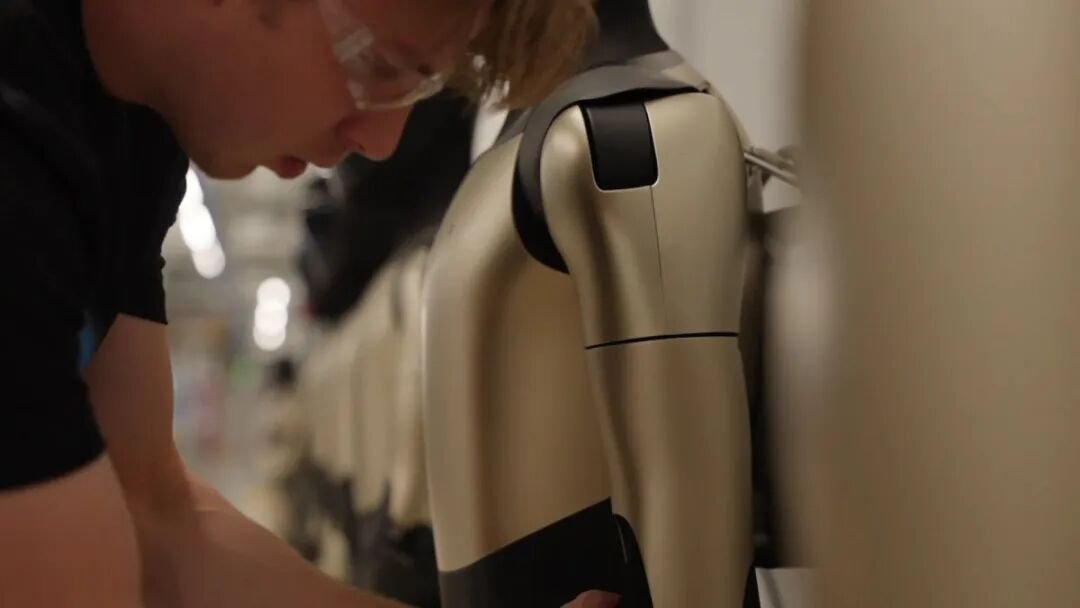
Unit manufacturing cost sits around USD 30,000 now and is expected to fall toward USD 20,000. External delivery is not expected before the end of 2027, and the likely structure is a lease rather than an outright sale.
The market read that as Tesla adopting robotics-as-a-service and another layer of recurring revenue. Those readings are not wrong, but they restate the financial language rather than explain it. The more useful reading, after the September reporting on the programme, is about where the risk is stored.
Editor’s note: This is an adapted translation of the original OFweek report. It has been trimmed and restructured for readability for an international business audience. The full original (in Chinese) is at https://robot.ofweek.com/2026-11/ART-8321206-8420-30711094.html.
The line, the volumes and the version problem
The Optimus line in Fremont occupies the space that built the Model S and Model X. Planned capacity is one million units a year, but reaching full rate will take at least a year. Weekly output climbed from dozens in the second quarter to several hundred in September, with a year-end target above 1,000 and a long-run ambition of 20,000 a week. The V3 units coming off the line now are explicitly not the commercial version, and most stay inside Tesla’s own facilities for training and data collection.
The reported plan is for initial external deployments to commercial customers on lease, with units recalled, upgraded or refurbished at expiry, and data from customer factories and warehouses feeding the training loop. The shortlist is specific rather than opportunistic: factories and warehouses whose layouts resemble Tesla’s own.
The hand is the binding constraint. A single hand costs more than USD 6,000, its service life in parcel sorting runs about six weeks, and annual maintenance approaches USD 100,000 per unit. Some tactile sensors are not reliable enough, and the fix is a replaceable sensor glove planned for next year’s model.
Selling transfers the risk. Renting keeps it.
Sell a robot and the risk transfers at the factory gate. Later failures belong to the buyer, and mass failures become a recall and a news cycle. Under a lease, the unfinished state of the product becomes institutional. Tesla keeps the right to disassemble, upgrade and take the unit back, and a hardware defect stops being an incident and becomes a routine step in a process.
The logic is that the robot leased today and the robot leased in a year may not be the same species. The hand gets a sensor glove, V3 is not the commercial version, the AI5 chip variant lands around April 2027. A sale freezes the buyer into one hardware state. A lease keeps Tesla’s authority over what that state is.
Risk does not vanish. Depreciation, maintenance, residual value and utilisation all move from the customer’s books to Tesla’s. A hand replaced every six weeks at nearly USD 100,000 a year in upkeep is the customer’s operating cost under a sale and Tesla’s cost of goods under a lease. Early failure rates and real utilisation have not been published, which means the unit economics are a set of numbers only Tesla can currently complete.
There is a second ledger. Without secondary trading there is no residual value data, and without residual data the financial instruments that depend on it, from lease pricing to insurance to asset securitisation, cannot price the asset. Tesla is carrying residual risk first in order to build the curve later.
Not the same as the software subscription
FSD supervised subscriptions hit a record in the third quarter, 75 per cent of new North American orders included it, and annualised recurring revenue is approaching USD 1 billion. That is software, where marginal cost approaches zero and scale improves margin.
Optimus leasing is a heavy asset business. Every unit leased adds depreciation, maintenance and residual uncertainty to Tesla’s balance sheet. Recurring revenue is the outcome, not the motive. The motive is that the hardware is not finished enough to sell and the customer data is too valuable to forgo, and a lease is the only structure that solves both at once.
Agility Robotics told a cleaner version of the RaaS story when it listed, pricing rates against labour cost so the customer sees day-one return. Agility’s own disclosure also says humanoids are unproven at scale. Tesla is not leasing because it believes more firmly in RaaS margins. It is leasing because it needs to settle what the machine should be before anyone signs for one.