Ant Group’s embodied AI unit Lingbo has open-sourced LingBot-Touch, a tactile pretraining foundation model for dexterous manipulation that treats pressure-resistive, optical and magnetic sensors as one input space.
The problem it addresses is mundane and severe. Every dexterous hand on the market carries a different tactile sensor, records contact differently, and produces data that no other hand can use. The result is that tactile data stays trapped inside the hardware that collected it.
Editor’s note: This is an adapted translation of the original Zhidx report. It has been trimmed and restructured for readability for an international business audience. The full original (in Chinese) is at https://www.zhidx.com/p/608827.html.
One representation across three sensor families
LingBot-Touch processes the raw signal from each sensor class separately, learns the shared contact features through a common model, and encodes them as unified tactile tokens that any dexterous hand and any policy can consume. Where the finger touched, how the force changed, whether the object slipped: those are physical facts that survive a change of sensor, even when the numbers do not.
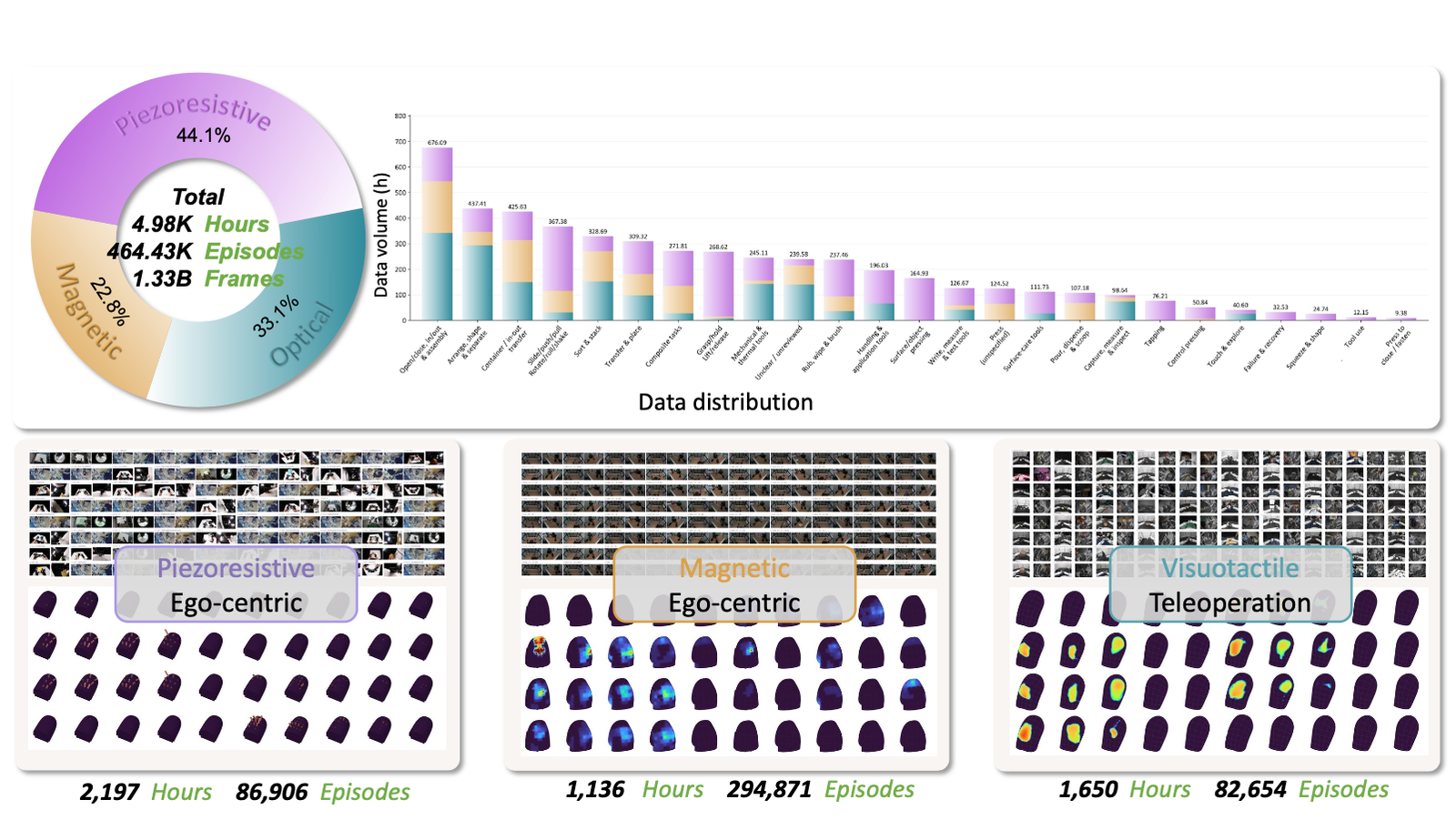
The pretraining set is 4,983 hours of real tactile data, roughly 464,000 interaction episodes and 1.33 billion frames, covering grasping, rotation and assembly. Of the total, 44.1 per cent is pressure-resistive, 33.1 per cent optical and 22.8 per cent magnetic, gathered from humans wearing tactile gloves and from teleoperated optical sensing. Training is self-supervised: sections of tactile input are masked and the model predicts the missing features from surrounding contacts, which removes the labelling burden entirely.
The numbers from 26 real tasks
Testing ran 26 tasks on two hands, Sharpa Wave and XHand1, with four policies: Diffusion Policy, pi-0.5, LingBot-VLA and T-Rex. Three conditions were compared, with no tactile input, with raw tactile input, and with LingBot-Touch features.
On Sharpa Wave, LingBot-VLA moved from 45.60 to 72.51 per cent average success, a gain of 26.91 percentage points, and pi-0.5 from 47.56 to 68.58 per cent. On XHand1, pi-0.5 went from 49.71 to 74.17 per cent across six tasks.
The task-level detail is where the argument lands. In bottle-cap twisting with T-Rex, no tactile input gave 56.25 per cent, raw tactile data gave 62.50 per cent, and LingBot-Touch gave 90 per cent. In zipper pulling with pi-0.5, no tactile input managed 39 per cent, raw tactile data dropped it to 15 per cent, and LingBot-Touch reached 59 per cent. Raw sensor streams do not merely underperform. They can make a policy worse. What helps is contact information the policy can actually use.
Transfer without retraining
XHand1 uses magnetic sensors whose model and contact layout were absent from the pretraining data. Lingbo did not retrain LingBot-Touch for it. The encoder was frozen and only the downstream policy was trained per task, and average success still improved.
That is the commercial claim. If tactile capability transfers across hands, companies stop paying three times for the same physical knowledge, once to collect data, once to train a model and once to adapt it to new hardware.
The competitive context is not empty. Genesis AI shipped GENE-26.5 in May with a tactile glove and hand of its own, and Generalist AI disclosed cross-embodiment work on GEN-1 in July. Both are building toward shared physical understanding. Lingbo’s contribution is to attack the sensor-format wall directly and then publish the weights.
Open-sourcing a pretrained tactile encoder does two things at once. It makes every hand builder a potential consumer of Ant’s representation, and it turns the industry’s fragmented tactile data into something closer to a commons that Ant sits at the centre of.