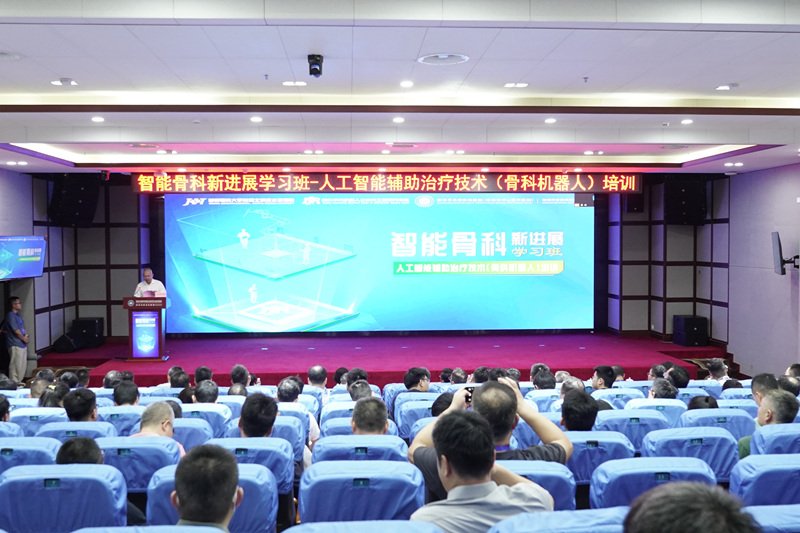
For the first time, Beijing Jishuitan Hospital’s orthopaedic robot surgery training programme has been brought to a district hospital, as a national AI-assisted treatment training course was held in Shenzhen’s Pingshan district on 1 and 2 August.
The course, organised by the National Orthopaedic Medicine Centre and Beijing Jishuitan Hospital, and hosted by Shenzhen Pingle Orthopaedic Hospital, trained 74 orthopaedic surgeons and technical staff from across China in robot-assisted surgical techniques.
Bridging tiers
Beijing Jishuitan Hospital, as the National Orthopaedic Medicine Centre, has been building robot surgery training bases since 2017. It was approved as Beijing’s first AI-assisted treatment training base for orthopaedics in 2025. The Beijing Development and Reform Commission established the Orthopaedic Robot Engineering Research Centre in 2021, led by Jishuitan.
The Shenzhen training marks the first time this national resource has reached a district institution. Shenzhen Pingle Orthopaedic Hospital will integrate deeper into the national centre’s regional collaboration strategy, bringing standardised smart orthopaedic diagnostics to the Greater Bay Area.
Hands-on training
Experts from Beijing Jishuitan, Qingdao University Hospital and Shenzhen Pingle conducted guided robot-assisted total knee replacement surgery. Lectures covered making robot surgery a routine treatment, individualised surgical targets, spinal surgery applications, paediatric orthopaedics, and pelvic fracture minimally invasive treatment.
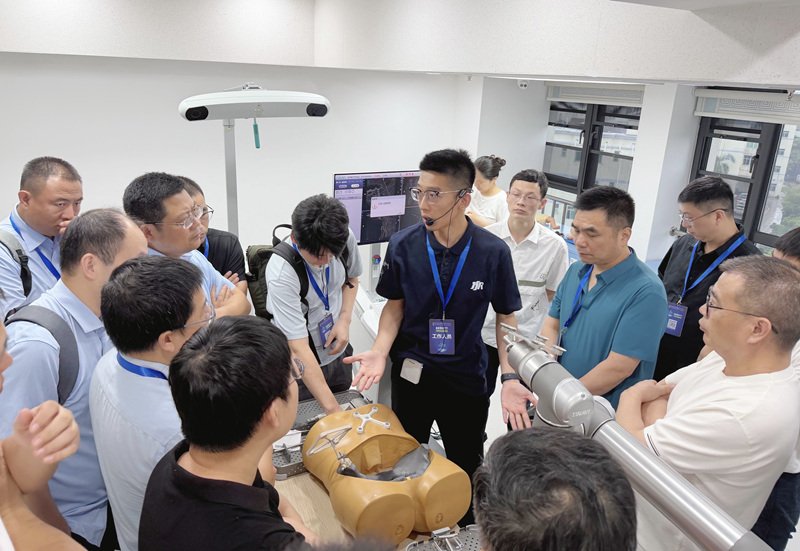
The 74 participants practised in groups: robot-assisted spinal surgery, trauma surgery, joint replacement, and simulation planning. Each completed the programme with a certificate.
Why it matters
Orthopaedic robot surgery has been concentrated in top-tier urban hospitals. Extending training to district institutions in Shenzhen signals a push to standardise and democratise the technology. As the Greater Bay Area’s medical infrastructure integrates, robot-assisted surgery becomes a routine tool, not a flagship novelty.
Editor’s note: This is an adapted translation of the original Shenzhen News report. It has been trimmed and restructured for readability for an international business audience.