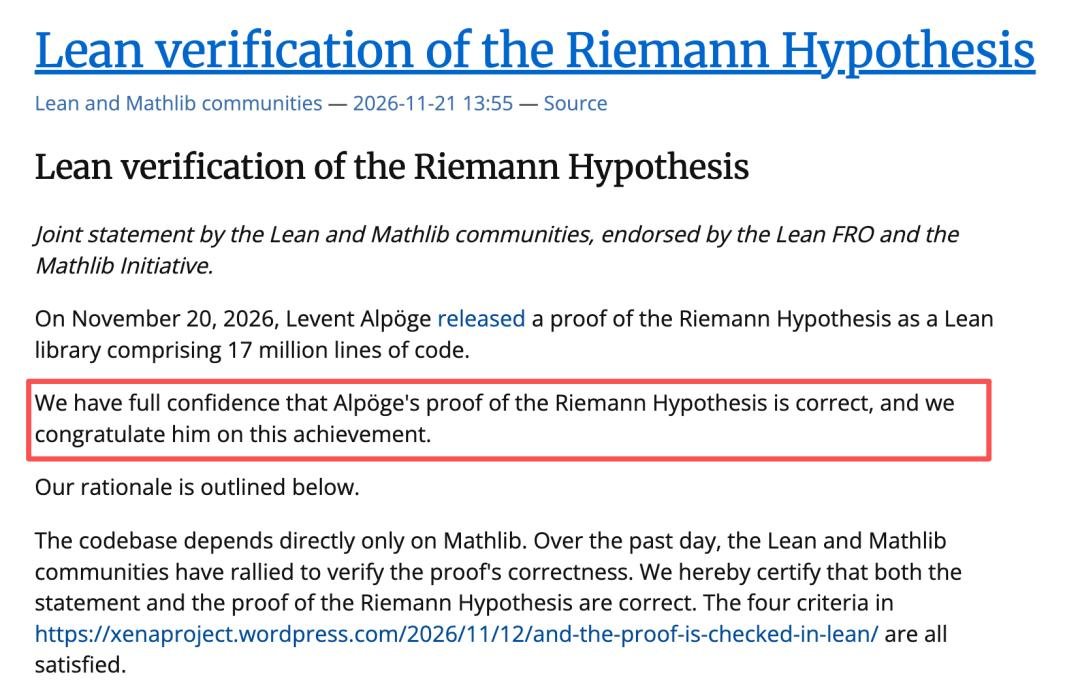
Lean FRO, the organisation that maintains the Lean proof assistant, and the Mathlib Initiative, which coordinates the core mathematical library, have issued a joint statement confirming that Levent Alpoge’s formalised proof of the Riemann hypothesis is correct. The two bodies congratulated him on the result. The announcement came after Alpoge, a mathematician at Anthropic, said on 20 November that he had found a proof of both the Riemann hypothesis and its stronger generalised form with help from Claude.
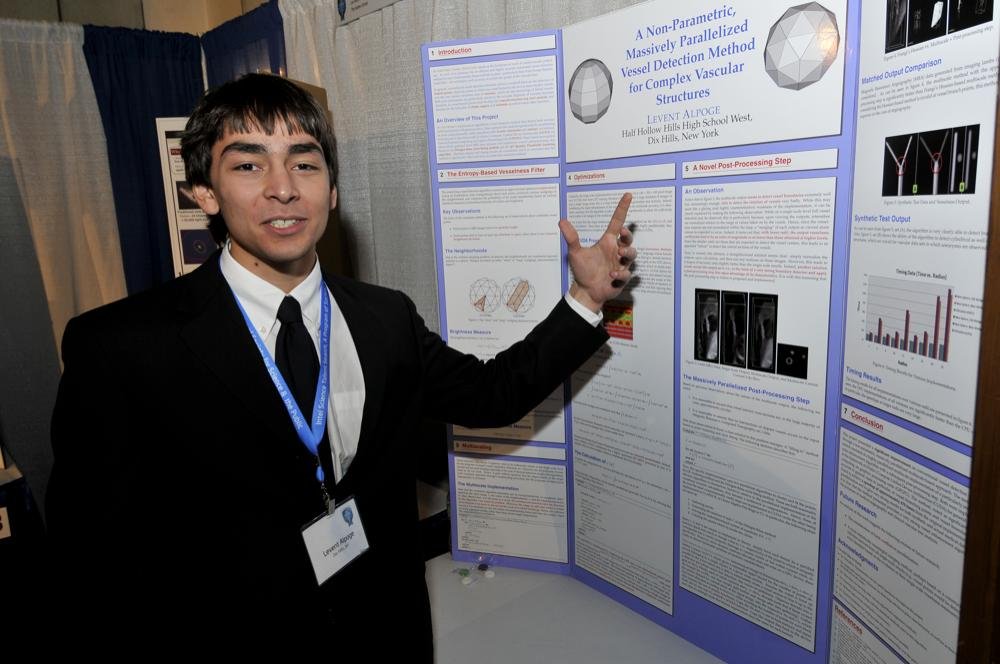
The text proof generated with Claude ran beyond 250,000 pages. Because that was too long to publish or read, Alpoge released a four-page note and the formal Lean code split across 14 compressed files, about 17 million lines in total.
What the verification actually established
The joint statement set out four checks. First, the proposition uses definitions already present in Mathlib and reviewed by Lean and number-theory experts. Second, dozens of people compiled the code independently with no errors or build failures and reproduced the same raw proof export. Third, the community extracted a Riemann hypothesis proposition depending only on Mathlib and used two separate tools to confirm that the theorem proved was identical, not a weaker namesake. Fourth, the exported proof passed several checkers, including the official Lean kernel, con-leche, con-ron and independently written implementations in other languages.
The two organisations also noted that con-leche and con-ron carry a formal proof relative to set theory, so they cannot admit a false proof, and that verification ran on a non-interactive export, protected from any malicious code in the source.
A live verification page showed that Alpoge’s Lean source compiled without error and that five main theorems relied on only three standard axioms. All modules were replayed through the Lean kernel. Two independently written kernels, nanoda and con-leche, accepted the full export, and lean4lean accepted every compiled module. Some checks, including the full lake comparator run, were still in progress at the time of writing.
Mixed reactions from the mathematics community
Ngô Bảo Châu, winner of the 2010 Fields medal and the Clay research award, said it was too early to declare the end of mathematical research. He argued that artificial intelligence would instead democratise the field. Future competitiveness, he said, would depend less on building long proof chains and more on asking good questions, observing and exploring. Machines might already be better at proving hard theorems, but mathematicians should treat them as tools and sources rather than rivals.
Terence Tao, a 2006 Fields medallist, wrote that the proof appeared to combine modern results from the Langlands programme and arithmetic geometry, and that the community would need time to verify it and map its central ideas. Ravi Vakil, president of the American Mathematical Society, published a 940-page candidate proof of the generalised Riemann hypothesis written entirely by a human, stressing that no AI was involved. About eight hours later he updated the post to say that several people using different AI models had found problems in the manuscript.
Musk called the result another astonishing achievement of superintelligence. Rutgers professor Alex Kontorovich joked that without Lean and Mathlib the community might have received a credible-looking 250,000-page natural-language paper, and asked what a disaster that would have been.
Not yet a formal conquest
Joint endorsement means the proof has been machine-checked inside Lean. It is not equivalent to classical peer review. A proof is normally published, left for at least two years, and accepted broadly before the Clay Mathematics Institute’s scientific advisory board begins substantive review. Alpoge’s Lean code covers the generalised Riemann hypothesis for all Dirichlet L-functions, but other forms of the generalised hypothesis fall outside this verification.
Alpoge and New York University professor Tristan Buckmaster have also turned to the Navier-Stokes equations, releasing a 79-page AI-assisted paper with Lean code while the verification certificates are still pending. The sequence marks a shift in how mathematics gets done. Proofs increasingly arrive from models first and are believed by people later.
Editor’s note: This is an adapted translation of the original 36Kr report. It has been trimmed and restructured for readability for an international business audience. The full original (in Chinese) is at https://36kr.com/p/4080372197282948.