Wherever the money is, the platforms arrive. For China’s robotics startups, they have arrived.
OpenAI has been posting robotics roles at a steady clip. As of 23 October the company listed 15 positions, running from robot software and control systems through motors, actuators, PCBs, test equipment and field engineers. The salary ceiling for the robotics electrical engineer role is $423,000. A full-stack hardware and software robotics team is being assembled.
OpenAI shut down its earlier robotics effort when training data proved insufficient. This time it is rebuilding the model, the hardware and the deployment layer together.
ByteDance is laying out the same hand
In June, ByteDance placed Seed Robotics under Zhou Chang, who oversees multimodal and world models, and began recruiting an L8-level embodied AI technical lead, targeting the number one technical role at leading robotics startups.
The company has assets to point at. Seed’s own site lists GR-3 and GR-RL in its robotics product line, and its careers page carries roles for robot simulation, embodied data development and body structure. Zhang Yiming is personally overseeing real-time spatial video and world models. Video generation, spatial understanding and robotics, previously separate lines, are being pulled together.
The competitive threat is not another startup. It is the leading model companies arriving with compute, models, talent and capital, pushing from software into the physical world.
What GPT-6 already does
A September RoboDojo test covering 42 tasks and 2,100 trials measured GPT-6 Astra at an average 22.48 per cent success rate with no task-specific fine-tuning, ahead of all 40 robot control models in the comparison.
On tasks with clear semantics and modest precision demands, it improves quickly. On high-precision work, dynamic control and dual-arm coordination, performance drops sharply. In a tower-building task the arm reached for the next block and knocked over the structure it had already assembled. It knew the next step and could not protect the result of the previous one.
Xu Huazhe, founder of Poke Robotics, is direct about the boundary: GPT-6 has strong semantic and spatial generalisation and weak physical generalisation. It can recognise chopsticks and pick them up. Using them for complex contact-rich manipulation remains out of reach.
That is already enough to change the division of labour. Startups used to own task understanding, step decomposition and motion planning as their moat. The upper half of that stack is being flattened by general models, and the stronger the models get, the less a pitch deck of general intelligence is worth.
OpenAI hiring for motors, actuators and test infrastructure shows it is not chasing model licensing fees. A robot feeds real-world actions, failures and corrections back into the model. Whoever controls the model, the hardware, the deployment and the data return path compounds.
The middle layer is where the damage lands
The window has not closed. Wang Qian, founder of Zibianliang Robotics, makes the practical argument: OpenAI and Anthropic still have to build data collection, simulation and validation infrastructure, run evaluations in real environments and solve hardware problems. At that point they face the same difficulties as everyone else.
The difference is that platform companies can afford more expensive mistakes. A startup cannot walk the same path twice.
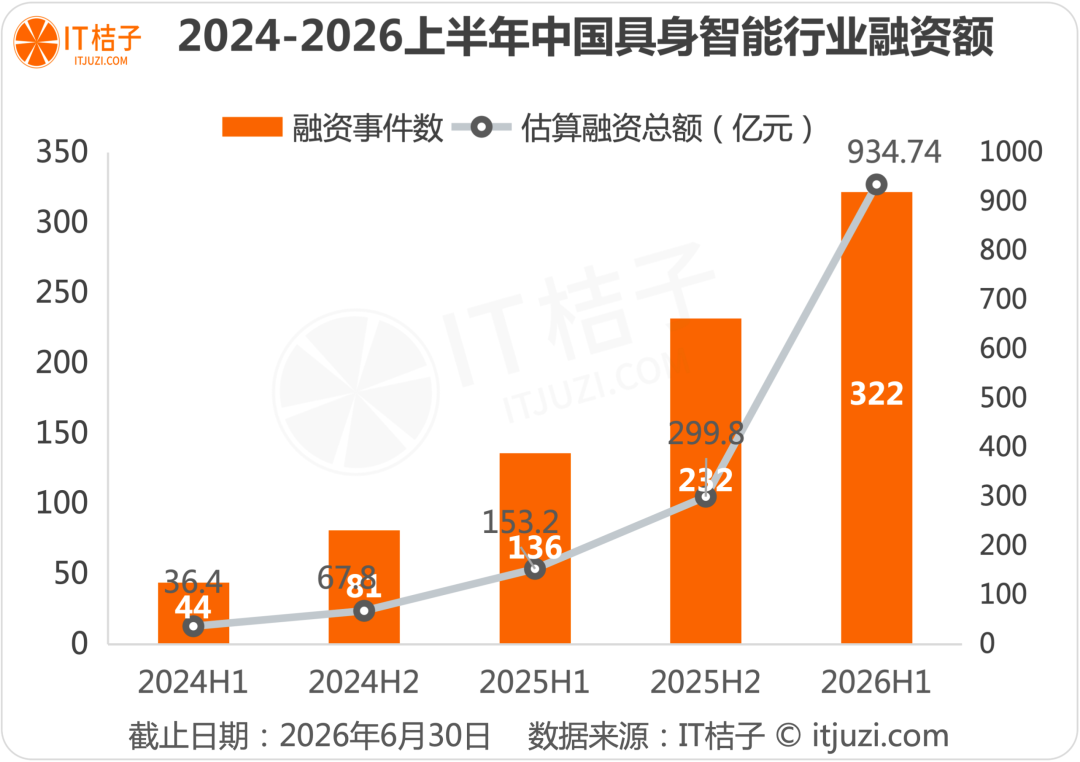
Capital is already pricing the stratification. IT Juzi counted 322 embodied AI financing deals in China in the first half of 2026 worth RMB 93.5 billion, up 137 per cent in count and about five-fold in value. There is more money than last year and a tighter exit.
Reuters reported in September that some humanoid IPO processes had slowed, with regulators asking how high valuations relate to government project revenue and genuine commercial demand. Private markets are still buying imagination. Public markets have started asking for answers.
The most exposed companies are the ones that look complete. They have a robot body and a model story, a data collection site and a few factory contracts. On a product slide, joints, dexterous hands, VLA and world models are all covered. Taken apart, the joints come from a supplier, the model sits on an open architecture, the data is handed to the customer with the project, and every new site needs re-tuning.
A little of everything, not enough of anything. The company presents as full stack and operates as a general contractor.
There is a cheap diagnostic. Do not count the layers on the slide. Look at the second project. Was deployment faster? Were fewer engineers on site? Could the last customer’s data and programmes be reused? If all three answers are no, the integrated stack simply means more delivery work stayed in-house.
Three positions that hold
Companies that control a layer look different.
A model company can skip building robots, provided the model works across bodies and it owns the data, evaluation and training loop. Skild AI disclosed in September that ten months after its first commercial deployment it had passed $100 million in annualised recurring revenue with more than 60 paying customers, covering handling, delivery, inspection, security, food service, warehousing, factories and data centres. The same Skild Brain is installed on dual-arm robots assembling NVIDIA Blackwell systems.
The test for a model company is unglamorous. Change the body, change the site, and see whether revenue still grows. A model that only works in its own demo is a feature. Cross-body revenue from external customers is a platform.
A body company has to convert shipments into effective installed base. Unitree sold 5,215 humanoids in 2025 for RMB 868 million of revenue, turning manufacturing capability into real income. The same listing document shows that 73.6 per cent of humanoid revenue in the first three quarters of 2025 came from research and education, with industry applications at 9.01 per cent. Shipping answers whether you can build and sell. It does not answer what the machine does all day after that.
Xu Huazhe proposes a harsher metric: daily active robots. Of 5,000 units sold, how many are still working every day? Machines that keep running return failure, motion and task data, and that data is what makes hardware iteration, service networks and brand reinforce each other.
A site company owns the operating data and the renewal. Agility Robotics has accumulated more than 65,000 hours of real Digit operation and moved over 100,000 totes at GXO at roughly 98 per cent task accuracy. At the Digit 5 launch in September the company said it held more than $300 million in multi-year orders. More important, the payload, battery, safety system and end effector on the new model all came from three years of customer-site feedback.
Counting factories visited or framework agreements signed means nothing. A robot that has done the work makes the next one deploy faster and err less. Orders, data and product roll inside one loop.
Three questions worth asking
Data is not a fourth path. It becomes an asset only inside a model, body or site loop. Data sold once, with no downstream feedback, will not carry a company.
So the questions are simple. If the foundation model is opened up tomorrow, what do you still have? With each additional robot delivered, can the next one be cheaper and faster to install? And who ends up holding the data, the customer relationship and the right to improve?
At least one of the three has to be yours. OpenAI and ByteDance will not eliminate robotics startups. They will screen out the ones without control, then make foundation models cheaper and let scale pull hardware costs down, widening the market for everyone still standing.
Editor’s note: This is an adapted translation of the original OFweek report. It has been trimmed and restructured for readability for an international business audience. The full original (in Chinese) is at https://robot.ofweek.com/2026-10/ART-8321206-8420-30708497.html.