Sales, brand and channel rankings in pool robots are settling fast, but the real technical watershed has barely arrived. Wireless models lowered the barrier to entry and unlocked Amazon, big-box and specialist channels. Early movers built shelf and brand advantages. Latecomers now face not just a product gap but a long channel-validation cycle.

Yet once freed from the cable, many pool robots still clean by repeated random passes. Facing irregular bottoms, steps, shallow shelves and waterlines, they struggle to know where they are or what they have covered. Leaks, repeats and manual intervention remain common.
The hard problem underwater
Robot vacuums solved this with lidar for stable localisation and mapping. Underwater, the same path gets far harder. Refraction, scattering, turbidity, bubbles and surface glare distort sensor signals; the difficulty is not getting data back but extracting usable localisation data from noise. Ultrasound, vision, point-ToF and line-laser each have limits, so no single method owns the problem.
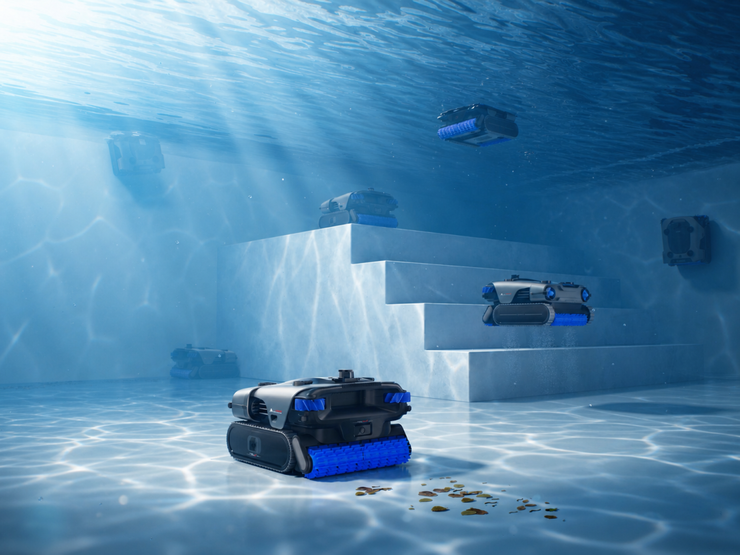
Wave Future (Langyong Weilai) tested ultrasound, point-ToF and line-laser before settling on sensor fusion. On the X10 it fuses lidar for contour, ultrasound for distance and vision for features, cross-checking when one signal is degraded. Internally, X10 mapping and coverage approach 100 per cent in regular pools and above 95 per cent on steps and curves.
From mapping to autonomy
Mapping plans one task; autonomy demands long-term self-directed cleaning, separated by motion control, cleaning structure, docking and reliability. Corner cleaning is its own puzzle: the right-angle between floor and wall needs the robot to angle its posture and hold distance, with A10 corner coverage near 98 per cent. Moving into shallow shelves changes buoyancy and drag, shifting sensor views.
True autonomy means the robot lives in the water, starting, returning and recharging itself, calling for the human only to clear debris or handle faults. That needs stable docking, waterside power and corrosion sealing. Channel structure lags technology: Wave Future entered Canadian Costco after about half a year, first online with 35 to 50 daily activations, then physical shelves.
The first round made pool robots easier to use. The next round must make them need no watching. Whoever achieves genuine autonomous operation may reorder the field. The connection between technology and channel is simple: better cleaning results show up in reviews, returns and service cost.
Editor’s note: This is an adapted translation of the original LeiFeng Network report. It has been trimmed and restructured for readability for an international business audience.