On 17 August, RoboScience released REX G1, a wheeled humanoid general-purpose manipulation robot and its first commercial product, pitched as a next-generation embodied-intelligence productivity partner. Built on the company’s self-developed VLOA general embodied model, Visics, the robot targets logistics, factories, retail and home settings, and is designed to close the full loop from task understanding to execution inside unstructured, fast-changing real-world spaces.
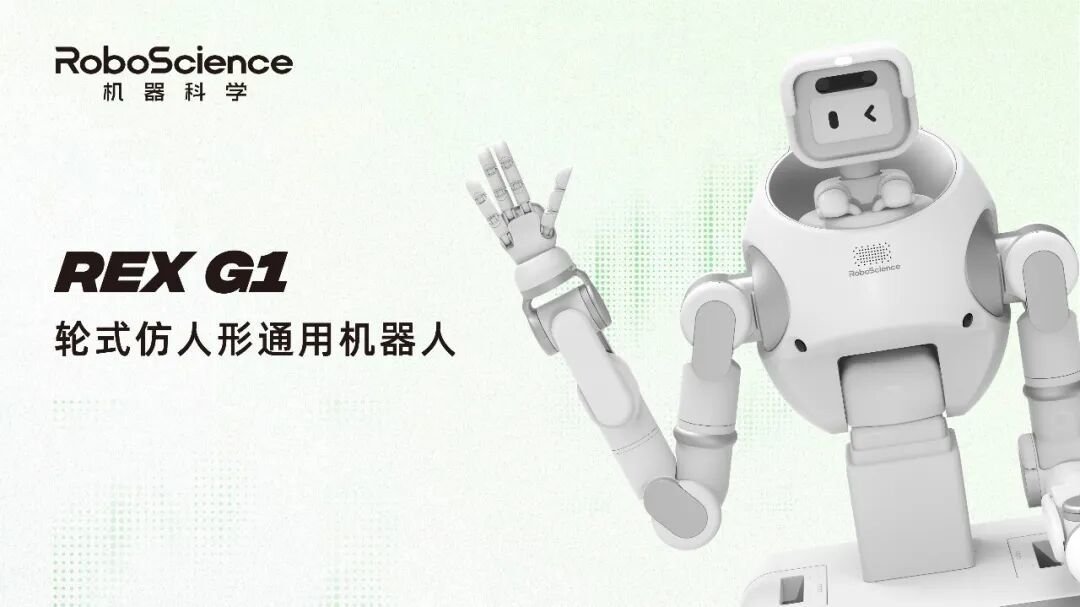
The body uses a “1+1” layout: a large lower unit carries the powertrain, while a smaller head unit handles command output and interaction. Edges are rounded and the surface is matte, for safe close proximity to people; an e-ink screen gives minimal feedback. A quick-release service hatch removes the need to dismantle the whole machine for maintenance.
A form that moves and works at once
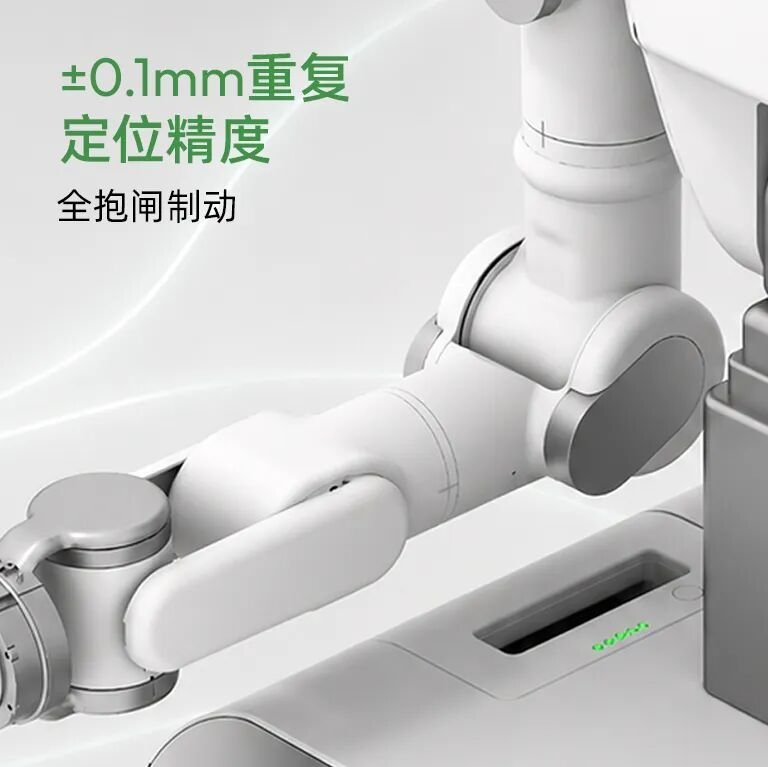
REX G1 carries 22 degrees of freedom (2 neck, 7 per arm, 2 waist, 1 lift, 3 chassis) and holds 10 kilograms in a dual-arm hug. In tight aisles it holds end-effector pose through zero-space control, so the chassis, lift and arms work together to locate and grab while moving, cutting the stop-realign-repeat waste of conventional robots. Repeatability is plus or minus 0.1 millimetre.
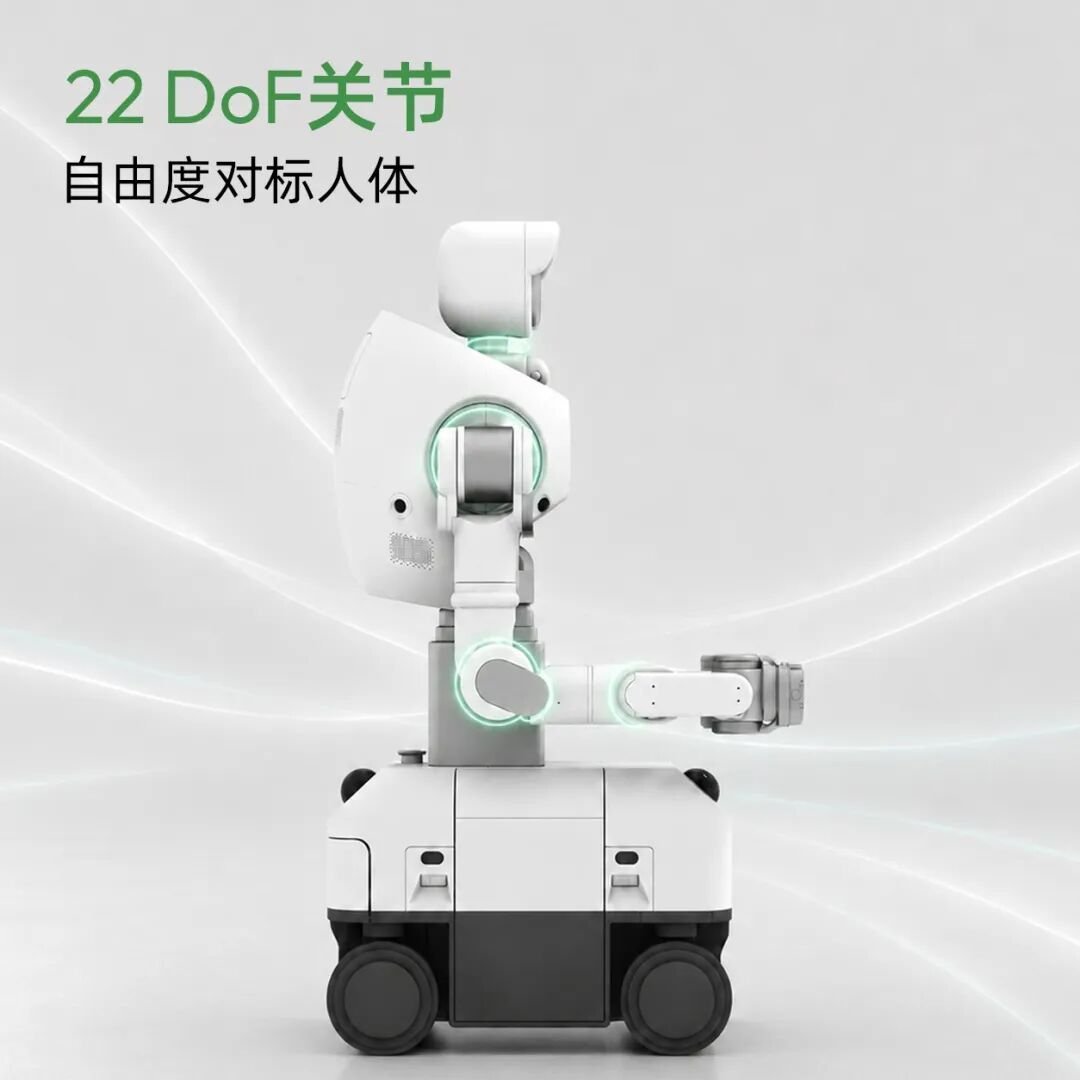
Instead of retrofitting sites, the robot adapts to them. At 540 millimetres wide and 540 to 640 millimetres long, with height from 1,100 to 1,700 millimetres, it enters 0.75-metre aisles and covers a 0.1 to 2.0 metre working height without changing the existing layout. Full-stack 360-degree stereo vision copes with shelf glare and low light, with adaptive fill light so no extra site lighting is needed.
A brain that understands the task
Visics uses a Vision-Language-Object-Action architecture that links perception, language commands and robot action. A dual engine splits the work: a world model predicts 3D object dynamics, and a manipulation model turns those predictions into low-level control signals for different bodies. By decoupling high-level task meaning from physical execution, the model generalises across embodiments, objects and tasks, and runs on 2,070 TFLOPS of on-device compute to limit cloud dependence.
For continuous work, REX G1 runs up to 4 hours and hot-swaps batteries in 5 seconds without shutting down, so high-frequency logistics flows never stall for charging. RoboScience frames the shift plainly: robots should adapt to the environment, understand the task, and keep working, rather than merely complete a one-off demo.
Editor’s note: This is an adapted translation of the original LeiFeng Network report. It has been trimmed and restructured for readability for an international business audience.