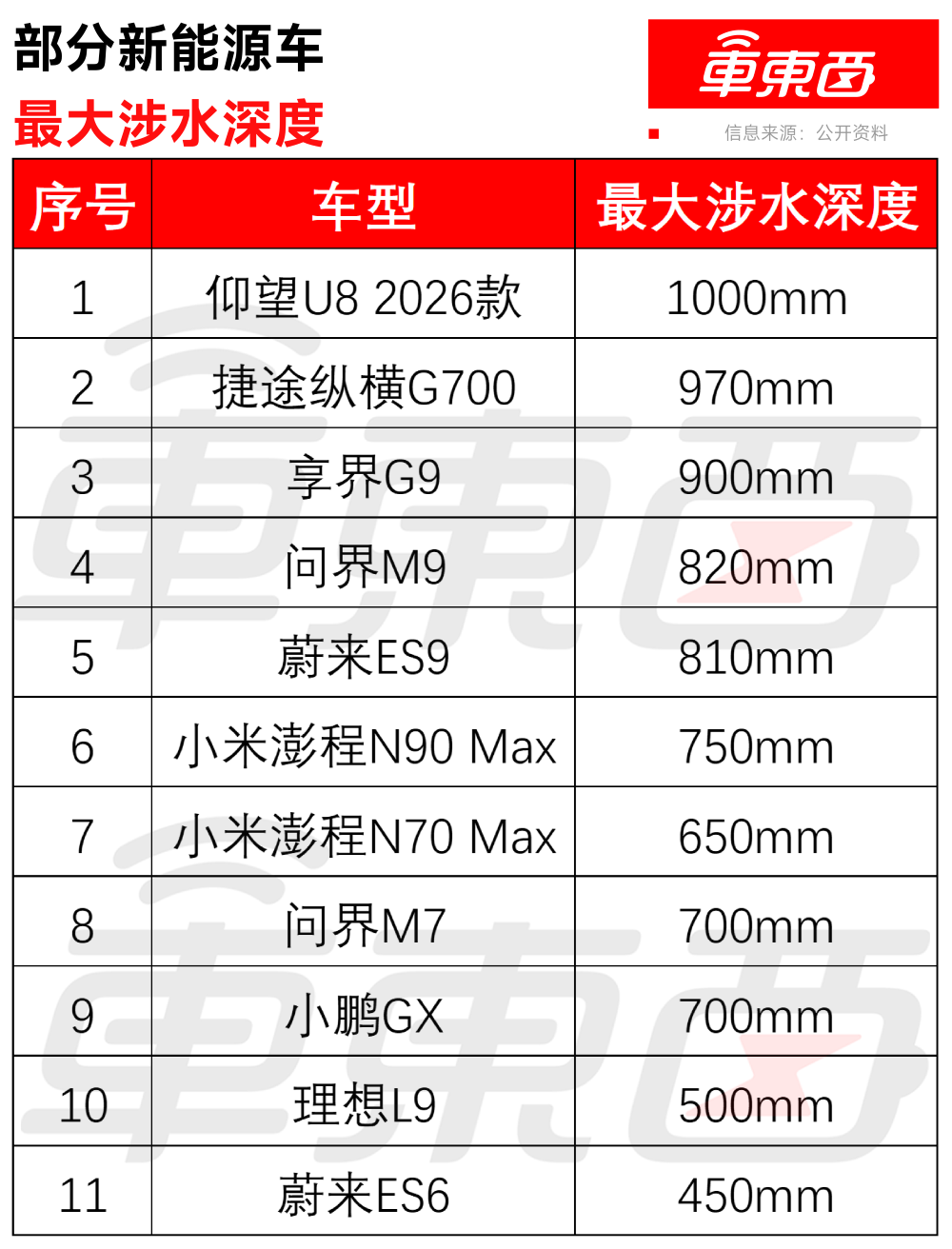
Storm season is quietly resetting the argument about electric cars and water. When Typhoon White Dolphin made landfall on 9 August, Shanghai recorded close to 300 millimetres of rain and thousands of cars were submerged across several cities. Xiaomi founder Lei Jun used the moment to post a reminder: pay attention to wading ability. Xiaomi’s Pengcheng N90 Max, he said, clears 750 millimetres and carries IPX8 and IPX9K battery protection.
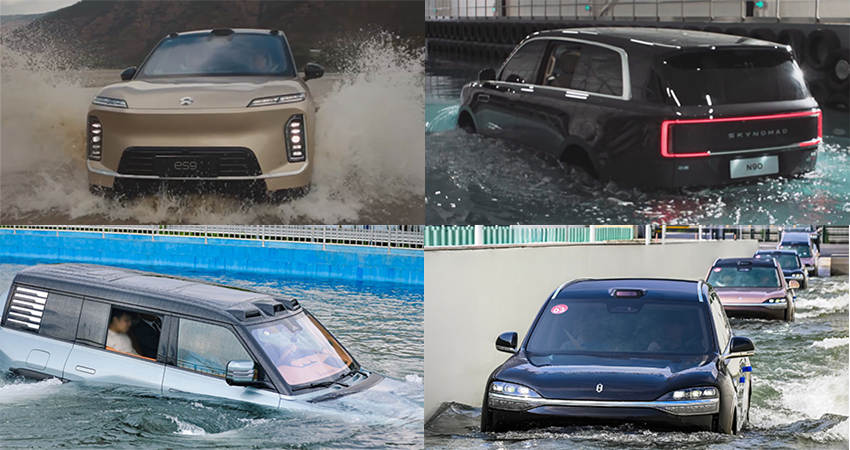
The reason EVs often beat petrol cars in floodwater is structural. A combustion engine drowns when water reaches the intake; an EV has no intake. China’s national standard GB18384-2025, in force since 1 July 2026, lifted the wading test depth to 150 millimetres, but real products go far beyond it. NIO’s ES9 clears 810 millimetres, the Xiangjie G9 reaches 900 millimetres, and the Yangwang U8 and Jetour G700 float at roughly 1,000 millimetres.
Sealing the core, then the whole car
The battery pack is the heart and the main worry. Mainstream packs use an aluminium shell with multi-layer seals, welded seamless, plus a breath valve, and typically meet IPX8, meaning 48 hours immersed at 1 metre, with IPX9K guarding against high-pressure hot spray. Motor shafts use magnetic-fluid seals for zero-leak rotation, and high-voltage connectors carry water sensors that cut output on intrusion.
Systemic design does the rest. On the Pengcheng N90 Max the range-extender intake sits 1,109 millimetres off the ground and the cabin vent moves to 950 millimetres, 250 millimetres higher than usual. In wading mode air suspension raises the body, the climate system switches to internal circulation, windows crack for air, and the screen shows live depth. Yangwang U8 adds emergency flotation: four independent motors drive it through water, with more than 3,000 seal points and 161 waterproof parts, capped at 30 minutes. Jetour’s G700 goes further with two stern thrusters, 7 km/h on water and over an hour of range.
Caution over confidence
The structure gives EVs a real edge, and buyers now track wading depth as a spec. Lei Jun’s own caveat stands: unknown depth, drive carefully. Wading ability is a passive safety feature, and the wise move in any flood is still to turn back.
Editor’s note: This is an adapted translation of the original CheDongXi report. It has been trimmed and restructured for readability for an international business audience.