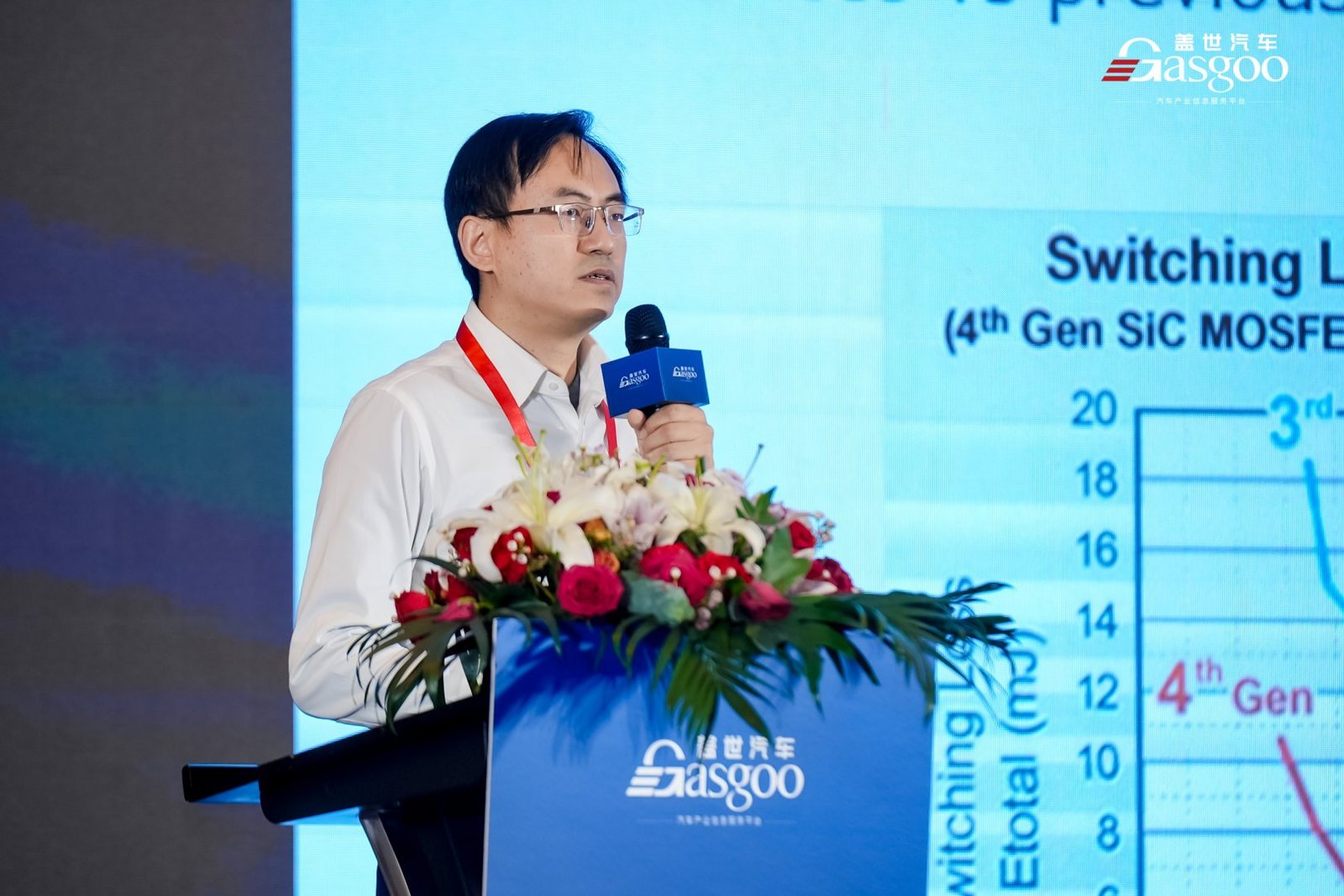
At the 2026 seventh New Generation Powertrain Technology Summit hosted by Gasgoo on 20 November, ROHM Semiconductor field application engineer Wang Tianyu set out the company’s silicon carbide portfolio and its plans for automotive powertrains.
From trench to planar
ROHM began silicon carbide research in 2000 and acquired German substrate maker SiCrystal in 2009. In the previous trench-based line, the fourth generation cut switching loss by about 50 per cent by optimising trench depth and cell size. The fifth generation changes structure to a planar design and targets conduction loss at high temperature. At 175 degrees Celsius, on-resistance falls about 30 per cent against the prior generation. Mass production is planned for 2027.
Ease of use is the other focus. Gate negative-voltage tolerance has been widened, with direct-current tolerance moving from minus 4 volts to minus 7 volts and surge tolerance from minus 6 to minus 10 volts, in line with mainstream rivals. Input and output capacitance have been adjusted so that paralleling multiple chips is less likely to cause oscillation or circulating current.
Wang summed up the trade: for the same chip area, the fifth generation delivers higher output current, or for the same output current, fewer chips and lower cost.
Tested in converters and inverters
In vehicle validation, ROHM simulated an 11-kilowatt onboard charger front-end three-phase power-factor-correction circuit. At a 100 kilohertz switching frequency, single-device loss fell 19 per cent and peak and average junction temperatures improved by about 10 degrees Celsius. In a main-drive inverter simulation, with module and chip area held constant, maximum root-mean-square current at 175 degrees rose 13 per cent, and at 200 degrees over 100 hours it rose about 16 per cent.
The product range spans TO-247 discrete devices, HSDIP and TRCDRIVE pack modules, and bare die or wafers for module makers. Isolated driving is mainly magnetic, with the most complex drivers reaching 20 amperes output. The company also offers thermal simulation, electromagnetic compatibility guidance and printed-circuit-board design support.
For European powertrain engineers, the detail that matters is the German substrate link. ROHM has controlled SiCrystal since 2009, so the move to a planar fifth-generation device couples chip design with a European supplier of the starting material at a time when silicon carbide capacity is a strategic constraint.
Editor’s note: This is an adapted translation of the original Gasgoo report. It has been trimmed and restructured for readability for an international business audience. The full original (in Chinese) is at https://auto.gasgoo.com/news/202611/20I70478657C103.shtml.