SemiDrive has open-sourced the software development kit for its D9-MAX chip. The device is an automotive-grade heterogeneous single-die platform aimed at what the industry calls the hindbrain of an embodied system, the layer that turns a plan into joint commands and does not get to be late.
The code is on Gitee, managed as multiple repositories.
Why one die instead of three boards
Conventional robot control spreads perception, motion and safety across separate boards, which means separate power domains, separate clocks and a communication path between them that has to be argued about at every integration.
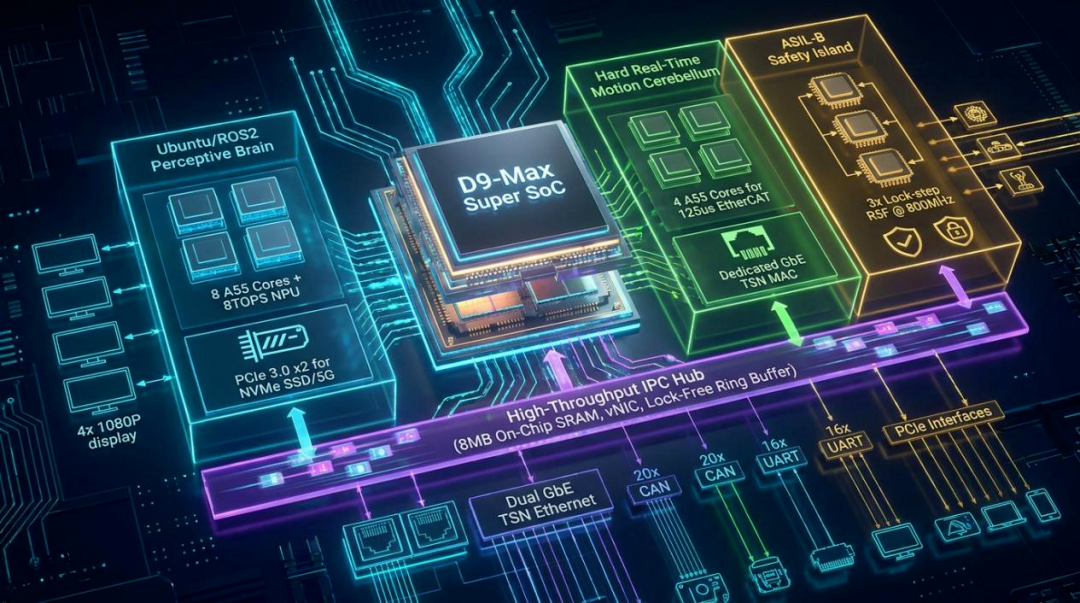
D9-MAX puts them on one die. The 12-core CPU is split into two physically isolated clusters of eight and four cores using Arm DynamIQ Shared Unit technology, so motion control and interaction workloads are hard-partitioned rather than scheduled politely. There is 8 MB of on-chip SRAM for cross-domain communication, plus two gigabit TSN Ethernet ports, 12 CAN-FD channels and 16 UART or RS485 interfaces, with a PCIe 3.0 x2 expansion lane. The part is rated from minus 40 to 105 degrees Celsius.
The numbers in the benchmark
Running the open-sourced Linux real-time stack on a single A55 core in bare-metal mode, the chip drove a six-axis motion control card at a 125 microsecond control cycle with no missed steps and no dropped frames.
Three pairs of lockstep Cortex-R5F cores form the safety island, with 25 nanosecond interrupt response, and the hardware security module supports ASIL-B functional safety and Evita Full certification.
The SDK ships the automotive-grade bootloader, a Linux 6.12 LTS kernel with the PREEMPT_RT real-time patch merged, a dual file system option covering Ubuntu 26.04 and Buildroot 2502, the real-time core firmware assets, and a code area containing an IgH EtherCAT real-time master stack, chip-level peripheral drivers and a lock-free inter-processor communication library for the on-chip SRAM.
What the release actually changes
SemiDrive says the D9 series is already in volume production with leading humanoid robot makers, and that cumulative shipments of its automotive-grade chip family have passed 15 million units, covering more than 90 per cent of domestic Chinese carmakers and some international ones.
Automotive silicon reaching robot controllers is not new. What is new is the software being open. A robot maker that previously had to build a real-time layer, an EtherCAT master and a safety argument from scratch can now start from an openly licensed baseline and spend its engineering budget on the motion model instead. That removes roughly a year from a control stack, and it removes the switching cost that used to lock integrators to whichever vendor sold them the board.
The automotive supply chain spent a decade proving that functional safety and volume pricing can coexist. Opening the software is how that same argument gets made to a robot industry that has been building its controllers by hand.
Editor’s note: This is an adapted translation of the original Gasgoo report. It has been trimmed and restructured for readability for an international business audience. The full original (in Chinese) is at https://www.gasgoo.com/apps/e060bad9eca91db7f01403fc7120041f/robot/news/70477265/.