On 27 October the large-model team at D-Robotics published Uranus, a world-model simulation platform, and put the whole stack in public: technical report, inference code, SDK and two versions of the model weights. A hundred early-access slots were opened to teams outside the company.
The Shenzhen company, which grew out of Horizon Robotics to build computing platforms for robots, is not releasing a robot. It is releasing the instrument that tells you whether a robot’s control policy is any good.
Seven bodies, one representation
Robot hardware is fragmented in a way that software is not. A single arm, a dual-arm cell and a mobile manipulator have different joint counts, different kinematic structures and different camera rigs, which is why simulation work tends to stay inside one lab with one machine.
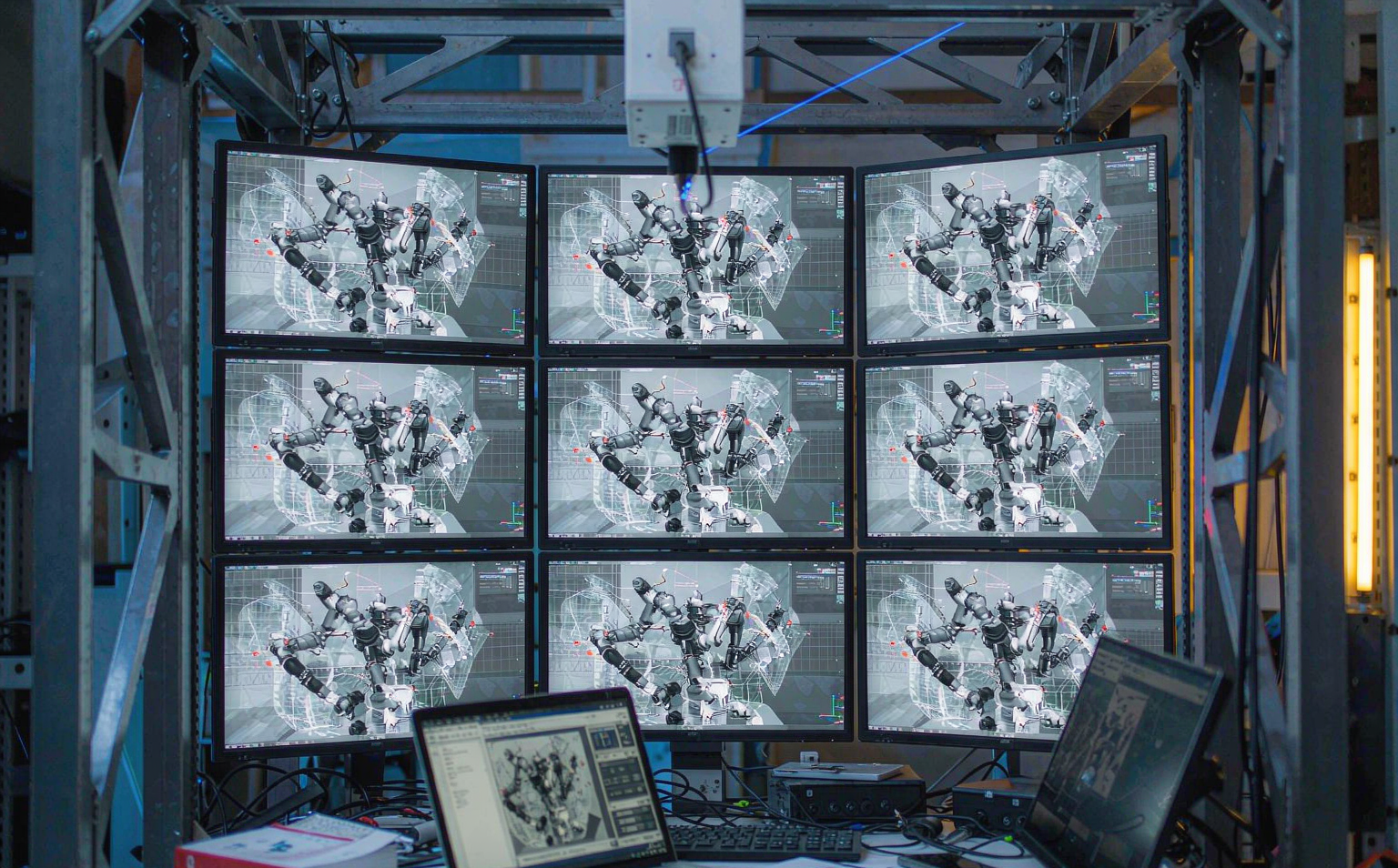
Uranus maps those differences onto a shared action and space representation and projects camera parameters into a two-dimensional skeleton image. At each interaction step the model receives joint positions for the next four moments, predicts latent frames, decodes them into continuous images and returns the observation to the upstream policy. Multi-camera views are generated simultaneously, and the same model accepts seven mainstream embodiments.
The engineering is in the state, not the pictures
Generating a convincing frame is the easy half. Keeping a rollout coherent for a minute is the hard half, because every predicted frame drifts a little and the error compounds.
D-Robotics uses a causal architecture with streaming inference. A reference frame stays in the cache as a stable visual anchor, history is held in a sliding window to cap the cost, and generation is compressed through distillation from the student model’s autoregressive rollout plus four-step denoising. State is kept per session so the system does not recompute what it already knows. The result is a jump from three-second training clips to closed loops that hold for about 60 seconds, with multi-view generation at minute scale.
What the numbers claim
The validation is the part worth reading closely. On five tasks in RoboTwin and nine closed-loop policy experiments, the correlation between Uranus and the original simulation environment on policy success rate came out at 0.98. The ranking metric MMRV was 0.01, meaning the platform preserves the relative order of policies, which is what a screening tool actually has to do.
On the WorldOlympiad robot evaluation suite the platform scored 0.722 overall and 0.730 on interaction.
A correlation of 0.98 is a claim about fidelity to another simulator, not to the physical world. The team says the next work is precise interaction, cross-task generalisation and validating whether results scored in the virtual environment transfer to real machines. That last item is the one that decides whether this becomes infrastructure or a demo.
Why a simulator is the competitive layer
Chinese humanoid and embodied teams have spent two years optimising for demonstrations, because a demonstration is what raises money. The bottleneck that follows is evaluation: without a cheap, repeatable way to compare policies, capital flows to whichever team edits the best video.
An open platform with published weights changes the cost of scepticism. An outside researcher can re-run a claimed policy, compare it against alternatives and publish the ranking. Labs that have been grading themselves will find that harder to sustain.
Editor’s note: This is an adapted translation of the original Gasgoo report. It has been trimmed and restructured for readability for an international business audience. The full original (in Chinese) is at https://www.gasgoo.com/apps/e060bad9eca91db7f01403fc7120041f/robot/news/70476218.