Shipbuilding is a high-mix, low-volume, non-standard discrete manufacturing business. Sub-assemblies, lifting lugs and hull panels vary in shape, incoming steel plate arrives deformed, groove gaps differ from the drawing, and the finished part rarely matches the model it was cut from.
Traditional industrial robots depend on manual teaching and playback. Change the workpiece family and the cell has to be reprogrammed. With skilled welders in short supply and rework costs high, automation has struggled to scale beyond a narrow set of parts, leaving non-standard fabrication dependent on experienced technicians.
Policy has pointed this way for some time. A 2025 action plan on AI plus manufacturing, issued by the Ministry of Industry and Information Technology with seven other departments, called for AI deployment in shipbuilding, including shipbuilding-specific models and intelligent upgrades across cutting, welding, coating and logistics.
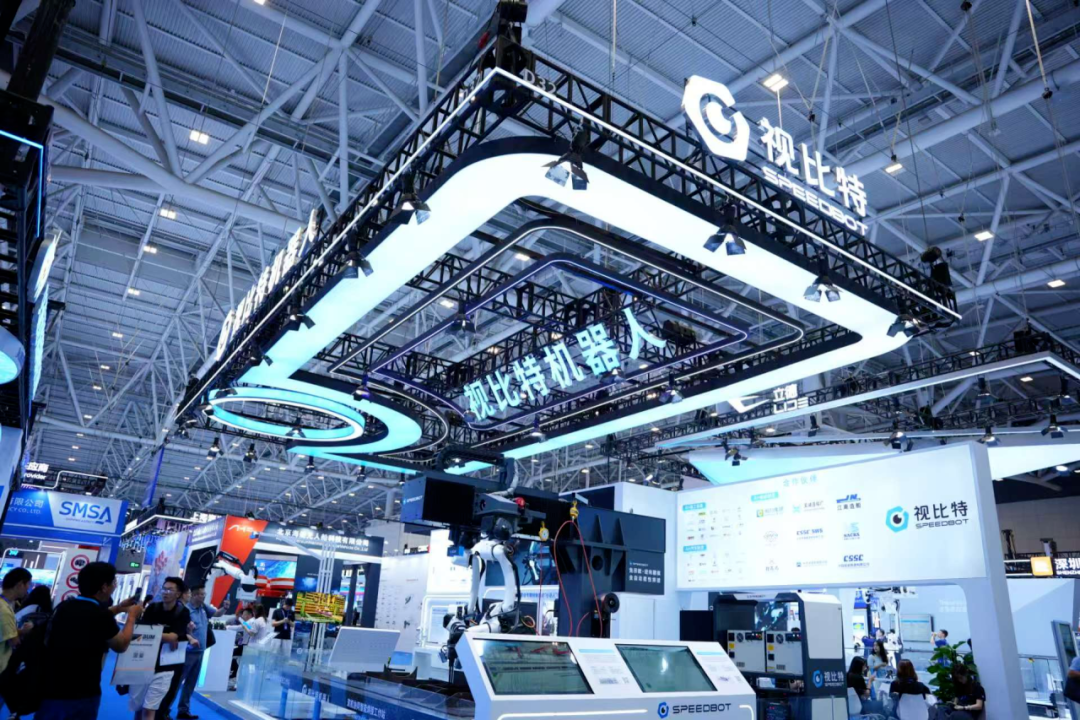
The underlying problem reduces to two failures. Machines cannot see the real workpiece, and yards cannot afford to rehearse. SIBIT, based in Hunan, has built its offer around both, packaging vision, welding control and simulation into a four-layer loop spanning perception, execution, decision and maintenance.
Vision first, because the drawing is wrong
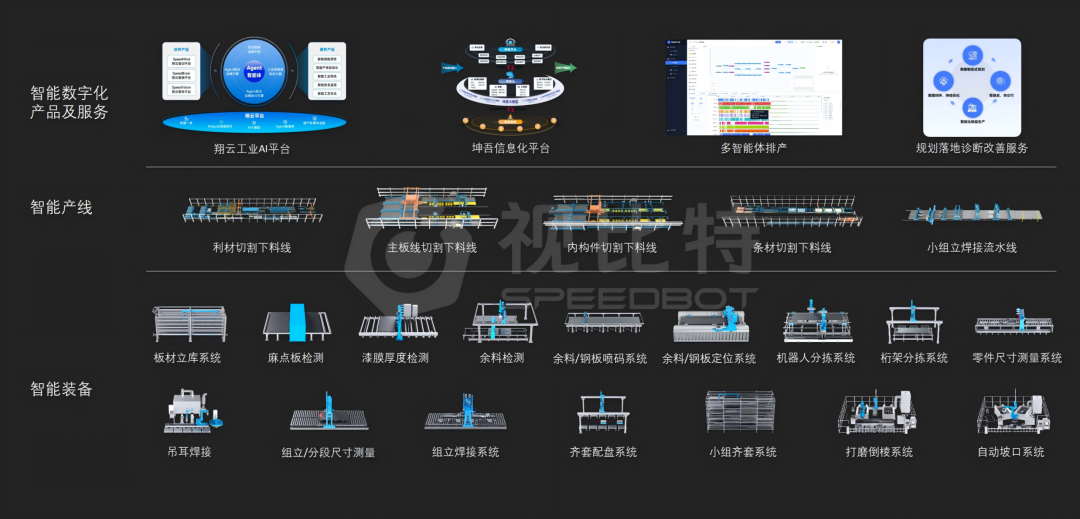
Its scrap scanning system uses line-scan cameras and in-house 3D algorithms to map leftover plate after nesting and cutting, extract contours, generate DXF models and drive secondary cutting. The same approach underpins a flexible grinding cell that identifies edges from a rule library, generates tool paths from a drawing, and switches process parameters without teaching.
Welding without a drawing
The dual-machine collaborative welding workstation combines 3D vision hardware, AI algorithms and the SpeedWeld control package, so the robot locates the seam itself. SpeedWeld supports CAD import or 3D scan-based reverse modelling, multi-robot coordination, and configurable weld sequencing.
Its commercial advantage is compatibility. The software runs on more than 20 robot brands including FANUC, KUKA, YASKAWA and ABB without access to their underlying protocols, which lets a yard standardise on one welding stack across a mixed robot fleet. The company says changeover for a new workpiece is 90 per cent faster and that welding current, voltage and speed are logged for traceability.
The stated capability envelope covers 0.5mm sheet, galvanised steel and stainless steel, the three material and thickness combinations that have historically defeated automated welding because of burn-through, porosity and arc reflection.
The robot that leaves the cell
Fixed cells still cannot enter confined hull compartments or reach oversized irregular structures without being dismantled and rebuilt between stations. SIBIT showed a full-size bipedal welding robot at 1.65 metres with a 10-kilogram arm payload, industrial-rated, intended for hull sections, heavy steel structures and construction machinery.
Its Kunwu platform is the other half of the argument. It spans line design, offline robot programming, virtual commissioning and scheduling simulation on a digital twin, and can generate deployable line control software from the simulated process, compressing on-site commissioning from weeks to days. The company says the platform carries more than 30 industry templates and 10 process packages.
SIBIT reports deployments with China State Shipbuilding Corporation, COSCO Shipping Heavy Industry and China Merchants Industry, along with private yards, and says its products run on more than 300 customer production lines with exports to North America, Europe, Japan and Korea.
Editor’s note: This is an adapted translation of the original OFweek report. It has been trimmed and restructured for readability for an international business audience. The full original (in Chinese) is at https://robot.ofweek.com/2026-10/ART-898890-8120-30708344.html.