Unitree published its third-quarter report on 29 October, and the numbers land in an awkward moment for the whole embodied-intelligence sector. Secondary-market sellers have been shopping old humanoid stock at half price. One founder publicly questioned in September whether data-collection centres were manufacturing revenue that would not survive an audit. In the middle of that, China’s first listed humanoid pure-play filed its accounts.
The report answers two questions the industry has been arguing about for two years. Yes, a humanoid can make money. No, it will not make very much of it.
Volume up, margin down
The audited-feeling numbers are these. Revenue for the quarter to 30 September reached RMB 665 million, up nearly 70 per cent year on year. Non-recurring net profit attributable to shareholders came in at RMB 105 million, down 17.4 per cent.
Strip out the first half and the third quarter on its own carries a gross margin of roughly 50.6 per cent on the main business. That compares with 56 per cent in the first half of 2026, is below both 2024 and 2025, and sits above only 2023, when the figure was 44.2 per cent.
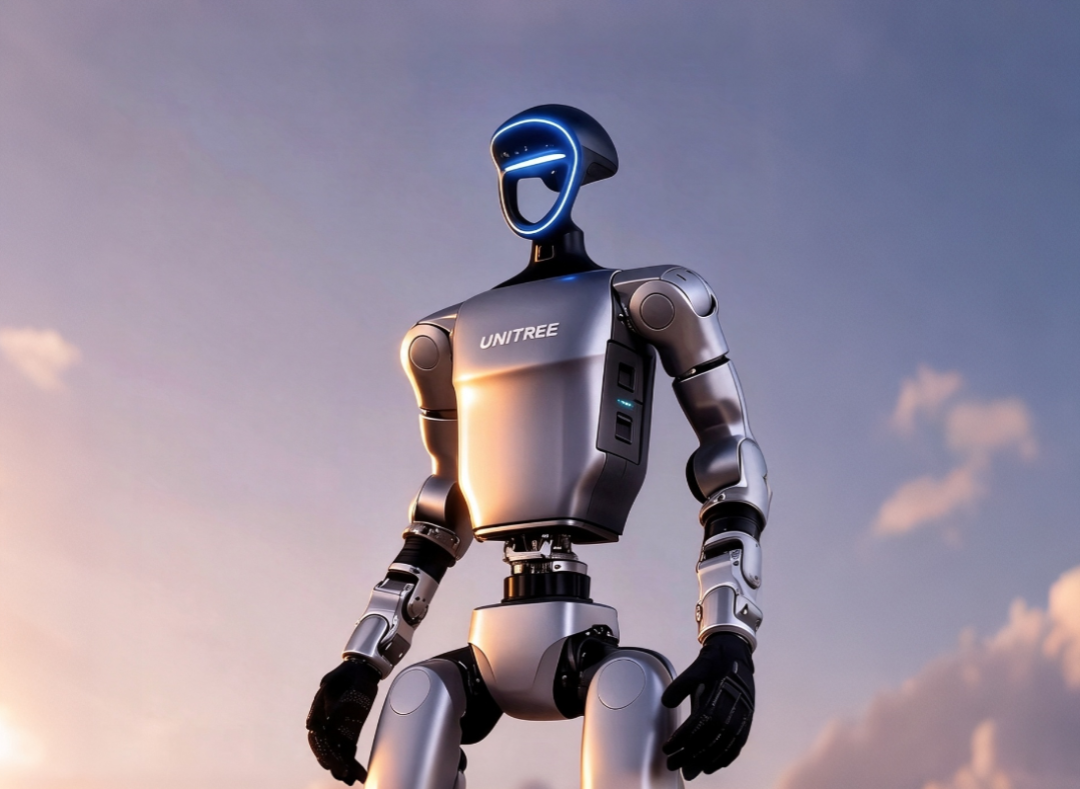
The company had already signalled the direction. Its prospectus shows the entry price of the G1, the machine that actually carries the revenue, cut from RMB 99,000 to RMB 85,000. The R1 Air, a light consumer and research biped, went to RMB 29,900.
The paradox is worth stating plainly. The share of revenue coming from high-margin humanoids keeps rising, and the profit per humanoid keeps falling. Competition is the unavoidable part of it. The G1 competes with AgiBot’s A2, Fourier’s GR-2 and UBTech’s Walker S1, several of them within a thousand yuan of each other. In the consumer tier the pressure is worse. One rival home robot now sells for RMB 9,418 after subsidy, which is close to the floor of the category.
Where the money went
Unitree is spending the difference on models. Its RMB 4.2 billion IPO raise earmarks close to half for robot-model research. In the quarter, R&D spending exceeded RMB 127 million, up nearly 250 per cent year on year and roughly equal to the previous two quarters combined. Management attributes it to embodied large-model work and the compute behind it.
The record shows the build-out. In January the company open-sourced UnifoLM-VLA-0, which let a robot read a task and then physically attempt it. In September came UnifoLM-WLA-1.0, aimed at generalisation and whole-body coordination, handling 64 table-top and whole-body tasks in a single model across a gripper and two kinds of dexterous hand. On 22 October, Wang Xingxing said the company is pre-researching a physical-AI self-evolution model, V1.0.
His language has shifted with the strategy. At the World Physical AI Conference on 22 October he spoke on the theme of believing in AI as far as possible. The word AI appears 25 times in an 1,800-character script. Embodied and robot together appear 18.
Inventory is the tell
Inventory reached RMB 1.02 billion at the quarter end, up 177.2 per cent since the start of the year and 51.9 per cent since the half year. That is what a company looks like when it moves from concept to volume.
The funding of it is familiar to anyone who has read a carmaker’s accounts. Accounts payable rose from RMB 245 million to RMB 693 million, a net increase of RMB 448 million, covering 69 per cent of the inventory value. Operating cash inflow of RMB 194 million covered about 30 per cent of the RMB 652 million inventory build. Suppliers are carrying the rest, and the company is carrying what it can.
One counterweight: the ratio of cash received to cash paid for goods and services rose from 107.6 per cent in 2025 to 111.3 per cent. Collection quality is improving even as margins compress. Humanoids, on this evidence, are not a bad business. They are a thin one.
The data bill
Alongside the accounts, Unitree disclosed a related-party transaction. Hangzhou Yushu Robot, its wholly owned subsidiary, will subscribe RMB 20 million into the Hangzhou embodied-intelligence pilot base to hold its 10 per cent stake steady through a capital increase.
The pilot base exists to fix a supply problem. Its first cohort of 18 tenants includes embodied companies such as Galbot and Star Sea Chart alongside Huawei, Alibaba and Moore Threads. A deputy general manager there gave a number worth keeping: one humanoid needs one to two data operators working alongside it, a simple action requires thousands of real demonstrations, and fewer than 50 per cent of the collected data is usable. That is the good case.
The base has already open-sourced a first real-machine dataset collected on Unitree hardware. The economics are not yet there. Audited owner’s equity in the vehicle stood at RMB 47.66 million at the end of 2025 and RMB 32.45 million at 30 September 2026, a loss of more than RMB 15 million in nine months. Public infrastructure does not pay for itself before the market arrives, which is precisely why the company is paying into it.
The bigger ledger
Global humanoid shipments grew nearly 300 per cent year on year in the first half of 2026. China shipped more than 40,000 units in that period, about 97 per cent of the world total. Unitree’s quarter and the national shipment data together form what might be called the sector’s third-quarter report.
Research and data collection carried the category in 2025, the year Unitree’s humanoid volume first overtook its quadruped line. That market has a ceiling set by grant budgets. Since then the body makers have moved toward industrial and commercial service deployments, because that is where a return on investment can be argued to a customer who is not spending public money.
Unitree won the research heat outright. Factories, retail and homes are the finals. Every workshop is a qualifying round.
Editor’s note: This is an adapted translation of the original OFweek report. It has been trimmed and restructured for readability for an international business audience. The full original (in Chinese) is at https://robot.ofweek.com/2026-10/ART-898890-12003-30709538.html.