On 9 September, the US physical-AI startup Harmoni closed a 10 million dollar Series A led by Bessemer Venture Partners, with valuation undisclosed, and on the same day unveiled HAL. HAL is an AI that lives on the shop floor: a worker can ask why a machine is running slower than usual, file a repair ticket, or flag a problem for the next shift. Founder David Caputo says it lets workers literally speak to the machines. The company has 40 customers and 19 people.
The floor: workers queuing, each clutching a USB drive
Caputo left banking in 2013 to buy manufacturing companies and was shaken on his first walk through a shop floor: workers lining up to clock in, each holding a USB drive with the CNC programs. He found no software that tied machine, worker and process together, and in 2020 founded Harmoni with manufacturing consultant Adam Ellis.
Two accidents in his own plants made the gap concrete. An operator ran the left-part work instruction on a right-hand part and drilled the hole in the wrong place, scrapping an 18,000 dollar component. A ten-year veteran retired, taking a USB drive he had hand-edited for a decade. Rebuilding the programs took a full year, and the product was idle for that year. The root cause was the same everywhere: ERP, machine and worker were never connected. Caputo calls the layer between ISA-95’s top, ERP and MES, and its bottom, machine and PLC, the wild west no man’s land.
Tablets first, then AI
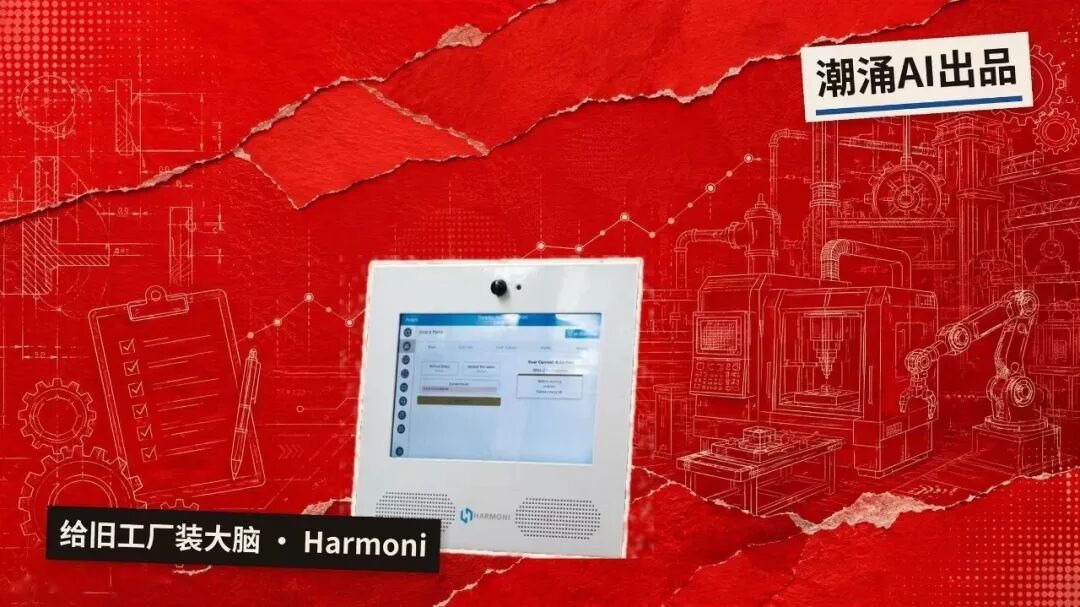
Harmoni’s hardware is a custom tablet that magnetically clamps to a machine, reaching from modern CNC systems back to machines built during the Second World War. Workers clock in, pull drawings, track work orders and report issues on it. Behind the tablet, RFID identifies who is at the machine, which work order, and which program version. The right instruction and checklist load automatically, time and machine state are recorded, and the data writes back to ERP. Multi-factor machine authentication, one-click engineering and maintenance calls, a real-time OEE light and a shop-floor dashboard all live in that layer.

Harmoni frames the logic as three pillars: automation kills non-productive motion, process control locks engineering data to the correct part version so an operator can never open a stale drawing, and observability fuses ERP, machine, worker and RFID into one live view. Deployment takes weeks. Customers recover about 200 productive hours per operator per year, roughly 30 to 45 minutes per shift.
WessDel, a San Jose precision shop serving aerospace and defence, started using Harmoni in 2024 after workers queued at three separate terminals. Now a badge swipe does it and machine activity is logged automatically.
Silicon Valley builds new factories, Harmoni retrofits old ones
As the US pushes re-industrialisation, Hadrian and Machina Labs build from scratch at high automation. Harmoni walks the opposite line, targeting the legacy factories still running old machines and human labour. We built this to arm these people to compete with those automated factories, Caputo says. The demand sits on a labour gap: a Deloitte and NAM study estimates US manufacturers may need up to 3.8 million extra workers by 2033, about half possibly unfillable. Waterloo’s William Melek warns the tech could also draw union pushback. Caputo says Harmoni keeps headcount and only cuts admin.
China funds robots, Harmoni funds tablets
Put in Chinese terms, 10 million dollars is about 70 million yuan. IT Juzi data shows China’s embodied-AI sector raised 93.5 billion yuan across 322 deals in the first half of 2026, with eight firms past the 20 billion yuan valuation mark. China’s money flows to bodies, brains and data factories. Harmoni’s goes to a magnetic tablet, RFID and the software between them.
The validation differs too. China benchmarks model capability, shipment counts and contract value. Harmoni benchmarks 200 hours saved per operator a year. The US has some 280,000 legacy factories whose pain is an information gap that robots cannot fix, so Harmoni leaves the equipment alone and repairs the data layer. China has the thicker automation base, yet its own SMEs face the same digitisation wall with no capital narrative attached.
The lesson worth stealing is Harmoni’s order: three years laying tablet tech, RFID, time, drawing versions and machine state, then AI on top. HAL’s ceiling is set by what the tablet can capture, which is a different thing from bolting a large-model API onto a factory and calling it intelligent. With tier-one valuations already in the 20-billion-yuan club and model progress hard to observe directly, Harmoni is a reverse reference: the moat in industrial AI may sit in the data a tablet can gather, not in the parameter count.
The caveat is honest. Forty customers, an undisclosed valuation, 19 people and a 10 million dollar A round are early numbers. Bessemer bought a direction, not a report card.
Editor’s note: This is an adapted translation of the original OFweek report. It has been trimmed and restructured for readability for an international business audience.