The business of making robots work in real settings has produced an unexpected winner upstream: the companies that sell the data. If the embodied AI industry kept an annual search ranking, embodied data would sit near the top. High-quality data has become a scarce and expensive input, and it has pulled in a crowd.
IT Juzi counts 25 Chinese embodied AI data startups raising more than RMB 17 billion in the first half of 2026. In the second half, as enthusiasm for embodied AI cooled, data infrastructure companies kept raising.
Three rounds landed inside ten days. On 24 October, Maxinsights closed a USD 30 million seed round. On 29 October, Jingshuo Technology, a subsidiary of WeRide, disclosed a Pre-A of tens of millions of dollars. On 2 November, Jianzhi Robot disclosed a USD 100 million A+ round. Three different players, three different cheques, ten days.
Why money keeps arriving as the market cools
Since the second half of 2026 the temperature gap in primary markets has widened. IPO scrutiny tightened, investors turned careful, and companies with only a technology story found it harder to raise.
Two things explain the exception. On the demand side there is a hard data gap, and on the supply side there are teams able to serve it.
Data has moved from an internal cost line to a purchase item with a named buyer. As robot hardware and models advanced, the industry bottleneck shifted from building a robot to training one. Real interaction data cannot be scraped from the internet and cannot be fully replaced by simulation, so collection stopped being a support function inside R and D and became its own procurement chain. That makes data one of the few certainties in the chain, because whoever wins on bodies or architectures still has to keep buying it.
Data also has a quantifiable delivery unit, the hour, which allows revenue to be recognised quickly. Building a whole machine depends on a production ramp, and the model architecture has not converged, so capital prefers the business with clearer demand and a shorter payback.
On the supply side, the three teams that just raised all came out of autonomous driving. Jianzhi founder Chen Jianxing was a senior algorithm director at Momenta and led production planning for its data flywheel. Jingshuo’s core team came directly from WeRide’s physical AI organisation, and chief executive Huo Da was WeRide employee number one, long responsible for the driving platform and data infrastructure. Maxinsights co-founder and chief technology officer Wang Kun was an early simulation engineer at Waymo and later co-founded QCraft.
Autonomous driving went through three elimination rounds, from algorithms to compute to data. Moving that playbook into embodied AI moves the starting line forward, and capital pays for lessons already bought.
Three models of the same production chain
Embodied data production splits into collection, processing and delivery. All three companies are trying to close that chain, with different points of emphasis.
Jingshuo starts at collection and moves toward data, models and skill assets together. Its goal is not to deliver hours but to turn real-world operating experience into trainable, reusable robot skill packages. The EGOK first-person capture device collects human operation data, and scale collection widens the coverage of real sites. The WorldEngine platform connects data governance with model training, while its GENESIS-Robotics world model explores how to understand and model the physical world. SkillForge then sits at the asset and delivery layer, organising data into standardised skill packages a customer can deploy.
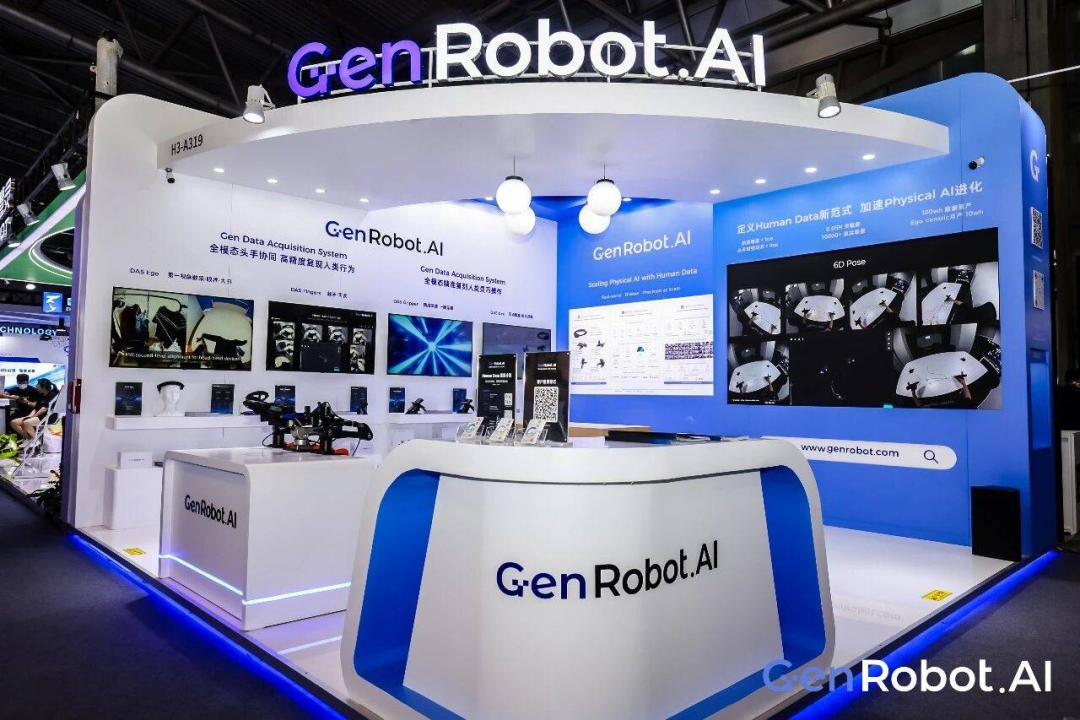
Jianzhi centres on multimodal collection and a data production line, connecting data to robot evaluation. Its Gen DAS device records human observation and manipulation through a headset, dexterous gloves and tactile sensors. DFM, the data infrastructure layer, aligns, reconstructs and labels multimodal information, and validates it against a real robot fleet before turning raw data into learnable skill data. Gen ADP is the production line itself, sending collection staff into homes and factories to turn daily work into data at scale.
Maxinsights trades a global collection network for high information density. It owns neither the sites nor large data centres, but it manages a network across eight countries. More than 3,500 collectors record first-person operation footage in homes, restaurants and hotels through headsets, and its own models handle hand tracking, action recognition and structuring. MaxGlove captures grip force and contact state that video misses, and MaxLoop scores quality at upload, flagging problems with the frame, the action or whether the task was completed.
The moat is not the hour count
Jingshuo’s strongest card is that it was carved out of a commercial driving platform. As a wholly owned WeRide subsidiary it inherits eight years of Robotaxi operating experience, including large-scale data processing, scene labelling and engineering delivery. It already works with NVIDIA, Tencent, Xiaohongshu and ByteDance, and claims more than 100 customers and ecosystem partners.
Jianzhi’s advantage is lifting the driving data flywheel out and rebuilding it for the multimodal gaps in embodied interaction, where touch and hand state matter in ways road data never required.
Maxinsights is betting that breadth of geography beats depth of site. That model lives or dies on quality control across 3,500 people in eight countries, which is exactly what MaxLoop is for.
Today’s rounds let these companies run. They do not decide who stays. What decides the endgame is whether a data company can offer assets, processing capability and service that a customer cannot easily replace once the hour count is matched. Specialisation is starting to appear in the embodied supply chain, and data infrastructure only earns the right to set prices when data can be bought, processed and reused as a standard input.
Editor’s note: This is an adapted translation of the original OFweek report. It has been trimmed and restructured for readability for an international business audience. The full original (in Chinese) is at https://robot.ofweek.com/2026-11/ART-8321206-8420-30710892.html.