Topstar, drawing on nearly two decades of manufacturing-scene experience, has teamed with Wuwen Zhike to build a shared industrial data ecosystem, a complete iteration loop for embodied intelligence that lets robots improve fast, reuse standardised skills and scale across sites.
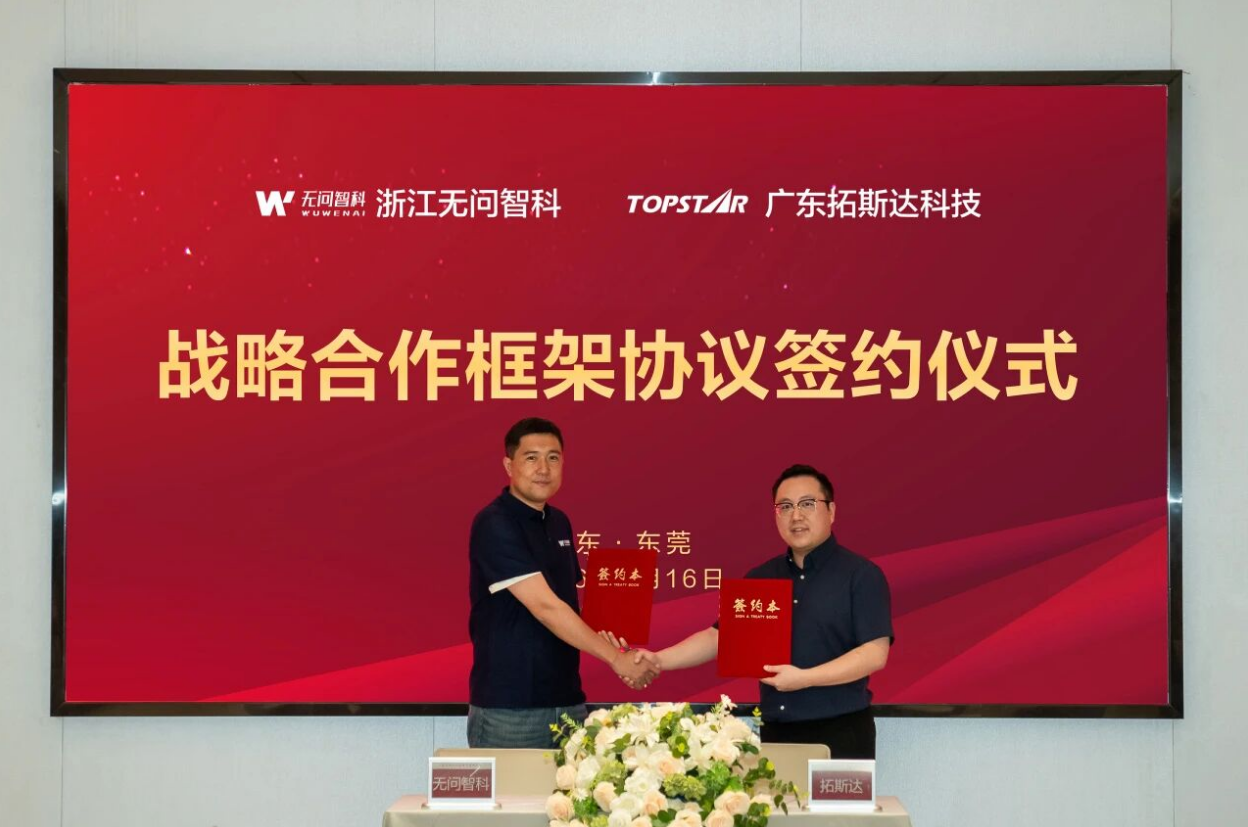
Wuwen Zhike was among the first to ship a physical-AI data-base platform, covering large models, industrial robots and embodied intelligence, and has already won tens of millions of yuan in simulation-testing orders from top manufacturers.
The two built an industrial-handling physical-AI data infrastructure that runs the full chain: virtual simulation, labelling, sorting, model training and real-robot testing. It gives Topstar’s embodied products a steady base to evolve on.
On a self-built physics engine, the platform renders high-fidelity digital twins and uses Scan2Sim and Gen2Sim to spin up training scenes in bulk, then synthesises long-tail edge cases. What used to be a month-scale field debug cycle is now measured in weeks.
Simulation data ships with perfect ground truth, while real data uses auto-pre-label plus human review, lifting efficiency about tenfold. A unified ‘data highway’ pulls in simulation, real-robot and line data, cleans and versions it, and automatically feeds real-robot failures back into simulation to grow the set, forming a discover, add data, upgrade model flywheel.
A three-tier perceive, plan, control training framework uses simulation pre-training plus real-robot fine-tuning, with incremental learning and hot updates so the robot keeps improving as it runs.
With this virtual-real base, Topstar has wired data capture, simulation expansion, model training and real deployment into one flow, freeing its embodied robots from single-scene custom builds.
Editor’s note: This is an adapted translation of the original OFweek report. It has been trimmed and restructured for readability for an international business audience. Source: OFweek.