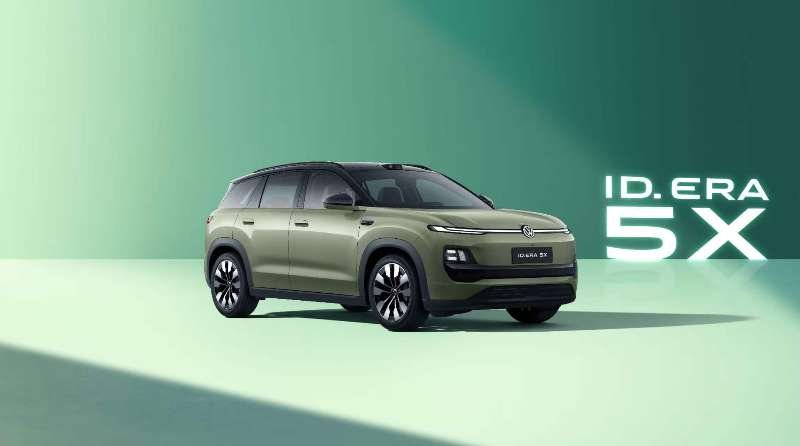
The first Volkswagen ID. ERA 5X came off the line at the SAIC Volkswagen plant on 16 October, marking the start of mass production for CMP, the group’s first new-energy vehicle platform developed entirely in China. A second model on the same architecture, the ID. AURA L5, follows at FAW Volkswagen later this year.
One platform, two powertrains, Chinese product definition
CMP was designed for Chinese customers and the mainstream segment, with enough flexibility to carry battery-electric and plug-in hybrid powertrains on the same base. Every CMP vehicle uses Volkswagen’s CEA electrical and electronic architecture, which the company describes as joining the hardware body to a software brain.
The specification reads like a local-market checklist. AI-enabled cockpit, enhanced Level 2 assisted driving, and over-the-air updates every 100 days that complete in 30 minutes. The ID. ERA 5X adds a 4-nanometre cockpit chip and lidar, running an end-to-end assisted-driving model called Hyper Sense 8 from Horizon Robotics’ CARIZON joint venture.
Packaging and thermal gains over MEB
Volkswagen claims a clear step up in interior efficiency against the older MEB platform, with a cabin-to-body ratio above 85 per cent on both the ID. ERA 5X and the ID. AURA L5. A new direct heat-pump system manages cabin, battery and motor together and cuts CLTC combined energy consumption by about 5 per cent at 0 degrees Celsius.
The chassis runs MacPherson struts at the front and a multi-link rear axle with close to 50:50 front-to-rear load distribution.
Durability targets borrowed from the global rulebook
CMP follows Volkswagen’s global engineering standards, with a durability target of 15 years and 300,000 kilometres. Validation includes two winters and two summers of real-world testing plus 24-hour continuous rig testing, aimed at a five-star C-NCAP result and a good rating from C-IASI.
The safety package includes a high-voltage fuse that cuts power in milliseconds and a standard emergency assist that steers to the roadside and calls for help if the driver becomes incapacitated.
Why this matters outside China
Dr Robert Cisek, CEO of the Volkswagen passenger brand in China, called the start of CMP production another milestone in the group’s electrification in the country. Volkswagen plans six CMP models in China within 18 months to cover the mainstream segment.
The strategic weight sits in the governance, not the vehicle. A German group handed product definition and development to a local team, then kept its global validation and safety standards on top. That combination is the template every joint venture in China is now being measured against, and it compresses the distance between a market signal and a production car.
For European suppliers and plants, the comparison is unavoidable. The same company can now launch a platform in China inside a cycle shorter than a single European model refresh, which turns cost and speed into a board-level argument in Wolfsburg rather than a slogan from Shanghai.
Editor’s note: This is an adapted translation of the original Gasgoo report. It has been trimmed and restructured for readability for an international business audience. The full original (in Chinese) is at https://auto.gasgoo.com/news/202610/20I70475380C501.shtml.