On the afternoon of 7 August, at the Shanghai Securities News roadshow centre, Unitree’s STAR Market IPO online investor session ran from 14:00 to 19:40. The planned three-hour event stretched to nearly six hours under investor heat. Over 360 questions hit Wang Xingxing, from how a 219-times price-earnings ratio holds up to what DeepSeek’s 141 million yuan strategic allocation locked for 36 months means, to the soul-searching “if others pump your stock, what will the company do”.
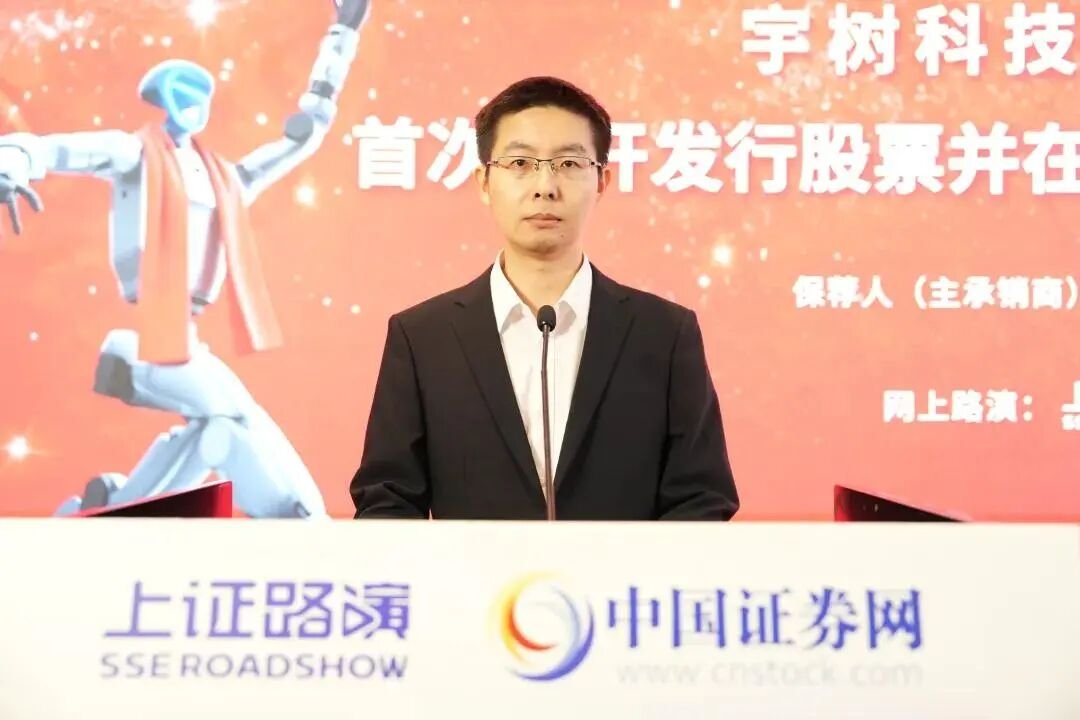
Wang took them all. “This capital-market entry is a brand-new starting point for Unitree,” he said. And: “The embodied-intelligence industry as a whole is still early, like the early days of the home computer.”
This is typical Wang, pouring cold water on himself and the industry at the brightest moment. Read his public remarks over three years and this hot-room-cold-words contrast is his most stable trait.
From the frank “no commercial path” at H1’s 2023 launch, to the “two 80 per cents” ChatGPT-moment definition at the 2025 import expo, to the “robot 100 metres under 10 seconds, beating Bolt” vision at the 2026 Yabuli forum, Wang’s quotes trace China’s humanoid industry from lab to capital market.
Now, as Unitree lists at 150.80 yuan a share with a near 61 billion yuan issue valuation, those quotes are no longer opinions. They are footnotes to the prospectus of the “first humanoid stock”.
A 13-year no, lit by ChatGPT. Wang’s attitude to humanoids was a long denial. In 2009, a Zhejiang Sci-Tech freshman, he built his first biped alone over winter break. “Deeply disappointed,” he later told China Entrepreneur. The control tech was not there, so he could not see the use.
That 14-degree-of-freedom biped, built for 200-odd yuan, became his starting point of rejecting humanoids for 13 years. Even after founding Unitree in 2016, asked by investors “will you do humanoids”, his answer was four blunt words: “We do not do humanoids.”
The turn came at the end of 2022. Tesla’s AI Day showed Optimus, and ChatGPT exploded. Wang realised “the software-hardware combined embodied-intelligence concept lit the industry’s enthusiasm”. By late 2022, even before Unitree started, customers already came asking to buy.
In February 2023 the humanoid project was set up internally. Half a year later, in August 2023, H1 launched at the World Robot Conference, billed as “China’s first full-size humanoid that can run”.
From “no humanoids” to a product in half a year, Wang’s logic never changed: “The market has demand, so Unitree builds.” He stresses he “clearly separates which tech is fun from which tech can be commercialised”.
This near-cold pragmatism sits oddly against the public “romantic engineer” who had robots dance at the Spring Festival Gala.
In May 2024 Unitree released G1 at a 99,000 yuan base price. That price was a bomb, pulling the industry average from hundreds of thousands to under 100,000. But Wang wanted more than a price war. At the 2024 World Robot Conference he argued against piling high-compute chips: “A humanoid is a motion system plus AI. Stacking large models alone without motion control will not land. Lightweight on-device models are the direction.”
The subtext: while the industry chased Nvidia GPUs and cloud models, Wang held the bottleneck was not compute but motion control. G1’s pricing and that WRC judgement formed Unitree’s two “dimension-reduction strikes” in 2024, using four-legged-era motor and reducer self-research to cut cost to a fifth or tenth of rivals, and dodging frontal compute wars with AI giants through motion-control depth.
Editor’s note: This is an adapted translation of the original OFweek Robotics report. It has been trimmed and restructured for readability for an international business audience.