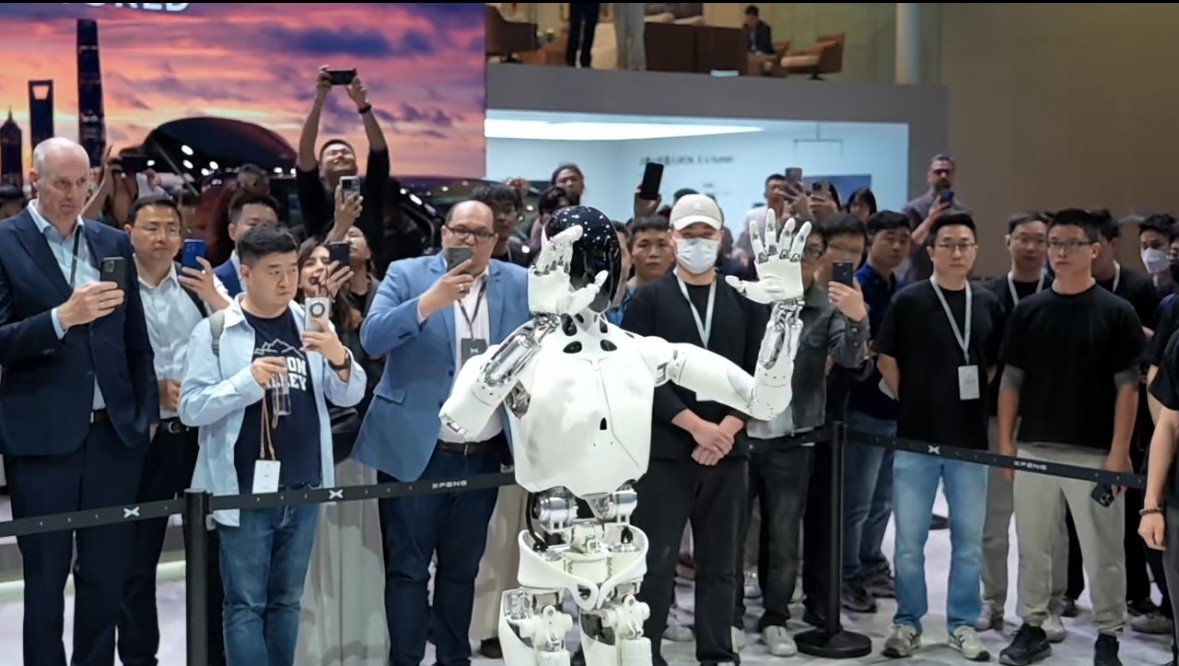
Xpeng disclosed on 28 October that the solid-state battery built specifically for its IRON humanoid has completed small-batch production, and that the robot itself has reached the final stage before formal mass production.
The detail came from group vice-president Gu Jie, speaking at the embodied intelligent robot conference held alongside the annual meeting of the China Society of Automotive Engineers. It was the first time Xpeng has published anything about a robot-specific solid-state cell.
The specification that matters is mass
Against a conventional liquid lithium pack, Xpeng says the new pack is about 30 per cent lighter and delivers about 30 per cent more usable energy. Those two numbers compound: lighter cells mean smaller actuators for the same payload, which means a smaller structure, which means less mass again.
Weight is the binding constraint on humanoids in a way it never was on cars. A vehicle can add 40 kilograms and lose a fraction of a percent of range. A bipedal machine that adds 40 kilograms has to carry it on every step, and the gait controller pays for it in balance and battery drain.
Safety engineered for a machine that walks
The pack is built with a thermal-runaway-propagation-resistant layout and has passed impact and nail-penetration testing, according to the company. For a stationary installation that is a compliance item. For a humanoid working in a shop or a showroom, surrounded by people, it is the design case.
This is where the robot business diverges from the vehicle business. Automotive pack engineering assumes a crash structure, a underbody and a cooling circuit with room to breathe. A humanoid has a torso, and everything inside it shares volume with the joints.
The supply chain is already locked
Xpeng held its first robot supply-chain partner conference on 22 September, bringing together suppliers in actuators, dexterous hands, sensors and AI chips. The company says it has completed supplier audits and designated core components, which is the step that usually precedes tooling rather than following it.
The published schedule is mass production by the end of 2026 and market delivery in 2027, with units going into Xpeng’s own stores and commercial sites for guiding and explaining. That is a modest deployment, and deliberately so. Retail floors are controlled environments with predictable floors.
Battery competence was built on the car side
The cell work is not new. In February 2026 Xpeng finished all-climate road testing on a pack with 78 per cent volume utilisation, 23 percentage points above a conventional liquid pack, and 35 per cent less weight. Chairman He Xiaopeng said in September that the company had invested in three cell manufacturers and would run the battery business in-house from 2026.
Running cells in-house is expensive and slow, and most robot makers will not do it. They will buy from CATL, EVE or a smaller specialist and accept whatever mass the supplier’s automotive programme dictates. Xpeng is betting that the pack is a competitive variable rather than a purchased part, which is the same bet Tesla made on the car side and the same reason its humanoid programme is vertically integrated.
Whether that bet pays depends on whether a robot-specific cell chemistry is genuinely different, or merely a smaller automotive pack with a different label. Xpeng has published the weight and energy delta. It has not published cycle life, cost per kilowatt-hour, or how many units small-batch actually means.
Editor’s note: This is an adapted translation of the original Gasgoo report. It has been trimmed and restructured for readability for an international business audience. The full original (in Chinese) is at https://www.gasgoo.com/apps/e060bad9eca91db7f01403fc7120041f/robot/news/70476289.