The shift at WAIC 2026 was not in any single product but in the script. Past editions debated what humanoid robots were even for. This year the answer was stacked on the booths: humanoids moving totes in warehouses around the clock, picking among 3,000 pharmacy SKUs, putting a Coke in the fridge and a dirty bowl in the dishwasher. The performative backflips were gone; real scenarios were everywhere.
Industry first
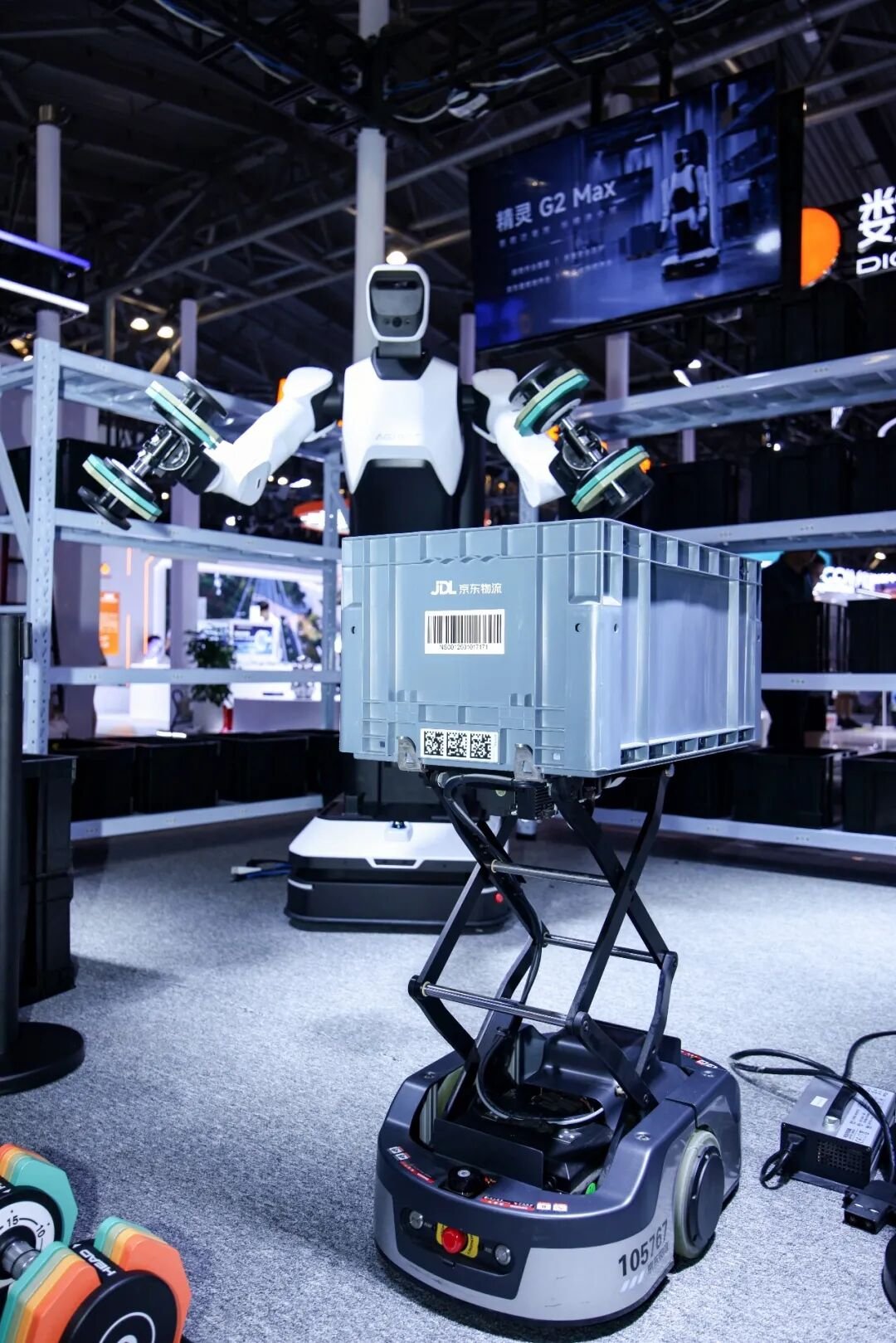
The factory floor was the clearest proving ground. AgiBot’s Spirit G2 Max, with JD Logistics, claimed the first humanoid deployment in a real warehousing line, running 24-hour palletising with no night shift. Galbot demonstrated a full chain, depalletise, transport, restack, using pure vision for centimetre-level positioning on randomly stacked boxes. Leju replicated a factory line with mass-produced humanoids handling carton and bin depalletising, already booked by more than ten clients including FAW, ZTE and Changhong.
Heavy payloads drew a different crowd. Fourier’s GRW wheeled dual-arm robot carries 16 kg; Kepler’s “Qilin” quadruped weighs 300 kg and hauls nearly a tonne for emergency and mountain work, a reminder that reliability, not generality, is the moat in harsh settings.
Coordination becomes standard
Multi-robot scheduling turned up on booth after booth. AgiBot, Keenon, Youi and Sudo all demonstrated unified control of several machines. Youi’s “Xifeng” humanoids reached 90 per cent success after just 50 training demos, “trained today, productive tomorrow.” Sudo ran four robots through a full battery-module assembly line at 98 per cent grasp success.
The home is harder
Domestic tasks exposed the real divide: rooms get messy, objects move, needs differ. Qianxun’s Moz1 took a “tidy the living room” command, fetched a Coke, opened the fridge, and kept going to the dishwasher after a worker moved the cup, the “resume after interruption” skill that separated the serious players this year. Fourier showed companion bots; several startups reported paid home deployments already running.
The throughline: single machines are mature enough that the industry is now thinking in systems, and the companies that win will be those whose single-unit competence is real enough to coordinate.
Read the original report (LeiPhone)
Translated and adapted from LeiPhone (leiphone.com).