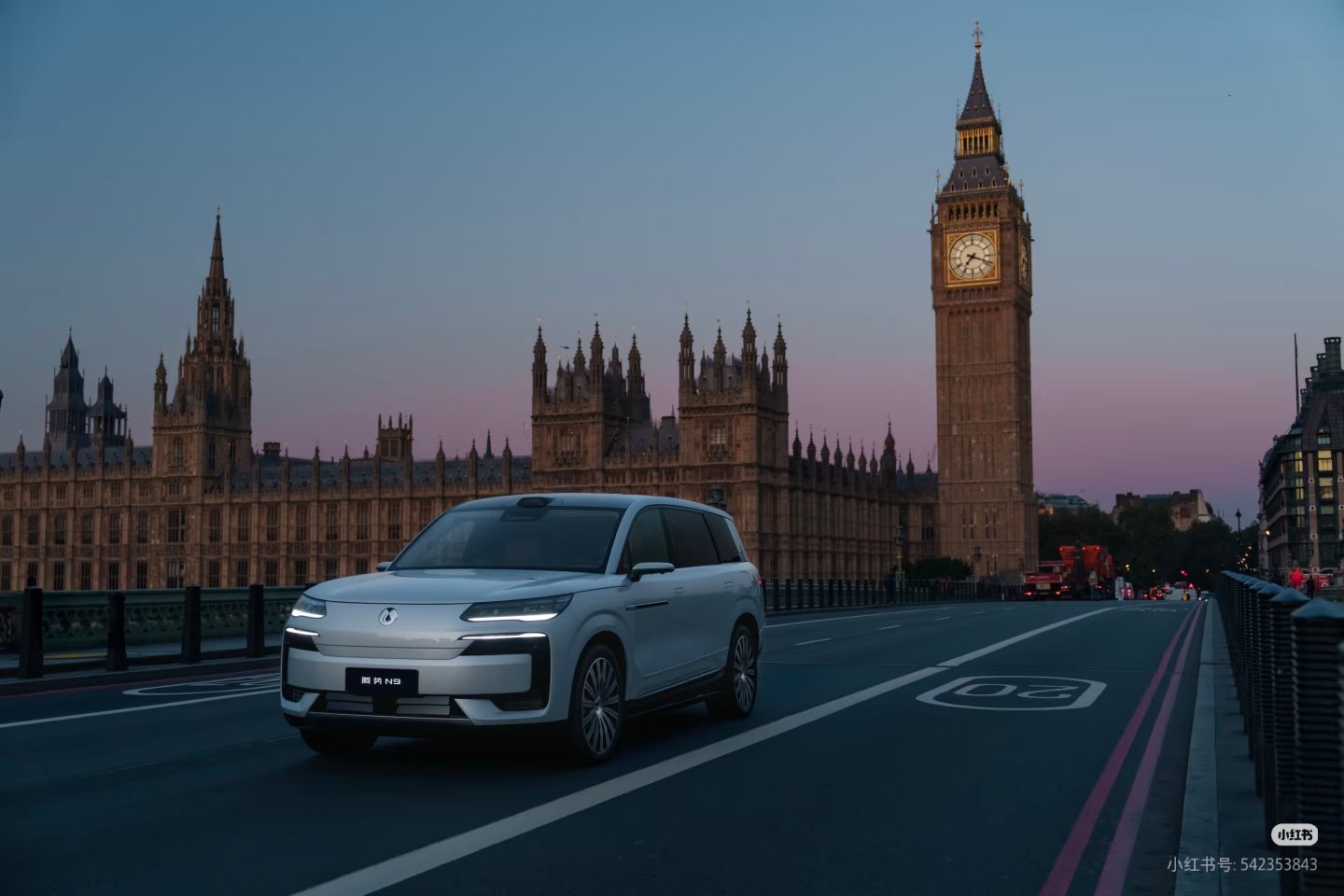
The Chinese Invasion
The Chinese EVs conquered Australia. Will Britain be next?
To see the future of Britain’s roads, look to the Antipodes. The data suggests an historic changing of the guard is imminent: Chinese marques are on course to overtake the established Japanese players by 2027—or perhaps even sooner.
Robot Belt Team | London, Sydney and Shanghai
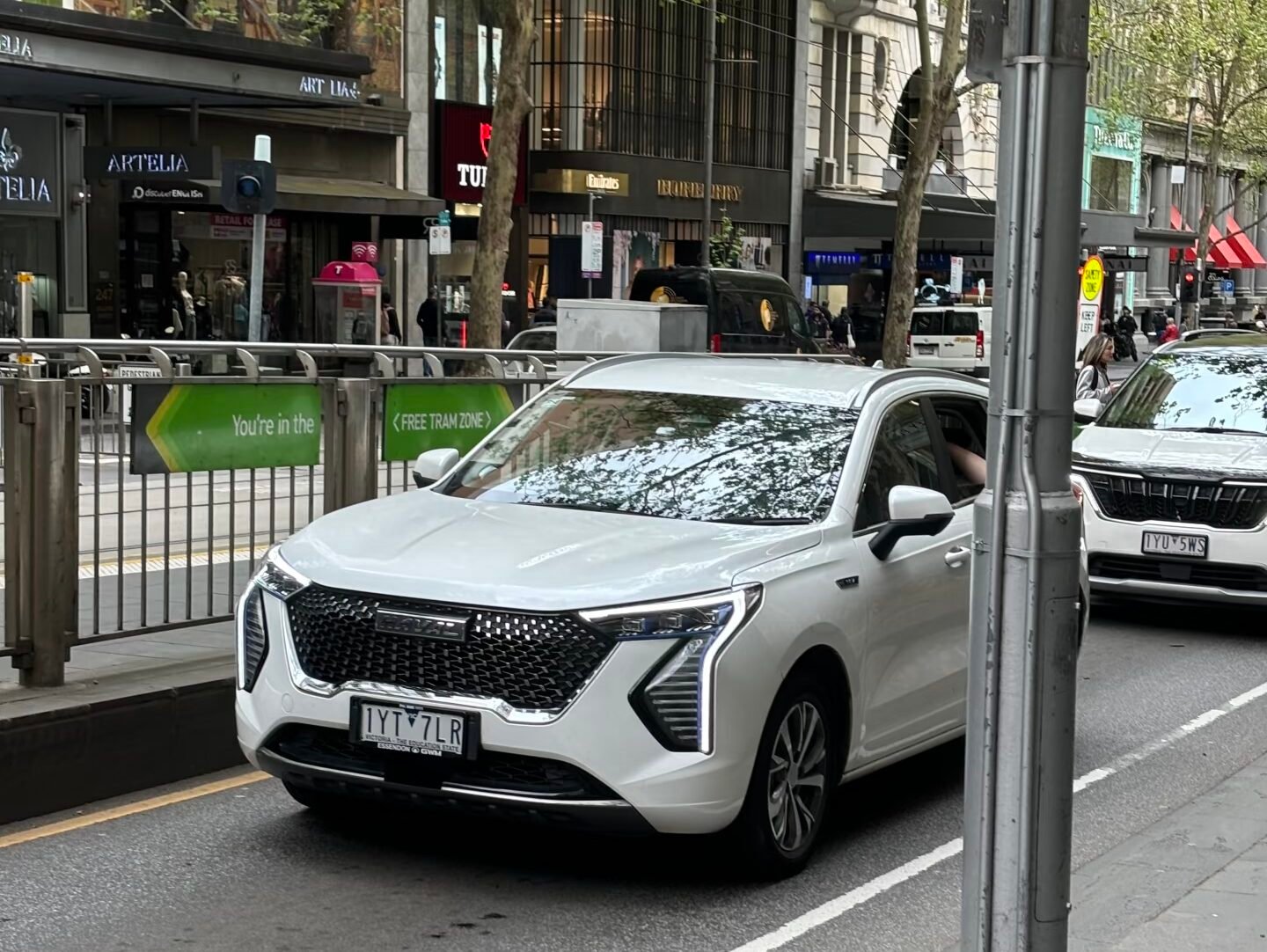
ECONOMIC GEOGRAPHY OFTEN relies on leading indicators. For the British motor trade, the most flashing red light on the dashboard is currently found 10,000 miles away. Australia, a fellow right-hand-drive market, has effectively served as a laboratory for the Chinese automotive invasion. The results of that experiment are now in, and they offer a stark prophecy for the United Kingdom.
The vacuum and the slaughter
However, it is a mistake to view the past five years as a direct duel between Beijing and Tokyo. In reality, the relationship has not been one of ebb and flow, but rather of opportunistic scavenging. Chinese marques have essentially feasted on the leftovers of a retreating Western mass market. When Ford axed the Fiesta—Britain’s best-selling car for 12 years—and General Motors (via Vauxhall) abandoned the budget hatchback segment to chase higher margins, they left a vacuum in the market. Chinese EVs simply rushed in to fill it. This was the “phoney war”: a period of non-violent growth where China captured the abandoned working-class segment without truly crossing swords with the Asian incumbents. That phase is now history. As of early 2026, Chinese brands have breached the psychological 10% market-share threshold. This is the tipping point. The easy growth is over; the vacuum is full. From this moment on, the real slaughter begins. Every percentage point gained by China must now be torn directly from the flesh of the established competition, with the Japanese marques standing directly in the firing line.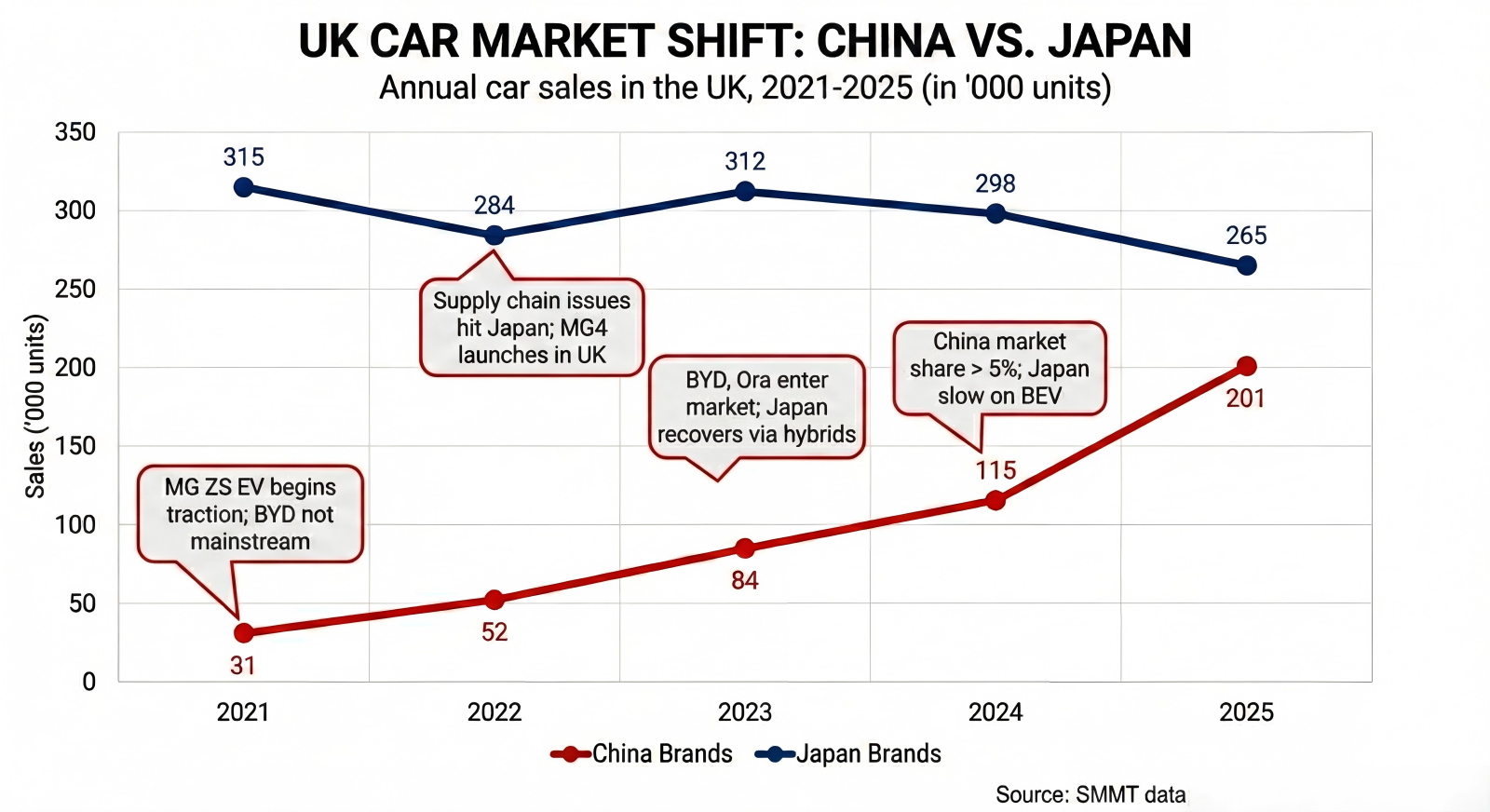
The “Kill Line”
The numbers tell a story of inevitable intersection. In 2021, for every ten Japanese cars registered in Britain, there was barely one Chinese car. The ratio was a comfortable 10:1. By 2025, that gap had crumbled to a precarious 1.3:1. Extrapolating this trend using the Australian coefficient, the crossover is mathematically locked in for 2027. For the Chinese manufacturers, this intersection represents a “Golden Cross”—the moment their momentum becomes irreversible. But for the Japanese incumbents, it represents something far darker. In the boardrooms of Shenzhen and Shanghai, this threshold is widely referred to as the “kill line” (斩杀线). Borrowed from gaming terminology, the “kill line” in this context signifies the point of no return. It is the moment where the challenger’s scale becomes sufficient to undermine the incumbent’s margins, forcing a retreat in dealership networks and brand presence. If the current momentum holds—specifically, if BYD continues its triple-digit growth—this kill line could be crossed as early as late 2026. Such an event would be a geopolitical earthquake for the global car industry. Japan has treated the British market as a safe harbour since the 1980s, anchoring its European strategy on reputation and local manufacturing. To be overtaken by newcomers who were virtually unknown five years ago would represent a catastrophic failure of defensive strategy.The Innovation Trap
Why is Japan losing ground? The answer lies in the “Innovator’s Dilemma”. Japanese giants, particularly Toyota, have spent the last five years fiercely protecting their niche in petrol-electric hybrids. It was a profitable strategy, but a myopic one. While they defended the technology of the 2010s, China cornered the market on the technology of the 2020s. The contrast is stark. Walk into a Toyota or Honda showroom in Britain today, and the battery-electric options are sparse, expensive, and technically underwhelming. Walk into an MG or BYD dealership, and the electric offerings are plentiful, immediate, and technologically superior. The Chinese are not beating the Japanese at their own game; they are changing the sport entirely.The only brake is financial
There is, however, one friction point that could delay the 2026 shock: the brutal calculus of the second-hand market. Here, the Australian crystal ball clouds over. In Australia, private buyers dominate. In Britain, fleet managers and leasing companies hold the keys. These actuaries are currently spooked by the plummeting residual values of Chinese EVs—a predicted three-year loss of 60% or more for some models. If British leasing firms decide that Chinese cars are too risky to underwrite, the flow of new vehicles could be throttled, granting the Japanese a temporary reprieve.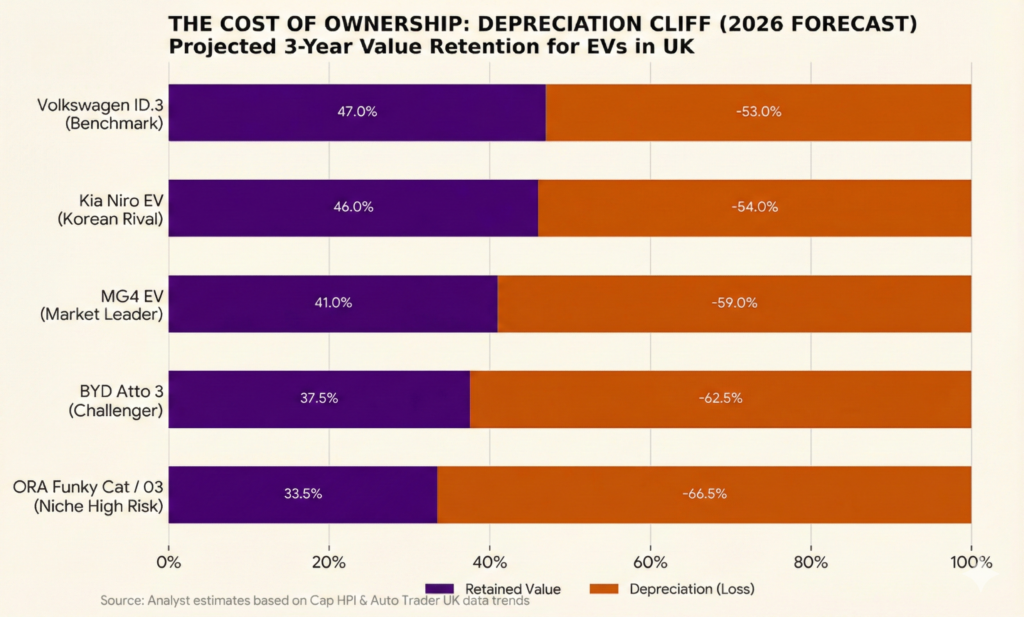 But this is likely a speed bump, not a barricade. The Chinese manufacturers have deep pockets and are already moving to subsidise lease rates and guarantee future values, effectively buying their way out of the “trust deficit”.
The writing is on the wall, and it is written in simplified Chinese characters. Australia has shown that once the price-to-technology ratio tips in China’s favour, loyalty to established badges evaporates with startling speed. Unless the Japanese incumbents can conjure a miracle, 2026 may well be remembered as the year they finally ceded the road to their neighbours. ■
But this is likely a speed bump, not a barricade. The Chinese manufacturers have deep pockets and are already moving to subsidise lease rates and guarantee future values, effectively buying their way out of the “trust deficit”.
The writing is on the wall, and it is written in simplified Chinese characters. Australia has shown that once the price-to-technology ratio tips in China’s favour, loyalty to established badges evaporates with startling speed. Unless the Japanese incumbents can conjure a miracle, 2026 may well be remembered as the year they finally ceded the road to their neighbours. ■