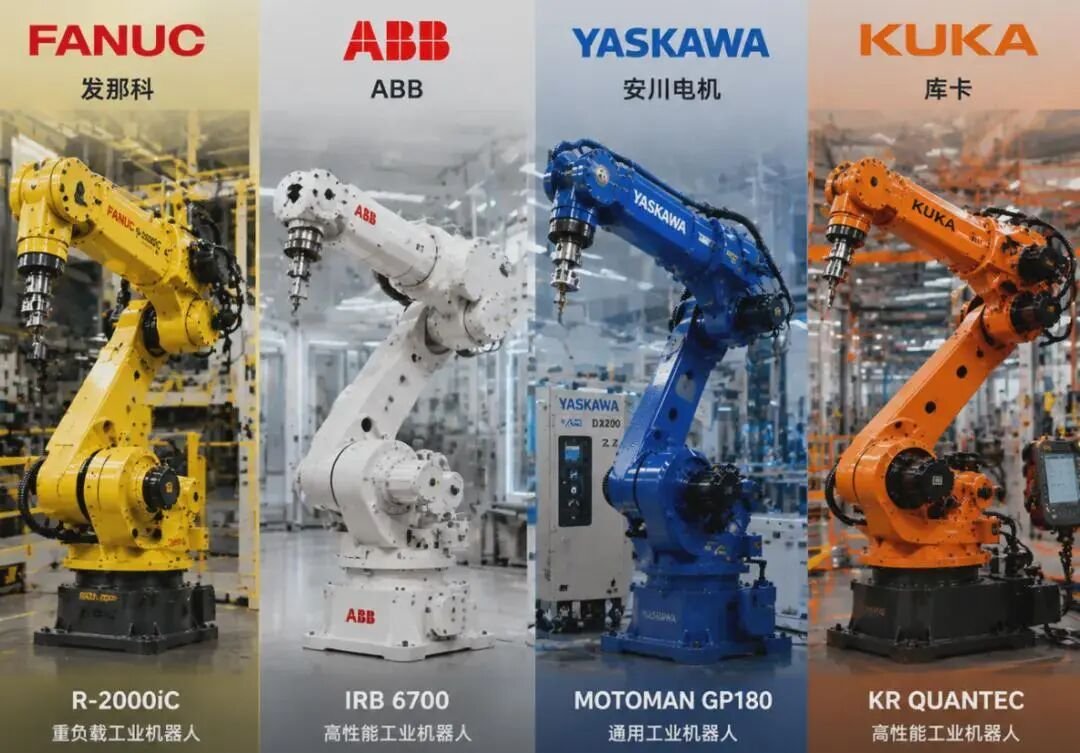
Fanuc’s share of China’s industrial robot market has fallen from more than 20 per cent at its peak to 9 per cent, according to first-quarter 2026 figures. Over the same period Estun, KUKA and Inovance each held 10 per cent, and Yaskawa was down to 4 per cent. Domestic brands collectively passed 55 per cent of the market for the first time, overtaking the foreign incumbents.
This is not a company in decline. Fanuc’s fiscal 2025 revenue reached 857.8 billion yen, up 7.6 per cent and a record, with an operating margin of 21.4 per cent and cumulative global installations above one million units. The China loss and the global gain appear on the same income statement, which is precisely the puzzle.

The deal
On 30 September Fanuc and Hitachi announced a strategic partnership covering joint validation and commercial deployment of physical AI, combining Hitachi’s AI capability with Fanuc’s industrial robots.
In the validation phase, Hitachi’s Ibaraki facilities are being used as what the companies call Customer Zero. The AI learns site-specific rules continuously during production: how to grip parts of differing shapes, what setup changes are needed when a line switches product. From fiscal 2027 the two companies plan to market the combined system to global customers across nine industries, including semiconductors, pharmaceuticals, automotive and shipbuilding.
The market read it as good news. Hitachi’s shares reversed an earlier 72 yen decline on the day, and Fanuc closed up 0.96 per cent.
What Fanuc is actually short of
Fanuc’s vertical integration is not in question. Servo motors, reducers, controllers and CNC systems are all built in-house, and a Fanuc line running for a decade without failure is unremarkable in the industry. Nobody replaces a ten-year-old Fanuc cell to save 10 per cent on the hardware. That trust took forty years to accumulate.
Physical AI changes the axis of competition. For thirty years the contest was precision, speed and reliability. Now it is whether the robot can judge for itself: understand the goal, adapt to a changed environment, complete a complex operation without an engineer programming each step.
Fanuc’s robots have the strongest bodies in the industry. Their weakness is a specific absence of data: the non-standard, undocumented knowledge of a real manufacturing floor. Simulation and imitation learning do not capture what an experienced operator knows by feel, such as how much a new batch of parts differs, which parameter needs a nudge during a changeover, or where the cycle-time bottleneck hides in a particular work cell. That knowledge lives in engineers’ heads, not in a dataset.
Hitachi has the factories, the processes and the accumulated operator experience. What comes out of those plants cannot be manufactured in a laboratory.
Customer Zero as an AI version of genchi genbutsu
The structure of the partnership borrows from the Toyota Production System. Lean manufacturing runs on genchi genbutsu, going to the actual place to see the actual problem and make the actual improvement. Fanuc and Hitachi are moving that improvement loop out of the engineer’s head and into a model, so that every setup adjustment and every difference in grip force becomes reusable capability.
This is more practical than a digital twin. A twin always leaves a gap between the simulation and the shop floor: lighting, dust, part tolerances, equipment ageing. Hitachi’s approach skips the simulation and uses the factory itself as the training ground.
What it means for Chinese competitors
In the short term the combination does not increase competitive pressure on Chinese robot makers. The target industries, semiconductors, pharmaceuticals and shipbuilding, are segments where Chinese vendors have low penetration. The direct fight with Estun and Inovance is in the mid-range domestic market, a different contest entirely.
The private-market implication is more interesting. For two years the valuation anchor in embodied AI has been bodies plus data, with more robots and more data implying a higher mark. Fanuc and Hitachi suggest a different rule: what matters is not the volume of data but whether it is real. A hundred-year-old manufacturer with functioning production lines may hold data that is scarcer than a startup’s synthetic dataset.
That is an uncomfortable thought for companies whose valuations rest on generated data. It is a useful one for anyone trying to work out where the next round of industrial AI value will settle.
Fanuc lost share in China and went looking for the data it could not build. Whether the brain, body and real-scenario package works in high-barrier industries by fiscal 2027 decides whether Fanuc keeps the industrial robot throne or gets moved off the table by the same wave it is now buying into.
Editor’s note: This is an adapted translation of the original OFweek report. It has been trimmed and restructured for readability for an international business audience. The full original (in Chinese) is at https://robot.ofweek.com/2026-10/ART-8321202-8420-30708402.html.