On the evening of 12 October, the Ministry of Finance and the tax administration published a notice that repriced Chinese car exports: from 1 April 2027 the VAT export rebate on new energy vehicles falls from 13 to 9 per cent. The change covers 67 product lines, taking in battery-electric passenger cars, plug-in hybrids including range-extenders, and electric commercial vehicles. Combustion models keep the full 13 per cent.
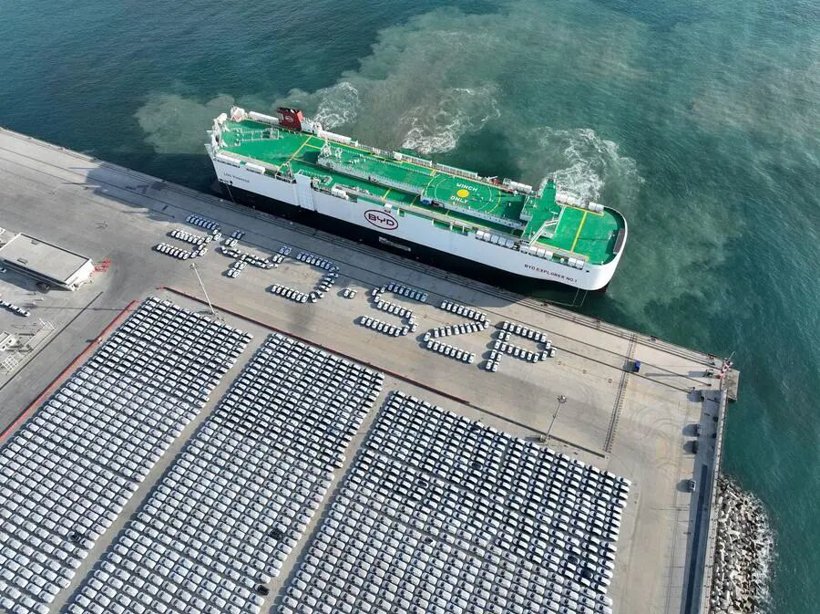
Four percentage points sounds like an accounting detail. It is not. Deutsche Bank calculates the change cuts about RMB 5,000 from the net profit of every BYD vehicle exported. JPMorgan’s sensitivity test, assuming companies do not raise prices at all, puts the 2027 earnings impact at roughly 18 per cent for BYD and Leapmotor, about 10 per cent for Geely, and 6 to 8 per cent for GWM and Chery. Bernstein’s read is colder still: given the intensity of competition, prices will not rise, so the impact lands on margin.
The four-point bill
Exposure differs sharply by company. Overseas revenue accounted for 52.4 per cent of Chery’s 2025 sales, 41.1 per cent at GWM, 38.7 per cent at BYD, 23.2 per cent at SAIC, 21.4 per cent at Geely, 20.2 per cent at Changan and 17.6 per cent at GAC. The buffer differs too, with overseas gross margins of about 26 per cent at Geely, 19.5 per cent at BYD and Changan, 16.7 per cent at GWM and 12.9 per cent at SAIC, whose vehicle business runs at 4.3 per cent.
Because only new energy vehicles were repriced, combustion-heavy exporters get a breathing window. BYD, at 100 per cent new energy, takes the hit first, though its near-20-point overseas gross margin can absorb it. Wanjian Securities expects smaller carmakers and trading houses without scale or overseas systems to be pushed out fastest.
The incumbents have been here before. China paid RMB 2.13 trillion in export rebates in 2025, 12.1 per cent of tax revenue and the highest share since 2008, in a year when general public budget revenue slipped 1.7 per cent. New energy vehicle exports reached 4.006 million units in the first nine months of 2026, 48.8 per cent of all vehicle exports and 1.3 times the prior year.
Who actually pockets a rebate
Empirical work on Chinese VAT rebates finds that roughly a third of any rate change is passed through to foreign buyers as lower prices. Exporters describe the same thing from the other side of the table: overseas buyers treat the 13 per cent as an automatic discount and deduct it before agreeing a price. Cutting the rate removes a margin that was already being shared. For a business built on the arbitrage it is fatal. For a company with genuine product pricing power it is a diet, not an amputation.
There is a technical detail European buyers should note. The rebate applies only to cars declared for export from China. The German trade press has already advised fleet customers that Hungarian-built BYD vehicles are unaffected and that prices should be locked before April 2027. Because the transition turns on the customs declaration date, a pull-forward in first-quarter 2027 exports is close to certain.
Why Beijing did it now
Three days before the notice, China and the EU reached an understanding in Beijing on hybrid vehicle trade. Thirty-nine days before that, the commerce ministry and two other departments issued guidance warning carmakers against predatory pricing abroad.
The timing is not accidental. When the European Commission opened its anti-subsidy investigation in 2023, it formally listed export rebates among the alleged subsidies. Beijing argued the reading was wrong. The final duties were calculated mainly on land, financing and grants, but in a politicised trade environment a 13 per cent rebate is a ready-made exhibit. Nine per cent does not buy the removal of a single tariff. It dilutes a narrative.
Europe’s own research has been chipping at that narrative for years. A study commissioned by the European Parliament found Chinese-brand electric cars sell in Europe at prices materially above their Chinese list prices, with no sign of dumping, and Bruegel has questioned the Commission’s subsidy arithmetic. The real barrier for Chinese carmakers in Europe has always been brand, distribution, service and compliance.
That is why the localisation map matters more than the rebate line. BYD’s Hungarian plant is near completion, Chery is preparing a Spanish site, and Leapmotor is building through Stellantis capacity. Tariffs, quotas and rebate cuts all apply to cars exported from China. None of them apply to cars built in Europe.
Editor’s note: This is an adapted translation of the original Gasgoo report. It has been trimmed and restructured for readability for an international business audience. The full original (in Chinese) is at https://auto.gasgoo.com/news/202610/26I70475869C501.shtml.