A humanoid robot that can perform a backflip may still be unable to put down an egg gently.
Cameras can locate an object and a large model can plan a path to it. The problem starts at contact. The robot does not know how much force it is applying, whether the object is slipping, or when to let go. These are hands that can see and cannot feel.
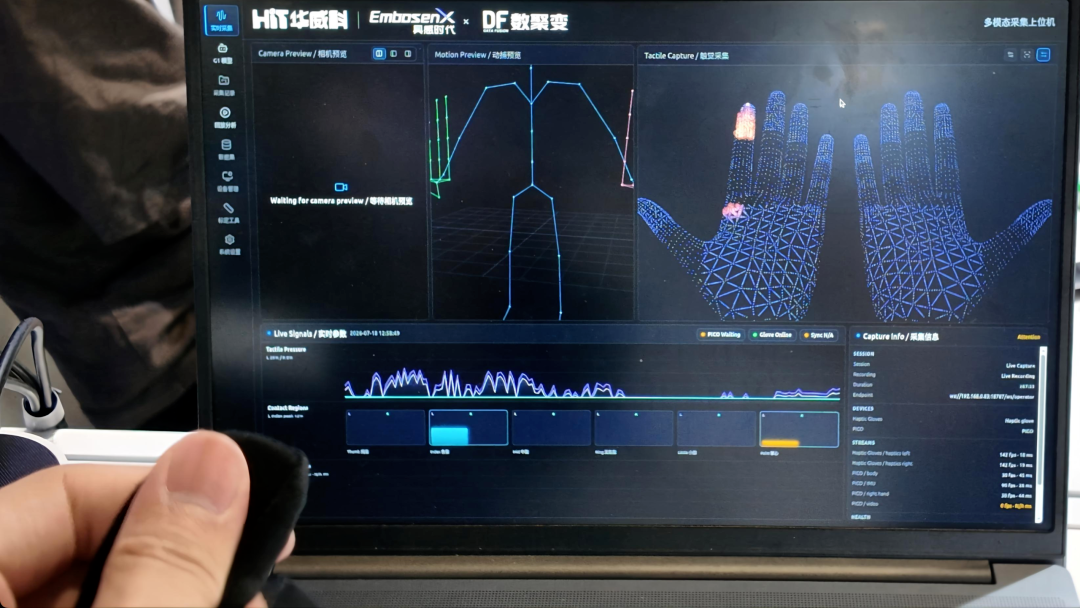
In 2026, touch became an investment theme. The capital arrived before the production line did.
Thirty deals, twenty companies, RMB 5 billion
According to Gasgoo Embodied Intelligence’s own count, the domestic embodied tactile sector disclosed about 30 financing rounds involving 20 companies between January and October this year, with disclosed amounts totalling more than RMB 5 billion.
PaXini alone took over RMB 2 billion of that: more than RMB 1 billion in a March B round, RMB 1 billion in strategic funding in August, and several hundred million in a B++ round in September. Cumulative funding has passed RMB 4 billion and its post-money valuation has crossed RMB 10 billion. The company has completed IPO tutoring filing with the Beijing branch of the securities regulator, aiming to become the first tactile-focused listing on the A-share market.
Tashan Technology completed its shareholding reform in roughly the same window, which the market read as a signal of an intent to list. It has closed three rounds this year. Founded in 2017, the company has disclosed 14 financing records in total.
Yimu Technology, Daimon Robotics, Qianjue Robotics, Wujie Zhihang, Jianzhi Robotics and Shutu Technology each closed one to three rounds this year.
The attach rate is the honest number
Gasgoo Embodied Intelligence estimates the global humanoid perception systems market at RMB 3.88 billion in 2026, rising to RMB 11.9 billion by 2030 in the base case, a compound annual growth rate of about 60 per cent.
Tactile grows steepest inside that. Actual fitment on humanoid robots was only about 2 per cent in 2025, and is expected to reach about 80 per cent by 2030, the fastest increase of any perception subsystem.
The physical coverage is expanding at the same time, from fingertips to finger pads, palms, arms, torso, legs and soles. Tesla’s Optimus Gen 2 carries tactile sensors at all ten fingertips, and Figure has made fingertip tactile standard on later iterations. Xiaomi’s latest high-degree-of-freedom bionic hand carries 1,500-point full-palm tactile coverage. The most aggressive work is large-area body electronic skin including the soles: Juqiao Industrial has built a customised glove, vest and sole set for Unitree, now in sample and small-batch validation, and PaXini has launched a sole sensor, the PX-FOOTRIX, that distinguishes ground hardness and adjusts gait.
Dexterous hands are the fastest-penetrating segment. Tashan Technology’s vice president for market and ecosystem, Fu Yihui, said the share of hands fitted with tactile was about 20 per cent in 2025, rose to roughly 60 per cent in the fourth quarter, and is still climbing.
The revenue does not come from humanoids yet
Tashan reports monthly deliveries in the tens of thousands of tactile sensors, and claims more than 80 per cent share of the humanoid tactile sensor segment on its own count.
Its revenue mix explains the stage of the market. In 2024 the business was dominated by automotive. In 2025 robotics contributed nearly half of revenue, with growth of more than tenfold. This year the company expects robotics to exceed automotive by three to four times, at about two thirds of annual revenue.
PaXini claims cumulative shipments of more than one million of its own tactile sensing chips over the past year, more than 1,000 customers, a repeat rate above half, and coverage of 70 to 80 per cent of humanoid body customers.
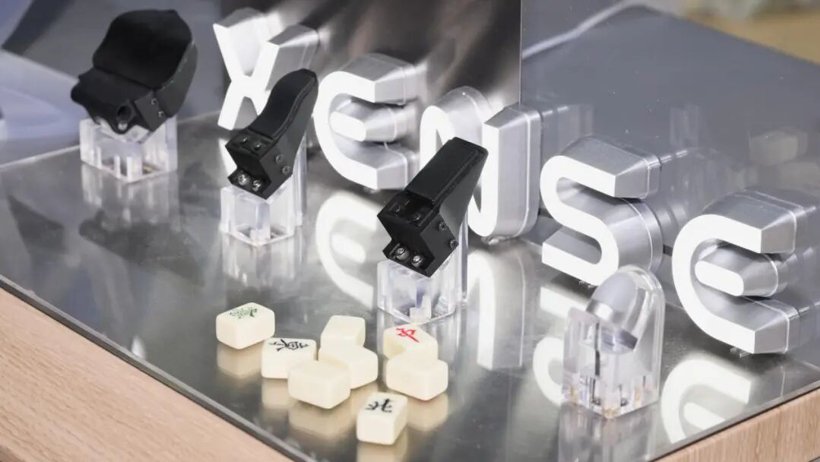
Daimon Robotics has shipped vision-tactile devices at the ten-thousand-unit level to more than 200 customers worldwide.
But these shipments do not all reach humanoid robots. Huawei Keji is the clearest example. Its tactile products are fitted to more than 30,000 dexterous hands, it claims over 70 per cent of the robot tactile electronic skin market and coverage of more than 85 per cent of companies in the sector, and yet its automotive-grade cockpit flexible electronic skin line has shipped more than one million pieces. The two figures are not the same order of business.
Tashan’s robotics revenue also spans humanoid bodies, dexterous hands, data collection and collaborative robots. The portion that actually ships inside a humanoid robot remains small batch.
The summary is blunt. Humanoid body customers are growing quickly from a very small base, and contribute valuation imagination more than revenue. Money is flowing into touch while deployment has not caught up, which is the most accurate description of 2026: hot in capital and expectation, cold in real humanoid shipments.
Why touch waited until 2026
Touch is not a new technology. MIT built the first GelSight prototype, a vision-based tactile sensor, in 2009. For years GelSight survived on surface inspection in aerospace and automotive. Humanoids pushing dexterous hands into the foreground is what pulled the technology back out.
The reason for the timing is simple. Touch exists to serve work, so there has to be a robot that goes into the real world and actually works before touch has a reason to exist.
For two years humanoids were showing capability, walking, running, jumping and performing simple grasps. Those tasks demand very little tactile feedback and can be handled with vision plus preset programs. In a demonstration-driven phase, tactile sensors were a high-technology ornament rather than a requirement.
In 2026 the emphasis changed. Robot makers began talking about going into factories to work, and about machines holding a post independently in real environments.
Vision handles global perception. It identifies position, shape and size and plans an initial grasp pose. It cannot know hardness, friction or actual contact state, and occlusion or reflection will break a vision-only grasp outright.
Daimon partner and chief business officer Zhang Dong put the requirement plainly: in precision assembly, flexible grasping, and operations on transparent or reflective objects, vision alone cannot close a reliable loop. The robot needs touch to judge whether contact has occurred, whether grip force is correct and whether the object is sliding, and to adjust in real time.
In early demonstrations robots often dropped objects, purely because without touch they did not know when to let go. Picking up a water glass is the standard case. The eyes lock the position, and the moment the fingers touch the surface, touch takes over the whole process.
Tashan chief executive Ma Yang described the deficit as working with thick gloves on, with accuracy, speed and stability all discounted. FuLai New Materials AI algorithm director Liao Yongxing gave a measurable version: in fine manipulation such as picking up a pinch of salt, task success rate improves from 45 per cent to 75 per cent when tactile information is added. Loose material plus visual occlusion means vision alone cannot establish that contact happened.
The data argument behind the valuation
Huawei Keji chief executive Zhu Xiaohui argues that touch will be AI’s third core sensing modality after vision and hearing. Skin is the body’s largest and most complex sensory organ, sensing pressure, temperature, vibration and impact at once, and human beings cannot pick up an object or strike a match without it. For robots and physical AI devices, he describes touch as the last centimetre of human-like dexterity.
The stronger argument is about data. Large models are fed on data. Images and text can be scraped from the internet. Contact data cannot. It can only be generated by touching, one attempt at a time. The more a robot touches, the thicker its physical interaction sample, and the closer manipulation gets to reliable work rather than demonstration.
That is the reason capital will pay a valuation above RMB 10 billion for a sensor company. Selling sensors alone is a components business worth a few billion. Becoming the fuel for the model training flywheel maps, in an investment narrative, onto infrastructure worth tens of billions.
The tens of billions are conditional on two things: that the data is resellable, and that the data entrance is not closed off by the robot makers. Who ends up holding the source, the sensor companies or the OEMs, has no answer yet.
The cost curve is what makes deployment possible
Imported tactile sensors once cost up to RMB 100,000 per fingertip, which priced robots out of the category. Domestic suppliers led by PaXini have pushed prices down to the hundreds of yuan. The PX6AX GEN3 base model sells for RMB 199.
The mechanism is not a price war. It is a replacement of the cost structure. Early imported sensors used rigid cores, electrode arrays and liquid filling in a biomimetic structure, with complex manufacturing and calibration that never reached scale, landing at tens of thousands to RMB 100,000 per unit.
The mainstream route now uses more mature and more scalable devices and processes. Vision-tactile products from Daimon, Qianjue, Weitai and Yimu all contact the object with an elastomer and capture deformation with a built-in camera or optical chip, then reconstruct tactile information with algorithms. Compared with precision-instrument designs, this route wins clearly on device cost, miniaturisation and production feasibility.
Editor’s note: This is an adapted translation of the original Gasgoo report. It has been trimmed and restructured for readability for an international business audience. The full original (in Chinese) is at https://auto.gasgoo.com/news/202610/28I70476019C601.shtml.