A bipedal robot runs for one to two hours on a charge, and most of that charge is spent staying upright. LimX Dynamics has built a version that skips the problem by removing the legs.
The Shenzhen embodied robotics company worked with ZINOVA, a physical AI developer, on a hybrid configuration that takes LimX’s TRON 2 dual-arm torso module and mounts it directly on the end of a large six-axis industrial robot arm.
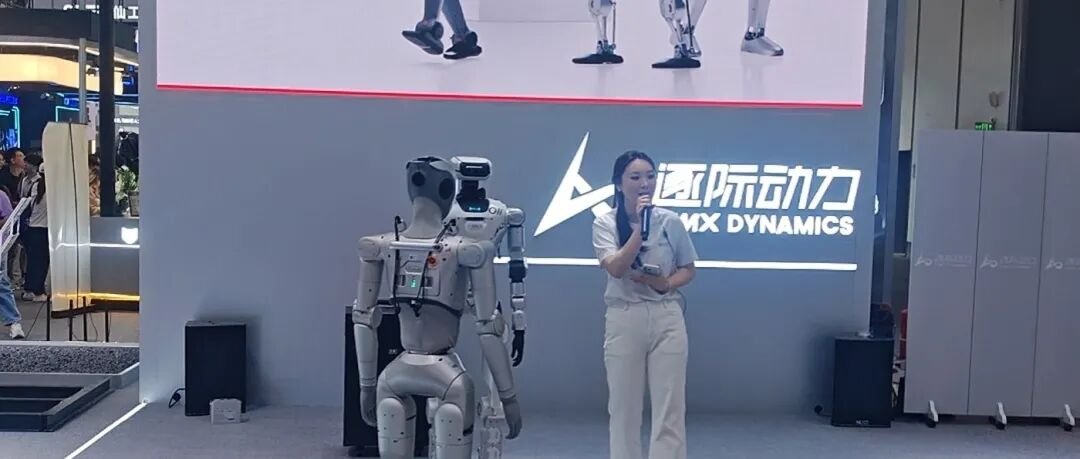
The machine combines the working envelope of a large crane with the manipulation of a human pair of arms. The industrial arm handles extension, rotation and high-rigidity load bearing, lifting the humanoid torso to working faces 15 to 30 feet above ground. The dual arms then hold pneumatic nail guns and timber, assembling formwork frames in coordination, before laying and tying rebar across multiple levels.
Walking quietly consumes half the compute budget
Keeping a bipedal robot stable on uneven ground is expensive in a way that rarely appears on a specification sheet. Trajectory planning, zero moment point compensation and model predictive control all have to run in millisecond loops, while lidar, depth cameras and inertial navigation stream fused data back at high frequency.
In mainstream full-size bipedal development and testing, most onboard compute and sensor bandwidth goes into base stability rather than into the work the robot was bought to do.
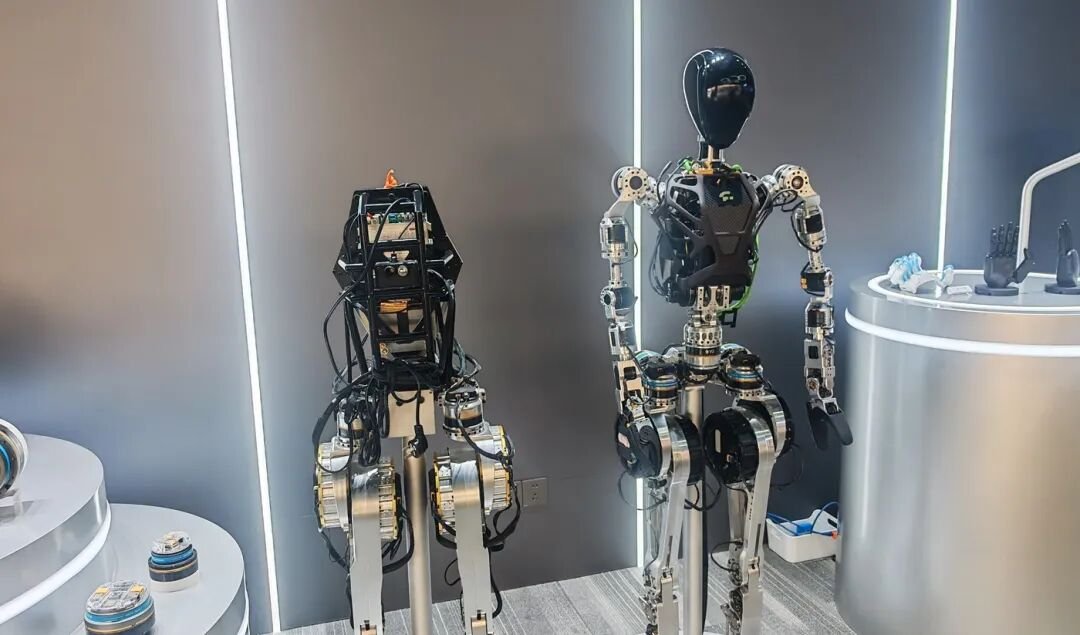
The power budget is the harder constraint. Bipedal walking requires more than a dozen servo motors in the lower limbs to work continuously against gravity, holding whole-machine consumption in the hundreds of watts to several kilowatts. Most bipedal robots on the market deliver one to two hours per charge, with the majority of the energy spent on not falling down.
A factory measures something else. Whether the process is assembly, fastening, sorting or grinding, the value sits in what the end effector does at millimetre precision. Whether the base walks, rolls on rails or stays fixed has little effect on yield or takt time.
Heavy work exposes the structural problem
Industrial production is full of contact forces and reaction forces. When a worker drives a bolt with a high-torque electric wrench, or fires a steel nail with a pneumatic gun, the instantaneous recoil demands very high support rigidity.
The human body absorbs it through muscle pre-tension and micro-adjustment of the centre of gravity. A bipedal robot with rigid mechanical connections has no equivalent. Because the ground contact area of two feet is small, whole-machine support rigidity is inherently weak. When the arms take tens of kilograms of reaction force, the impulse travels up the arm into the torso and forces ankle and knee actuators into high-frequency extreme compensation. The end effector wobbles, precision is gone, and a little more force tips the machine over.
This is why bipedal robots have largely been limited to carrying light material boxes in testing. On hammering, drilling and other hard-contact processes, the weak base cannot be hidden.
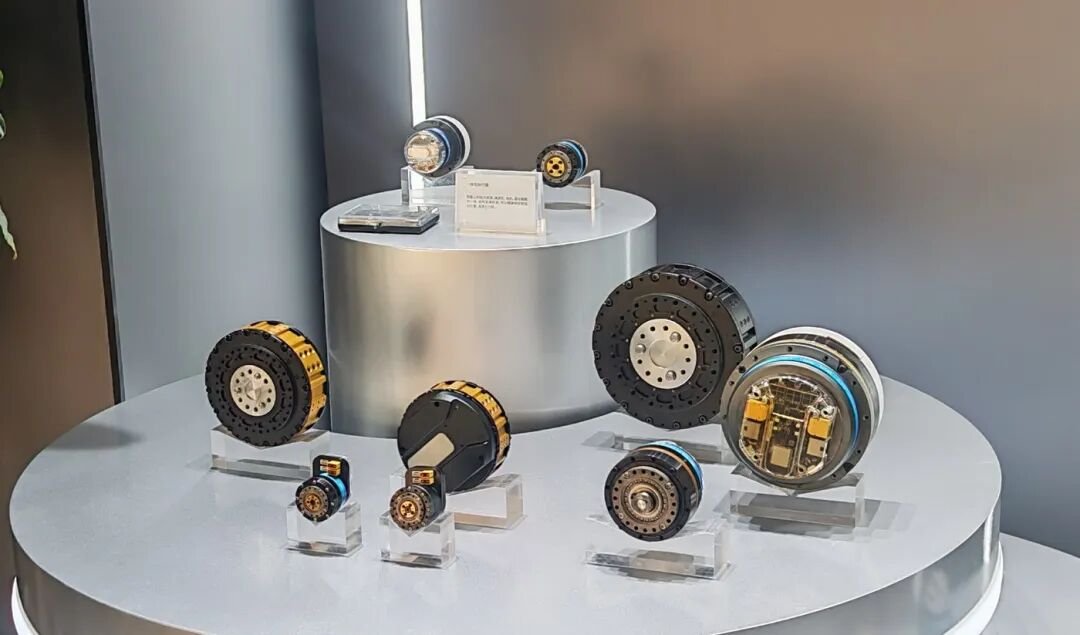
The hybrid configuration solves it by buying rigidity. A large industrial arm weighs hundreds of kilograms to several tonnes, with its base anchored to the floor or a heavy rail, giving very high mechanical rigidity and torsional resistance. In this architecture the arm absorbs most of the recoil from nailing and drilling while providing a wide three-dimensional workspace. With no lower-limb balance burden, sensors, compute and degrees of freedom all go to the hands.
Learn from how people use tools, not from how people look
ZINOVA founder Xu Ziyou set out the design principle directly: the breakthrough in physical AI should not be confined to any single robot form, and the core task is teaching algorithms to understand, grasp and operate the mature tools humans already have.
According to LimX, the TRON 2 algorithm stack focuses on general tool grasping, force and torque contact feedback, and cross-form adaptation. The robot visually identifies off-the-shelf industrial nail guns, plans its own palm grip pose and trigger action, then uses force sensors to read the vibration and resistance of the tool against timber.
In operation, one robot holds and aligns the boards while a second delivers the nail gun to the seam and fires. The nail gun needs no pneumatic interface rebuild and no digital retrofit. Handing an existing industrial tool to the algorithm removes the cost of purpose-built machinery for each process, and avoids the detour of making mechanical structures more complex in order to imitate human anatomy.
On a factory ledger, the arithmetic is not close
A full-size bipedal humanoid carries hardware and development costs running into hundreds of thousands, sometimes millions, of yuan. Maintenance is the worse problem. With many joints and complex loading, continuous stable operating time in harsh factory conditions is limited, and a fall on a production line is both expensive to repair and a stoppage risk for the whole line.
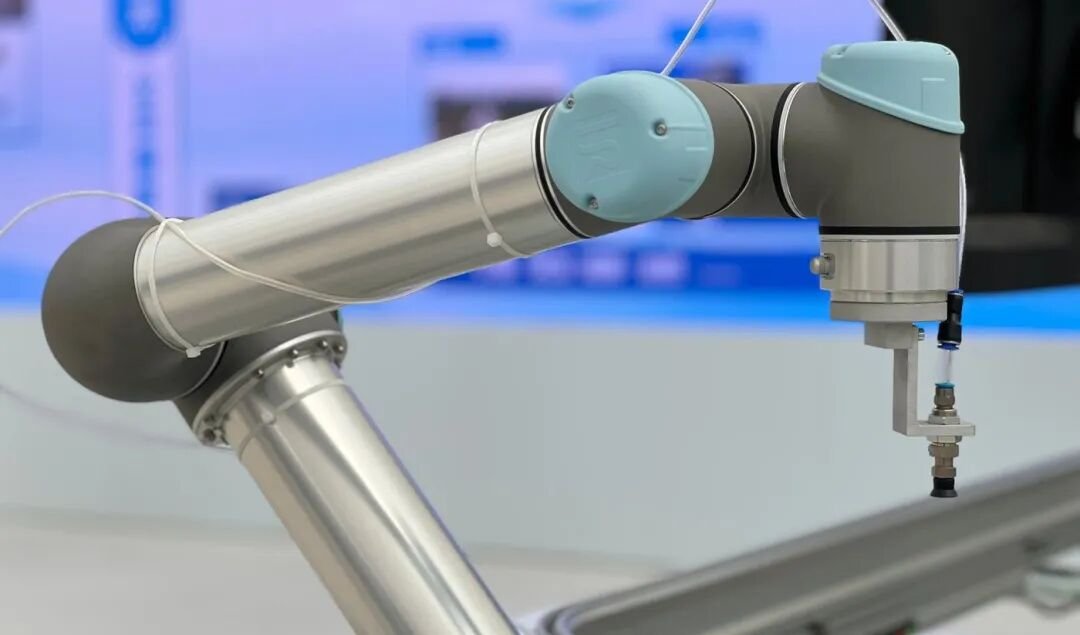
Conventional industrial automation is a different market. Robot arms and mobile bases have been competed over for decades, the supply chain is mature, and marginal hardware cost is very low. Mean time between failures reaches tens of thousands of hours, machines run year round in harsh conditions, and they plug directly into 380-volt factory power with no range anxiety.
LimX co-founder Pang Bo said that opening hardware and software interfaces so industry developers can validate quickly on a mature configuration is the necessary route to making embodied AI practical.
On the accounting side, the base and arm use mature low-cost industrial standard parts with very low failure rates, so the embodied solution only carries the incremental cost of dual-arm control and vision. The arms still do fine work, while borrowing the factory’s existing power, safety fencing and standard components.
Factory procurement is simple. It calculates payback period, output per unit and maintenance cost. A system mounted on an industrial arm that can drive thousands of steel nails at height without frequent stoppages, and with a base that does not move, is very difficult for a bipedal design to beat on a serious heavy-industry line.
The shakeout in embodied AI is the industry being forced by customers to do this arithmetic. Bipedal form retains genuine research value in special exploration and rescue. On a production line where seconds matter and tolerance for error is low, legs are not the point. Plant managers need hands that work, eyes that read the process and a brain that schedules. What they do not need is an expensive pair of mechanical feet that fall over.
Editor’s note: This is an adapted translation of the original OFweek report. It has been trimmed and restructured for readability for an international business audience. The full original (in Chinese) is at https://robot.ofweek.com/2026-10/ART-898890-8420-30709103.html.