Lingshu Zhifu, a Shanghai company founded in April 2025, has closed a seed and an angel round for a combined total above RMB 10 million. Oriza Holdings and Huawei Hubble took part in the seed, Oriza followed on in the angel, and Linglu Capital acted as sole financial adviser. The proceeds go to a pilot production line and customer sampling.
The company does not build robots. It builds the sense of touch that goes on them, using a materials route called ionic skin.
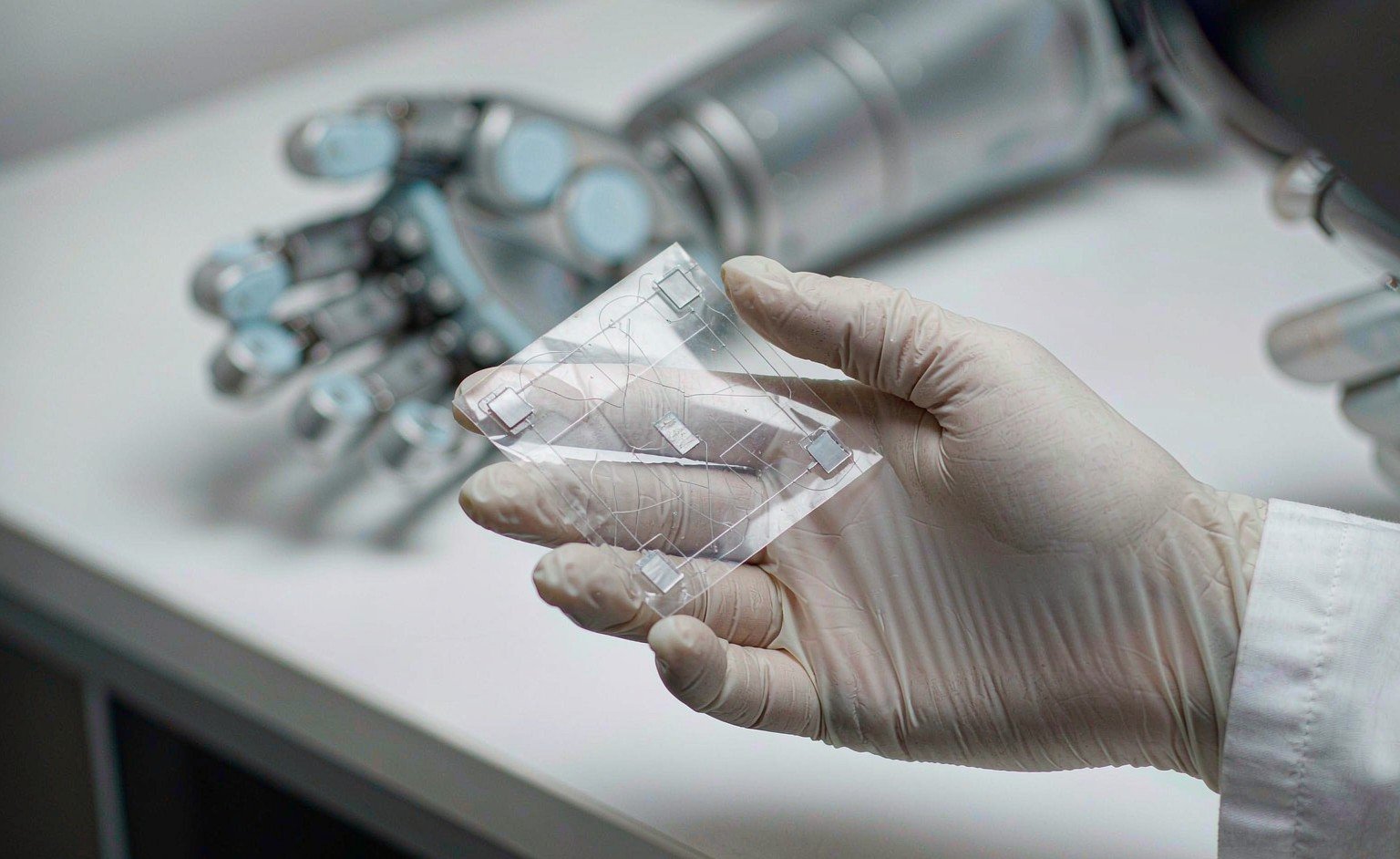
How the material works
Ionic skin embeds ions in a soft polymer substrate. Deformation moves the ions and generates an electrical signal. The material conducts ions rather than electrons, so it stays soft and can be worn against skin or wrapped over a dexterous hand like a glove. It registers what was touched, how hard, and whether the contact is sliding.
The chemistry leaves wide room for formulation, which is where the sensitivity and signal stability come from, and it can be layered with self-healing behaviour. Lingshu says the material has passed double 85 reliability testing and more than 10 million repeated mechanical cycles, and it has shipped a finger sensor and a fingertip plus palm module supporting tap, long press, slide and tangential force.
The founding team comes out of Fudan’s polymer science department, including founder Jia Wei, who completed his undergraduate, master’s and doctoral work there. That provenance explains the approach. Most tactile sensing companies in China come from MEMS or flexible electronics backgrounds and start from device design. This one starts from polymer chemistry.
Why touch is suddenly fundable
Tactile sensing has been called the last piece of the embodied AI puzzle, and money has been moving into electronic skin and tactile components through 2026. The reason is the same one driving data collection investment: vision tells a model where an object is, but not whether the grip is slipping.
The near term market is data gloves and dexterous hands, where a sensing layer raises the information content of every recorded demonstration. The further market is the robot itself, where a tactile skin could replace a good deal of the force sensing currently done at the joint.
None of that is settled. Lingshu is sampling into humanoid, companion robot, wearable and automotive customers and has not reached volume production. Passing a customer’s validation and turning a pilot line into a stable supply are two separate tests, and the second is where materials companies usually discover that a laboratory result and a shipment schedule are different products.
Editor’s note: This is an adapted translation of the original Gasgoo report. It has been trimmed and restructured for readability for an international business audience. The full original (in Chinese) is at https://www.gasgoo.com/apps/e060bad9eca91db7f01403fc7120041f/robot/news/70476745-seeds-%E5%A4%8D%E6%97%A6%E5%9B%A2%E9%98%9F%E5%81%9A-%E7%A6%BB/.