Jiben Intelligent closed two funding rounds back to back for a combined total close to USD 10 million. Alphaist Partners and Yao Tu Capital led the respective rounds, with Jieli Angel and the controlling shareholder of a component supplier following.
The company was founded in September 2026, which makes it weeks old at the point of closing, and its two founders are both researchers born after 2000.
Who they are
Chief executive Li Puhao studied automation at Tsinghua and has worked on dexterous hands and manipulation since 2021. Chief technology officer Chen Zeyuan holds a master’s from Peking University and has published on low level interaction algorithms for manipulation, including ClutterDexGrasp and CADGrasp, with research stints at Amazon FAR, AgiBot and JD.
That combination is the point. One founder carries hardware and system integration, the other carries the grasp planning literature. Chinese robotics has plenty of each and comparatively few teams where the two sit in the same room at founding.
The technical bet
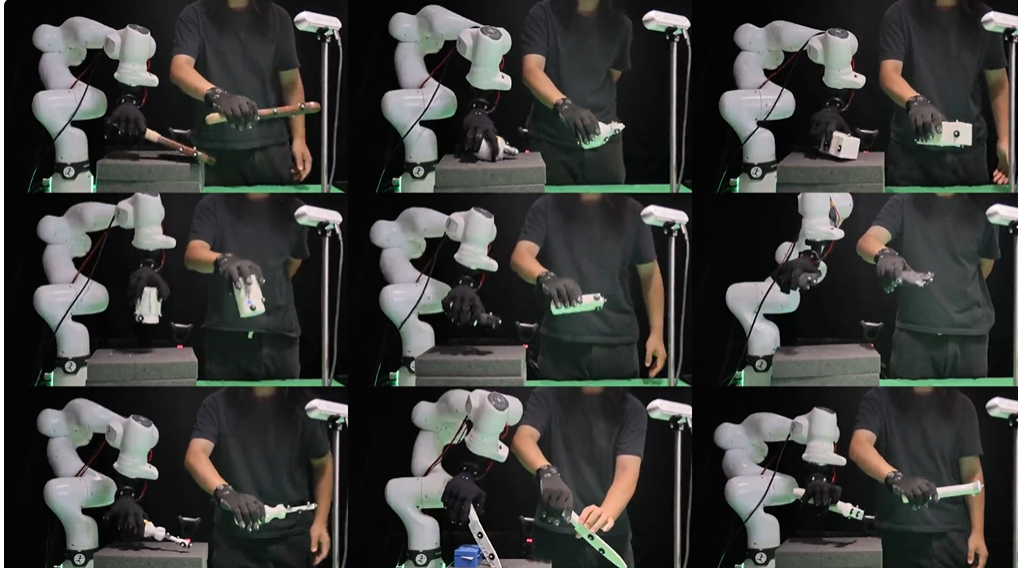
Jiben is pursuing reinforcement learning rather than imitation alone: models that learn manipulation policy through interaction, trial, error and feedback. The data pipeline mixes simulation, human demonstration and generated interaction trajectories, and the team is working on sim to real transfer onto physical hardware.
The stated ambition is a manipulation model platform that sits between a multimodal model issuing a goal and whatever hand is attached to the arm. Upstream it consumes intent. Downstream it adapts to different end effectors. If that works, the model outlives any single hardware generation, which is the only version of this business that scales.
It is also the hardest version. Cross embodiment transfer is where most manipulation stacks break, and a platform claim requires the model to perform on hardware the team did not build. Jiben is hedging by developing its own hardware and by working with hand makers, so it can generate real interaction data rather than simulated approximations.
Nearly USD 10 million is a seed scale cheque in this market, not a war chest. What it buys is a year of iteration on the one problem that decides whether humanoids are useful: getting a hand to do something delicate, reliably, without a human standing behind it.
Editor’s note: This is an adapted translation of the original Gasgoo report. It has been trimmed and restructured for readability for an international business audience. The full original (in Chinese) is at https://www.gasgoo.com/apps/e060bad9eca91db7f01403fc7120041f/robot/news/70476751-seeds-%E6%9C%BA%E6%9C%AC%E6%99%BA%E8%83%BD%E8%BF%9E%E7%BB%AD/.