The entire embodied AI industry has spent two years collecting a few million hours of robot data. InSpatio opened a facility in Hangzhou on 30 October that it says will produce one million hours a month, at roughly a tenth of the cost of teleoperation per sample. If the number holds, it changes what a training budget buys.
The company calls the facility China’s first simulation-led embodied data centre. It is a factory in the literal sense: three automated stages, an input of physical space and an output of graded training samples.
Why capture does not scale
A useful embodied sample has to carry three things at once: a three-dimensional observation of the scene, a record of physical contact, and an executable action sequence. Recording all three from a real robot is slow. An operator running a machine for an hour, after setup, faults and task resets, may bank less than thirty minutes of usable trajectory. Scaling that means buying more robots and hiring more operators, which is a linear business with a fixed ceiling.
First-person wearable capture removed the robot from the equation but brought its own constraints. It depends on the site. Changing the clutter, the lighting or the table surface means sending people back to rearrange the room and record again. Many sites will not permit it at all, since a working supermarket, a live factory floor or a private home is not a film set. High-risk areas, cleanrooms and security zones are out of reach entirely.
Simulation was supposed to solve this and instead moved the bottleneck. Engines such as Isaac Sim provide physics but not scenes. Building one interactive room means modelling objects, binding joints, setting collision boundaries and assigning friction coefficients, which is days or weeks of 3D artist time per room. Handing the job to a frontier model has not fixed it either: generating one object takes tens of minutes and one scene takes hours of iterative render-and-compare, and the output tends to look assembled rather than measured. Without real spatial measurement as a constraint, geometry and scale drift between viewpoints, which widens the gap between simulation and reality.
Three stages, one pipeline
InSpatio’s approach is to treat physical space as raw material and run it through a production line built on its Topos spatial engine.
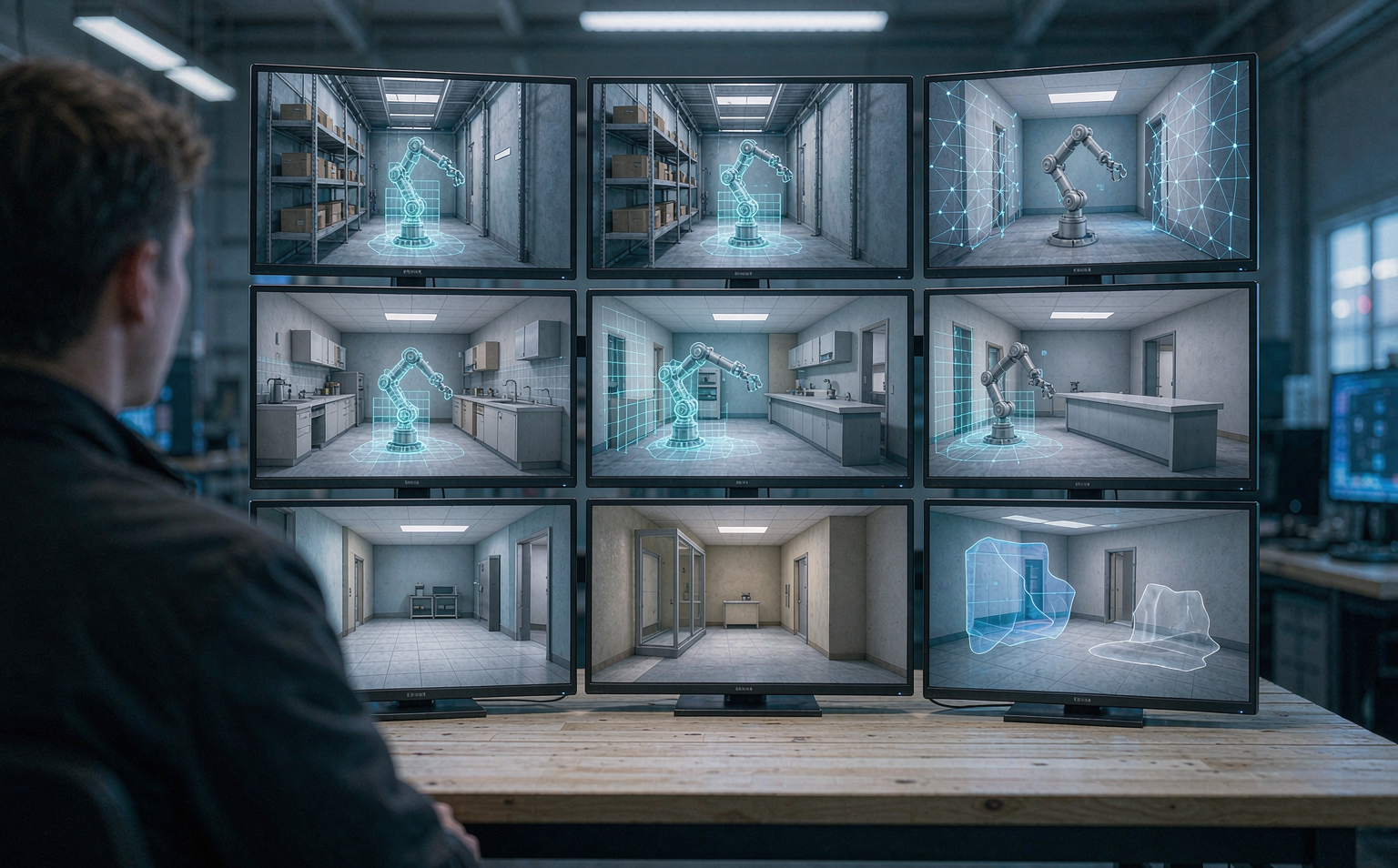
The first stage is intake. A portable scanner covers more than a hundred square metres in about fifteen minutes. For sites nobody can enter, multi-angle video or photographs from staff on site feed a native 3D generation model instead. Once inside Topos, the system does three things automatically: it segments operable objects such as cups, medicine boxes, drawers and door handles away from the background, it completes surfaces the camera never saw, including object backs, undersides and the gap a removed object leaves behind, and it assigns physics, generating collision boundaries, mass, friction and joint axes for doors and drawers so the scene can run in a physics engine. Conversion takes hours, not weeks.
The second stage is amplification. Once a room exists as an editable digital master, changing conditions is a parameter edit rather than a site visit. A small number of real demonstrations seed the system, then multiple simulation channels run in parallel, computing grasp, push and placement outcomes and discarding penetrations and drops. The output is a batch of samples carrying depth, pose, contact force and action semantics. Throughput then depends on how many times a scene can be reused and how much compute is available, not on how many people can be sent to a warehouse.
The third stage is quality control, which is where most data businesses quietly fail. InSpatio scores each scene as a complete room or premises. Changing the lighting or the camera angle in the same room counts as a variant, not a new scene, so the headline number cannot be inflated by re-shooting a kitchen. Deliveries are graded by spatial geometry, physical interaction and closed-loop task evaluation.
There is also a feedback loop that matters commercially. When a customer’s model fails repeatedly on transparent cups, reflective surfaces or dense stacking, InSpatio can generate a batch of environments with exactly those properties and run regression tests in the same set, without sending anyone to a real site.
The catch worth watching
The industry has already built more than 70 training grounds in China, with another 40 or so planned, according to the China Academy of Information and Communications Technology. Most concentrate on presentable tasks: folding clothes, tidying a table, sorting and carrying. Hours accumulate while the variety of spatial layouts barely moves. Adding another camera rig to the same shelf photographs the same shelf again.
That is the gap a simulation pipeline is built to attack, and it is also the gap that will test the claim. Synthetic hours are only worth a tenth of teleoperation hours if they transfer. A model trained on generated kitchens that fails in a real one has produced cost savings and nothing else.
The company’s own framing is that language models scaled because the internet had already digitised text for them. Physical space has not been digitised, and somebody has to do it room by room. Whether that becomes an industrial input or an expensive library of rooms is the question the next year of deployments will answer.
Editor’s note: This is an adapted translation of the original Zhidx report. It has been trimmed and restructured for readability for an international business audience. The full original (in Chinese) is at https://www.zhidx.com/p/606540.html.