A Shanghai company that builds six-armed industrial robots has closed a Pre-B round of several hundred million yuan, and says its 2026 revenue will roughly double on last year.
Sazhi Intelligent took the money from Jiantou Investment, Nantong Investment Management and Yunqi Capital. Earlier backers include Shenzhen Capital Group, Shunwei Capital, Jinyu Maowu, Xiaoxiang Venture, Guoyuan Equity, Haitong Kaiyuan, Yuanhe Puhao, Sanyi Capital and Ivy Capital. The new funds go to model research, multi-arm body iterations, production line expansion and overseas sales.
The machine
The company was founded in 2017 and sells into 3C semiconductors, automotive, energy, and food and pharmaceuticals, with more than 50 Fortune 500 or listed customers. Its founder and chief executive Zhang Jianzheng holds a doctorate in intelligent robotics from Shanghai Jiao Tong University’s school of mechanical engineering, and worked at Fanuc and at Estun before founding the company.
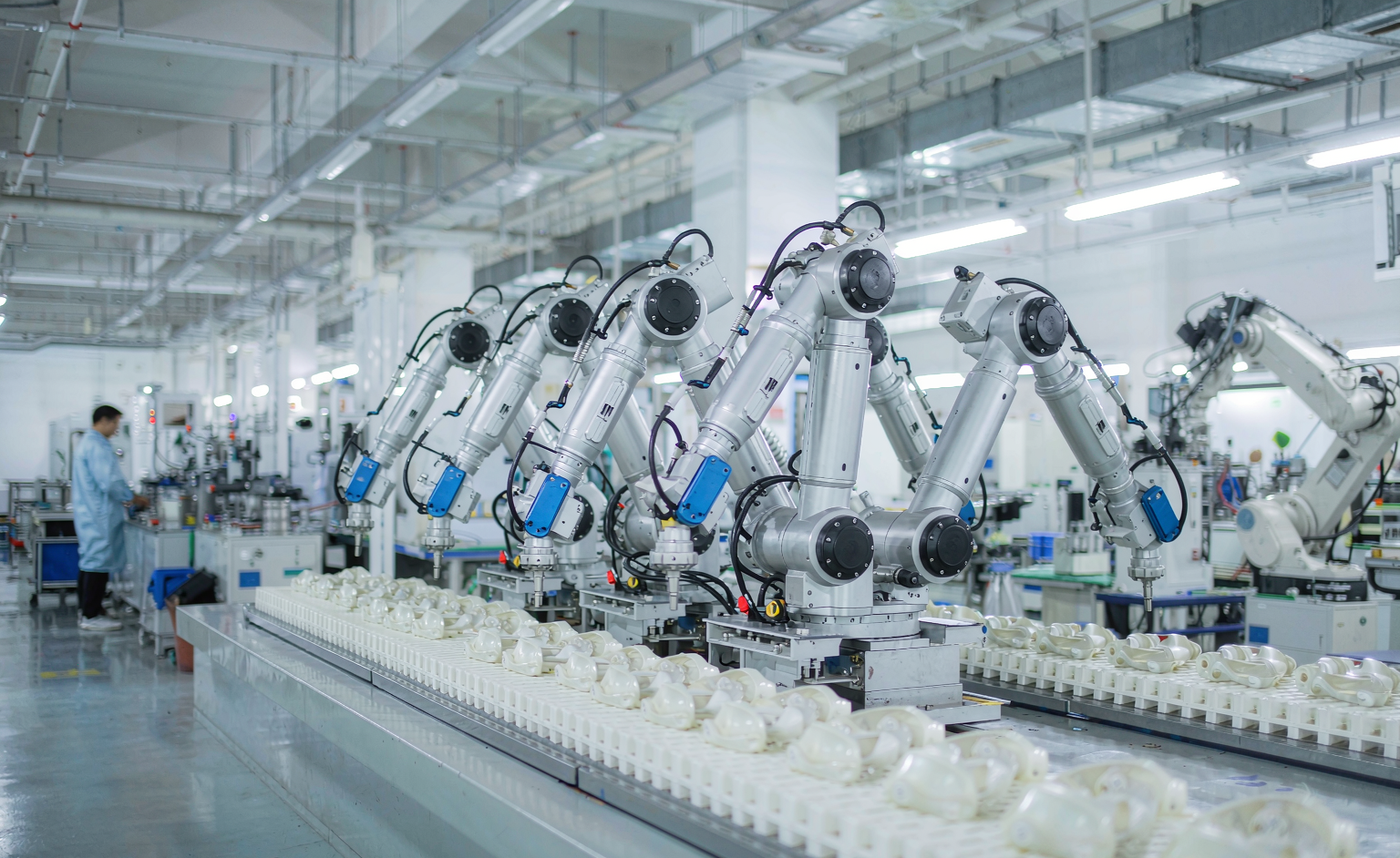
Its six-arm unit, which the company says is an industry first in spatially heterogeneous arm layouts, carries 111 degrees of freedom and holds positioning accuracy of plus or minus 0.03 millimetres. It runs two workstations in parallel and can alternate two-plus-two co-operative operation, so a single machine covers grabbing, assembly, fastening and inspection on one high-takt line.
A four-arm version integrates a multimodal vision-language-action model and accepts voice commands. Each arm carries 16 kilograms to plus or minus 0.05 millimetres inside a 360 degree cylindrical workspace. The two-arm version is the lightweight option, at the same 16 kilogram payload and 0.05 millimetre accuracy, moving at up to 1.5 metres per second.
The model underneath
The hardware is the visible half. Sazhi launched an industrial world model called SageNexus this year, built on multimodal industrial sensing that combines vision, motion, force control and process data. The company says the model has absorbed 2,000-plus scenario skills and reaches 99.9 per cent reliability in precision assembly, flexible loading and complex inspection.
That claim matters more than the arm count. Industrial buyers do not pay for generality. They pay for a machine that does not stop, and the reason six-armed robots have struggled commercially is that a six-arm cell has six times the failure surface of a single arm.
Where the growth is coming from
Sazhi says it matched its entire 2025 revenue in the first half of 2026, with full-year growth of 100 to 120 per cent. Overseas is the second curve: heavy business in Mexico last year, a push into Southeast Asia this year, and large European orders starting to land. The company says overseas intent orders have passed RMB 500 million.
That overseas number is the interesting one for the sector. Chinese industrial robot makers have spent a decade losing on price in Europe. A multi-arm cell is a different sale, because it replaces a line configuration rather than a single machine, and line configuration is where European systems integrators make their margin. Winning there means the Chinese vendor is being bought for capability, not for a discount.
The risk is the same one that has hit every Chinese embodied AI company this year. The round is Pre-B, the revenue base is small, and the world model claim has to survive a customer’s uptime audit rather than a trade show demonstration.
Editor’s note: This is an adapted translation of the original OFweek report. It has been trimmed and restructured for readability for an international business audience. The full original (in Chinese) is at https://robot.ofweek.com/2026-11/ART-8321202-8120-30710157.html.