JD Logistics runs more than 3,600 warehouses and employs more than 600,000 people. It has also built nine families of robot, and the company’s own framing of them is unusually blunt: the industry should test robots inside its existing operations, not in a demonstration hall.
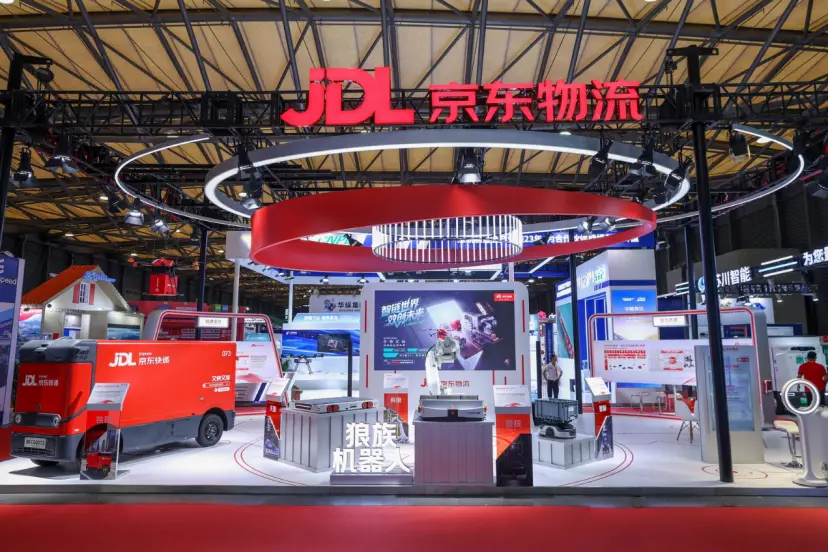
In September the company put nine machines on one stand at its global technology conference in Beijing, under a single brand name. The Wolf family covers storage, picking, sorting, transport and delivery. What makes the case worth following is not the hardware but the test range behind it.
Nine machines and six stages
A parcel moves through six stages: storage, picking, palletising, sorting, transport and last-mile delivery. The Wolf line maps onto them. Zhilang is a box-level goods-to-person system with a shuttle variant. Tianlang handles dense pallet storage. Dilang moves pallets. Canglang picks inside the warehouse. Yilang is an embodied dexterous arm working in sorting. Baomulang is an automated sorting wall. Dulang covers delivery vehicles and autonomous light trucks. Feilang is the drone.
The dexterous arm is the one with public numbers. JD says it carries close to 100 interchangeable hand configurations and has handled more than 13 million real parcels, running around the clock at multiple sites. That figure separates it from almost every humanoid demonstration in China this year, because it is a count of completed work rather than a video.
In cold storage, where standard equipment fails repeatedly at minus 20 degrees Celsius, JD’s low-temperature goods-to-person system uses a global control layer, active defrosting and contactless power delivery. The company reports 100 per cent more storage capacity, 200 per cent higher throughput and 10 per cent lower cost per order. It did not publish the baseline or the scope of those numbers, and they are not itemised in its financial reports.
Why the market is smaller than the noise
China’s industrial embodied intelligence market was worth about RMB 5.74 billion in 2025. The general-purpose humanoid segment inside it was worth RMB 2.11 billion, and most of that sits in demonstration lines, university labs and exhibition builds. Orders are fragmented, unit prices are high and volume is thin.
The segment that works is the unglamorous one: dedicated equipment in closed environments where the economics close. Warehouses qualify because the customer owns the floor, the items are known and the labour cost being replaced is measurable.
Capital has noticed the gap. Domestic embodied AI financing passed RMB 67.7 billion by early June 2026, close to the entire 2025 total, and the evaluation standard has moved from technical narrative to closed commercial loop.
JD is buying positions, not margins
The company does not compete for robot body profit. It builds the infrastructure layer: a component alliance and a factory in Wuxi, channel and experience stores, and a maintenance network covering more than 100 countries.
Its equity stakes follow the same logic. In July 2025 it invested in three embodied AI companies in a single day, two of which, EngineAI and LimX Dynamics, are registered in Shenzhen. Across May to August 2025 it backed six. Paxini handles tactile sensing with a Tianjin data factory that produces close to 200 million high-dimensional training records a year. LimX works on manipulation algorithms trained on human video with zero real-robot samples. EngineAI builds bodies. Qianxun Intelligence and AgiBot sit in the model layer.
On the data side, JD Cloud says it will collect more than 10 million hours of real-scene human video within two years across Suqian and more than 80 RoboBase sites under construction. Its first open first-person dataset, EgoLive, has been requested by universities and research institutes in eight countries.
That is a different bet from the one most humanoid startups are making. They are betting that a general model eventually generalises. JD is betting that whoever owns the floor, the parcels and the maintenance network captures the value regardless of which model wins.
Editor’s note: This is an adapted translation of the original OFweek report. It has been trimmed and restructured for readability for an international business audience. The full original (in Chinese) is at https://robot.ofweek.com/2026-11/ART-8321202-8420-30710360.html.