The hardest question in embodied intelligence this year is deployment, and it has two halves. A robot has to be built in volume and delivered, and then it has to survive the specific place it was delivered to. AgiBot calls the second half the deployment state: machines leaving launch events and trade shows for real production and service environments.
One robot performing a difficult movement on a stage makes a headline. Several hundred robots starting work on time every day, inside real foot traffic, improving as they operate, is the actual test of an industrial company.
On 24 September, Hengqin Chimelong Spaceship Park reopened as what the two sides describe as the world’s first large-scale embodied intelligence theme park. More than 300 AgiBot robots are spread across over 100 interaction points, covering seven scenarios: entertainment performance, science education, guidance, service retail, intelligent companionship, hotel service and sports competition.
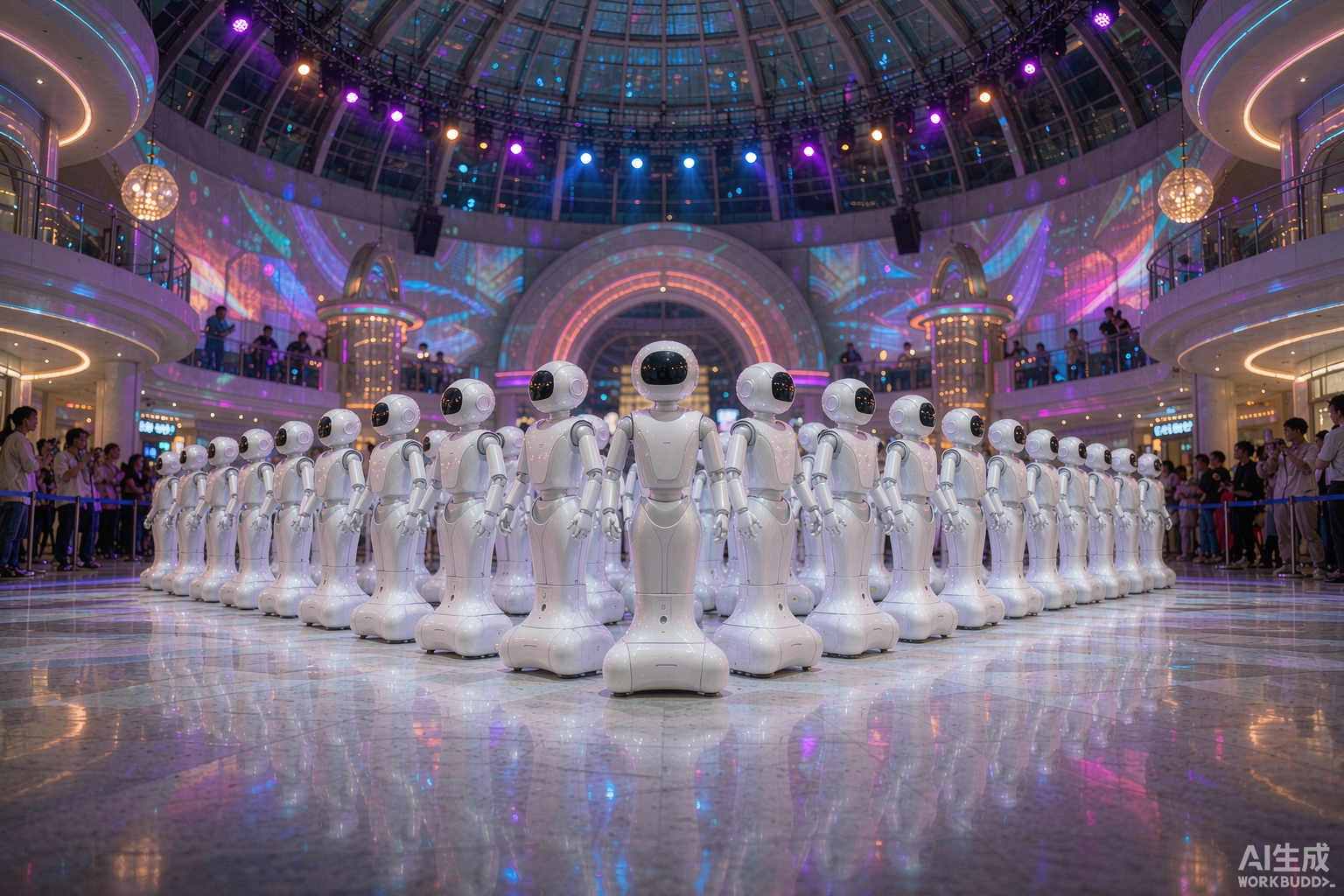
Those 300 units are phase one. AgiBot expects to move into other Chimelong sites, with the full deployment eventually reaching several thousand machines. The same day, the company’s 20,000th embodied robot, an Expedition A3 Ultra, came off the line and was delivered to Chimelong Group. A joint research institute for cultural tourism was unveiled, and a large-scale 5G-A embodied application developed with China Mobile was announced alongside it.
From the production line to the service floor
The 20,000-unit milestone carries a signal. Earlier this year, unit 15,000 went to Longqi Technology’s production line, an industrial setting measured in labour productivity. Unit 20,000 went into a theme park, a service setting measured in service productivity. The requirements differ sharply.
Chimelong provides the test site: the largest indoor theme park in the world, with more than 10 million visitors since opening, over 40 million a year, and overseas visitors up nearly 50 per cent in the past year. High footfall plus complex scenes makes it a high-frequency, unstructured proving ground.
What is new is the word normal. Wang Chuang, an AgiBot partner and senior vice president who runs the general business unit, noted that robot performance had become a fairly mature application by 2025, but most bookings were rentals: the show ended, the robot left. Chimelong changes the model. The robots stay, work fixed shifts and perform several shows a day.
Renting for a day and standing on the roster every day are different problems. A demonstration, an event or a few days of trial operation cannot prove a robot works in a real setting. It has to remain on site, run to a rhythm, absorb daily changes in traffic, environment and task, and adjust while operating.
Three firsts, all of them operational
The project claims three global firsts, and each is about running machines rather than building them. The first is a large-scale 5G-A deployment for cultural tourism using 5G slicing, local edge deployment and security isolation, physically separating visitor traffic from robot traffic to hold end-to-end latency down. The second is a single management platform for operating and maintaining robots across a scenic area, moving service from go-live to long-term operable. The third is a standing safety scheme spanning space, personal safety, charging and fire, AI, data and operations.
These are the problems that appear after delivery. A handful of robots can be watched by hand. At hundreds or thousands, device status, charging, network, faults, safety and task scheduling all have to move into one operating system.
What keeps a robot on shift
AgiBot’s stack is built around three intelligences in one body: motion intelligence as the executor, interaction intelligence as the source of emotional value and therefore service productivity, and task intelligence as the engine of labour value. The body has to be reliable, capable and cheap.
In a park, interaction intelligence is the binding constraint. The company’s WITA model connects model-level understanding and generation to visual perception, voice interaction and motion, so the robot can notice an approaching visitor, speak first and respond to what is happening. Above that, the LinkSoul platform customises voice, expression, persona, motion and costume across five dimensions, letting Chimelong’s intellectual property run through appearance and behaviour.
The duller engineering matters as much. The Expedition series runs 10 hours on a charge, against an industry average of about three, so a battery swap is needed at most once a day. Acoustic front ends, noise reduction, multi-person recognition and lip reading were tuned for crowded halls, and the robot can switch between internal and external microphones. It senses 360 degrees, stops its arm if someone enters the motion envelope, and uses compliant control in the upper limbs to reduce impact force.
Network is the third leg. On-device compute cannot yet carry every interaction locally, so the robot still calls the cloud, and crowded venues are exactly where network traffic concentrates. AgiBot boosted signal inside the A3, supports both Wi-Fi and dual 5G, and works with the carrier on private network optimisation with a dedicated slice, a technique previously used for stadium concerts.
The operating arithmetic
Capability has to land on a cost sheet. A human guide needs shifts and breaks. A robot can carry long stretches of repetitive explanation, and on an international resort, staffing every language adds cost with every language added. One robot can support dozens of languages.
Wang Chuang describes two directions for cost. The first is the ratio of people to robots, from three-to-one today toward ten-to-one and then twenty-to-one as autonomy improves. The second is service life: the purchase price is a one-off, so if a machine runs reliably for two or three years, the cost per day and per interaction falls further.
AgiBot calls 2026 the first year of the deployment state, and the metrics change with it. The question is no longer how impressive a demo looks but whether a robot can hold a post reliably inside hundreds of thousands of visitors, whether it stays operable rather than merely launched, and whether it improves with time. Xiong Yan, a partner and co-president who heads central research, reckons three to five years before robots need no manual tuning at all.
Deployment is not the end of a project. It is the beginning of the next training round, and the only question that matters is whether the machine does the job better a year from now.
Editor’s note: This is an adapted translation of the original Leiphone report. It has been trimmed and restructured for readability for an international business audience. The full original (in Chinese) is at https://www.leiphone.com/category/robot/23F3DiDtv7Puosqy.html.