LangChain’s valuation more than doubled in a year without a change in what it sells. A US$300 million round says the enterprise agent market has moved from trying models to running infrastructure.
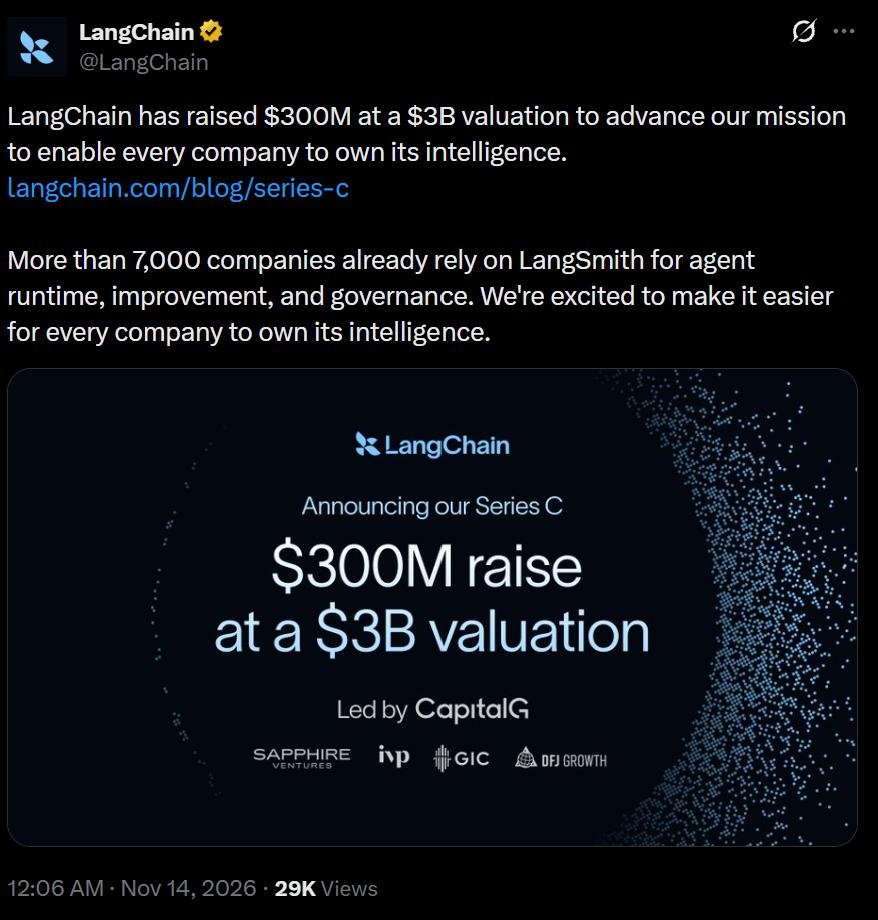
On 14 November, the US AI agent management company LangChain announced a US$300 million Series C, about RMB 2.001 billion, at a post-money valuation of US$3 billion, about RMB 20 billion. CapitalG, the Google-backed growth fund and an existing shareholder, led the round. New investors GIC and DFJ Growth came in at size, with IVP, Sapphire Ventures and other existing backers following.
In October 2025 LangChain raised US$125 million at a US$1.25 billion valuation. The new round more than doubles that figure in just over a year.
From an open source side project to a platform
LangChain began in late 2022 as a personal open source project by co-founder Harrison Chase, built to help early large language models do things they found difficult, such as searching the web, calling APIs and reaching databases. The company was formally set up in early 2023, is headquartered in San Francisco and has offices in New York, Boston and Amsterdam.
Its products cover development, deployment, evaluation and governance of LLM applications and agents. LangChain, LangGraph and LangSmith help enterprises connect models, data and external tools and then build and manage agent systems in production.
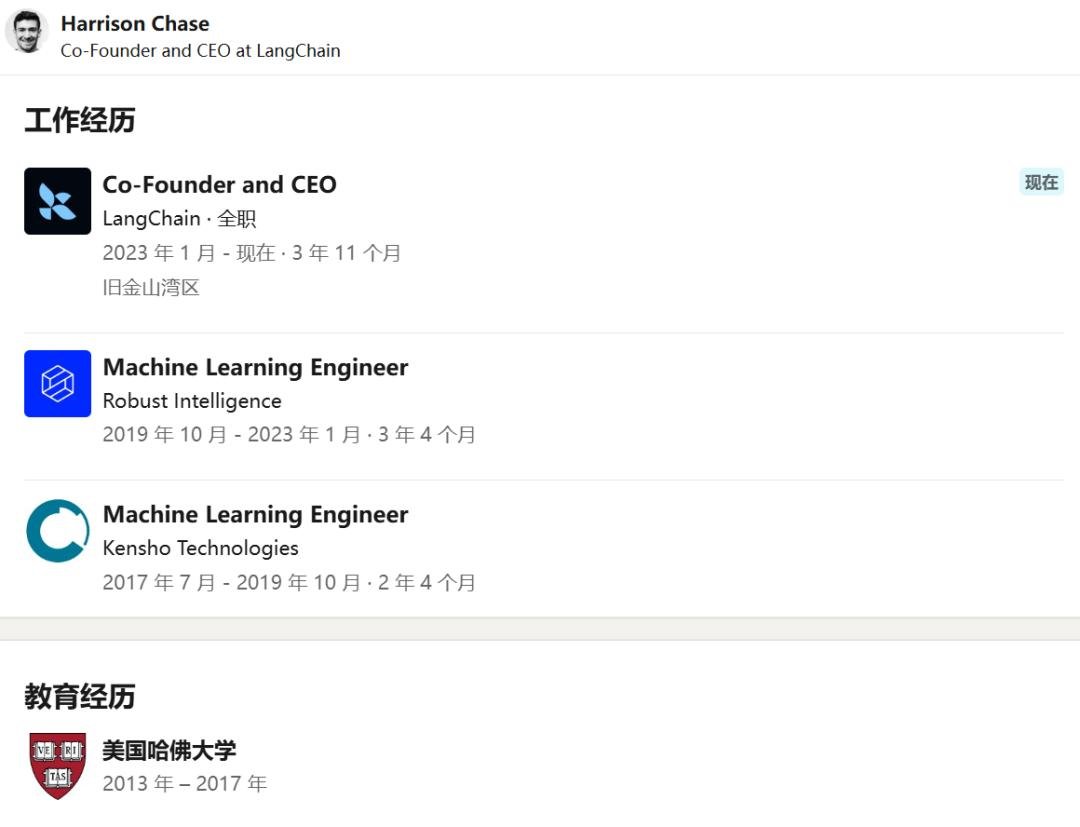
Chase studied statistics and computer science at Harvard, worked on entity linking at Kensho Technologies and was a machine learning engineer at the model testing and verification firm Robust Intelligence.
The thesis: companies want to own the stack
LangChain argues that agents will reshape economic structure, and that future agents will differentiate on vertical domain knowledge, enterprise data and user experience, sold either as standalone products or used to rebuild internal operating processes.
In that world, enterprises want control of their own intelligent systems: choosing the models that fit the business, controlling data and infrastructure, improving agents continuously, and meeting the security and governance requirements of deployment at scale. That is the gap LangSmith is meant to fill.
LangChain says more than 7,000 organisations use LangSmith. Customers include AI startup Harvey, enterprise software firm Rippling and voice market research firm Listen Labs, alongside Fortune 500 companies including NVIDIA, Toyota and Salesforce.
What sits inside LangSmith
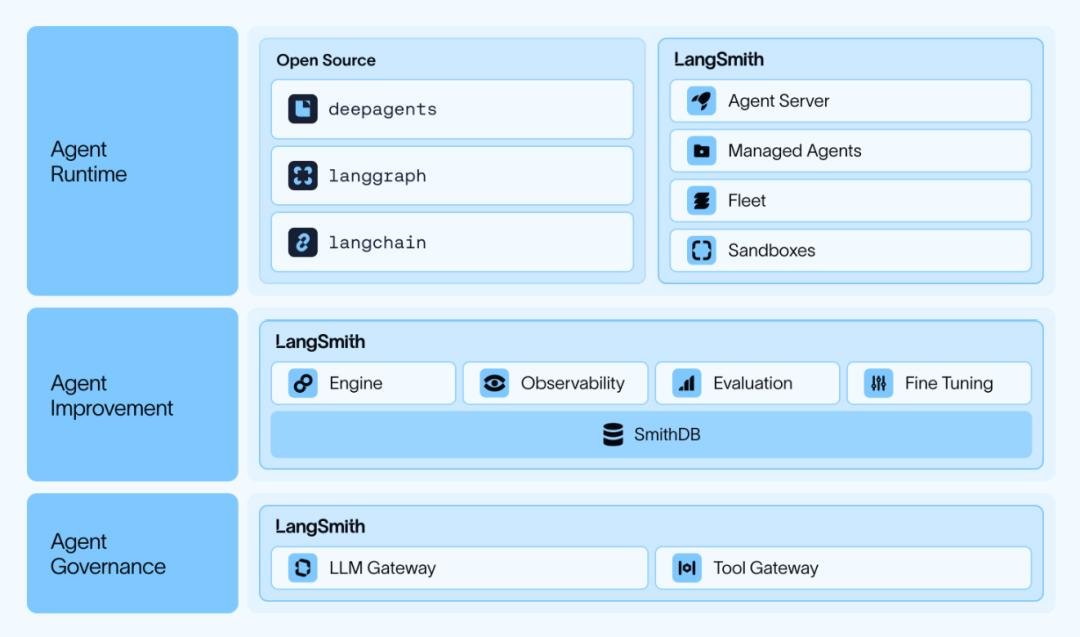
Agent operation supplies the architecture and infrastructure to run agents reliably. Deep Agents, LangGraph and LangChain give developers agent architectures, model choice and context management. LangSmith Agent Server and Sandboxes support safe deployment in the cloud or in a customer’s own environment, while Managed Agents and Fleet offer hosted building, deployment and runtime.
Agent improvement covers testing, monitoring and raising performance. LangSmith Observability and Evaluation track agent behaviour and assess output quality. LangSmith Engine is a built-in agent that finds errors, writes code and prompt fixes, and watches production traffic for performance regressions. LangSmith Fine-Tuning turns agent trajectories into training data for fine-tuning and evaluating specialised models.
Agent governance uses an LLM Gateway and a Tool Gateway to centrally manage model budgets, model fallback policy, sensitive data protection, tool access permissions and identity authentication.
LangChain plans an online launch event on 20 November to announce new LangSmith capabilities, and says it will keep extending the platform across agent building, deployment, evaluation and governance to lower the barrier for enterprises developing high-performance agents.
The round is a marker for where enterprise agent budgets are going. Spending is shifting from model and application experiments toward infrastructure and scaled deployment, with reliability, continuous improvement and safe use across many teams and business units becoming the priorities. As more agents enter production, demand around runtime efficiency, outcome evaluation, data security and cost control keeps rising.
Editor’s note: This is an adapted translation of the original 36Kr report. It has been trimmed and restructured for readability for an international business audience. The full original (in Chinese) is at https://m.36kr.com/p/4073292469752969.