Audi and SAIC opened the AUDI Innovation and Technology Center in Shanghai on 5 November, giving a joint venture entity end-to-end authority over the brand’s Chinese models from concept definition to start of production. The facility employs roughly 300 engineers and marks a structural change in how a German premium manufacturer develops cars for its largest market.
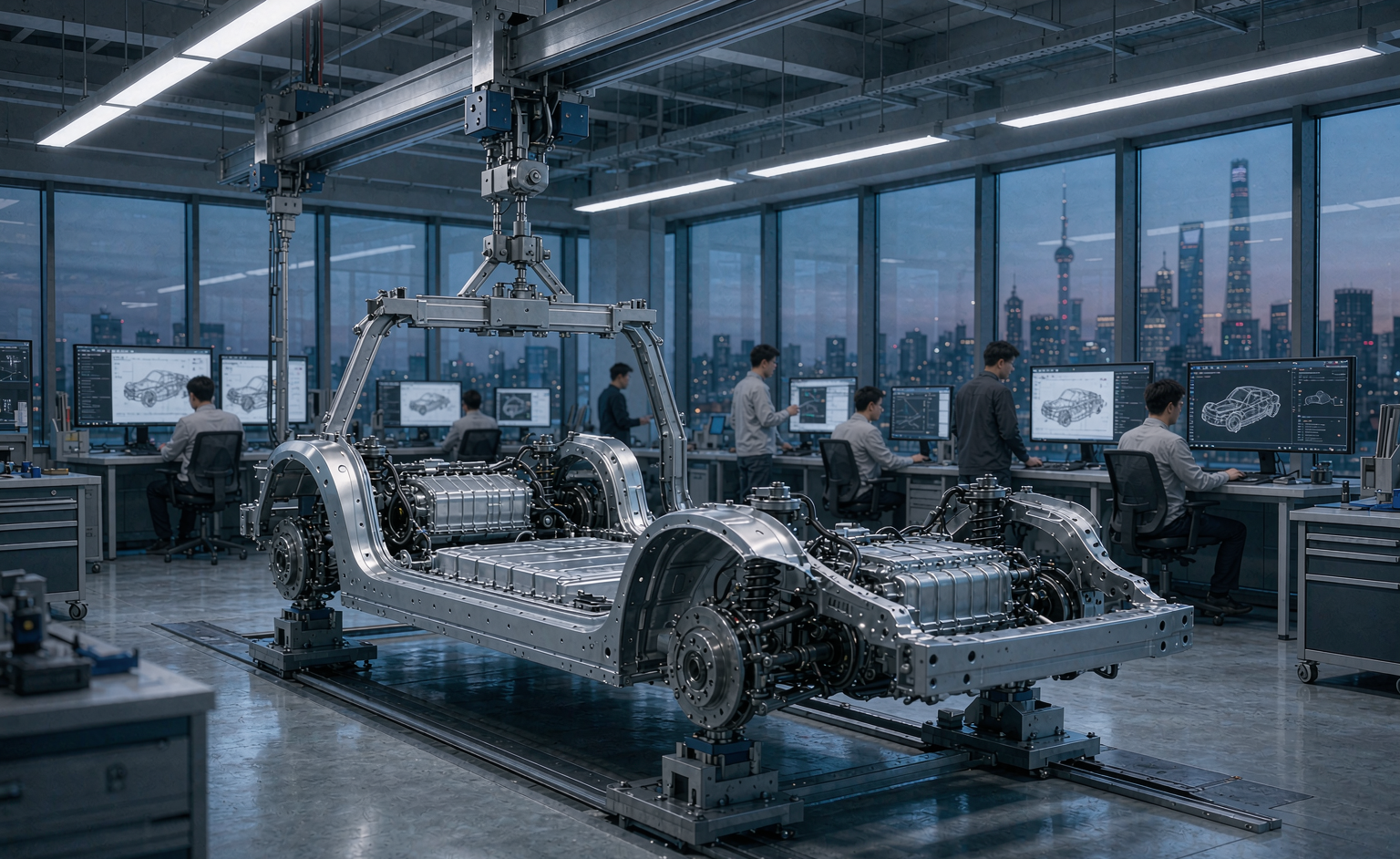
Gernot Döllner, chairman of the board of management at AUDI AG, described China as both a critical market and one of the most dynamic innovation centres in the industry, and said success there requires development work that sits closer to customers. Jia Jianxu, president of SAIC Motor, said the centre would let German luxury engineering and Chinese digital capability operate on the same schedule.
From adapted to defined
The old pattern for foreign manufacturers in China was adaptation. Headquarters defined the product, the local team localised it. The new centre inverts that order, and the company’s own language names the shift: from adapted for China to defined in China.
Matthias Pfister runs the centre as general manager, with Shan Yunwei as deputy. Three pillars are stated. Defined in China treats the market as the starting point for engineering targets. Native Intelligence puts AI into the vehicle architecture from project inception so that hardware and software are developed in parallel. Advanced Engineering combines Audi’s quality standards with SAIC’s digital capability and local development speed.
The parallel development model is the operative detail. Driver assistance, the electrical and electronic architecture, the cockpit and the vehicle system all run from the first day of a project rather than in sequence. AI stops being a feature added late in the cycle.
Volcano Engine and the cockpit
AUDI is working with Volcano Engine, ByteDance’s cloud and AI platform, on next-generation cockpit definition, the AUDI OS software architecture and multimodal interaction, including convergence between cockpit and driver assistance systems. The stated goal is to extend AI from cabin interaction into vehicle-wide intelligence.
Fred Schulze, chief executive of the Audi SAIC strategic cooperation, said the brand was built for Chinese customers and that the centre systematises the conversion of their expectations into product experience, spanning concept definition, software and driver assistance, and over-the-air updates across the lifecycle.
The ADP 2.0 platform
The centre is developing the second-generation intelligent digital platform, ADP 2.0, built on central computing and zone controllers with compute and AI integration specified to support L3 and L4 driver assistance. The platform is designed around Chinese electric vehicle requirements rather than retrofitted to them.
Four new models on ADP 2.0 will enter the Chinese market from 2028. The brand’s first two products, the E5 Sportback and E7X, are already on sale and established the joint development model the centre now formalises.
Why the direction of travel matters
A European premium brand has moved the definition of its product, not merely its calibration, into the market where the software competition is hardest. That is a different concession from building a local plant. A plant imports engineering decisions. A centre like this exports them back to the group.
The competitive question for European suppliers and engineers is what happens when the Shanghai-defined electrical architecture, cockpit stack and driver assistance system start appearing in products sold outside China. Audi has not announced that. It has built the capability that makes it possible.
Editor’s note: This is an adapted translation of the original Gasgoo report. It has been trimmed and restructured for readability for an international business audience. The full original (in Chinese) is at https://auto.gasgoo.com/news/202611/5I70477049C109.shtml.