From Xiaolingtong to hotel robots: a UTStarcom old guard takes Wuxi firm past HK$15.5bn
On 9 September, Youdao Robotics surged as much as 176 per cent on its first trading day, with its market value briefly crossing HK$15.5bn. History had not vanished. It merely returned in a new posture, as a founding team that grew up in the Xiaolingtong (little smart phone) era spent more than a decade in hotel corridors, KTV rooms and campus roads before suddenly standing in the robotics-capital spotlight.
Chairman Lu Ying is a telecoms veteran who served as COO, CEO and president of UTStarcom, and Youdao’s early team shared deep roots in UTStarcom’s China business and terminal operations. General manager Gu Zhenjiang also spent years at UTStarcom, as did several co-founders. When the team entered robotics around 2013, it did not chase the humanoid robots now favoured by capital, but moved into low-speed autonomous driving. After hitting the cost wall of open-road autonomy, it pivoted to hotels, KTVs, offices and semi-enclosed spaces, launching the “YouXiaoMei” robot in 2016, then expanding into heavy-load delivery, campus delivery, commercial cleaning and unmanned retail.
By 26 March 2026 Youdao held 508 granted Chinese patents with over 268 more pending, and a 140-person R&D team that is 35.5 per cent of staff. Its architecture evolved from LiDAR SLAM to multi-sensor fusion and edge vision models paired with cloud vision-language models. In 2023 it paid about RMB 104m for vision-algorithm source code, lifting that year’s R&D spend to roughly RMB 160m, a deliberate mix of in-house R&D, external acquisition and engineering integration.
The shareholder list reads like a who’s who of the sector. Alibaba is the largest external backer, with Ele.me operator Lazars and Yunfeng Fund holding about 14.3 per cent combined, having entered around 2018 as Youdao shifted from autonomous driving to indoor delivery. Legend Capital took an 8.02 per cent A-round stake in 2016, SenseTime’s Guoxiang capital holds 5.89 per cent, and iFlytek’s subsidiary is also on the list. Most telling are hotel groups H World, BTG and GreenTree, whose small stakes bind them as priority buyers and deployers. In 2024 the company moved its headquarters from Shenzhen to Wuxi, planning RMB 1bn in local investment in a headquarters, global sales centre, R&D centre and manufacturing base.
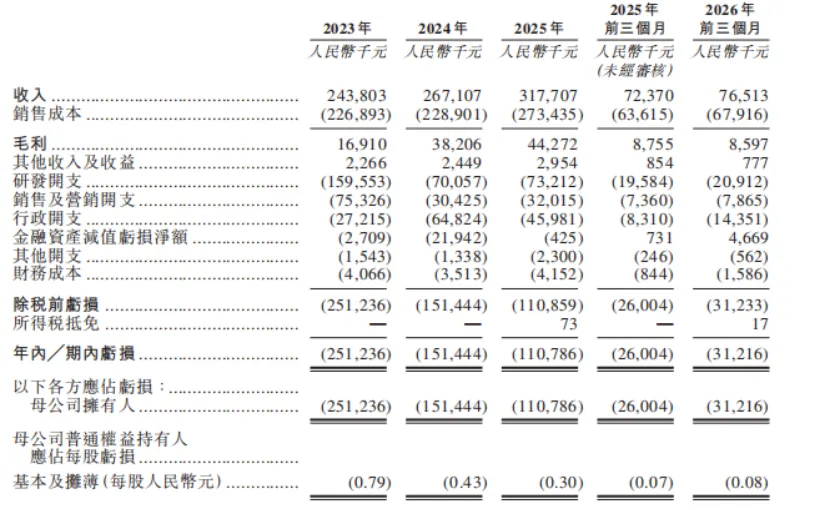
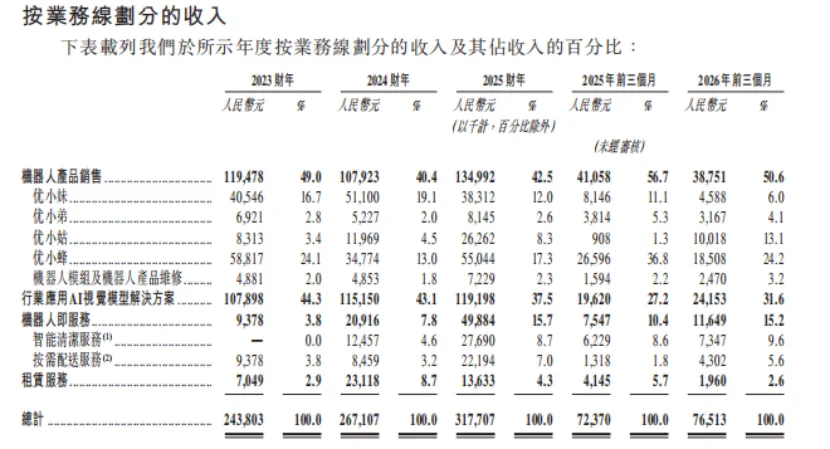
By 26 March 2026 Youdao had sold more than 114,600 robots to over 5,100 customers worldwide, with over 15,000 units connected to its cloud and more than 360,000 task instructions processed daily. Revenue rose from about RMB 244m in 2023 to RMB 267m and then RMB 318m in 2025, a two-year compound growth of roughly 14 per cent, while gross margin recovered from 6.9 per cent to 13.9 per cent. Per Frost and Sullivan, China’s commercial service-robot market was about RMB 2.2bn in 2025 with a reachable market near RMB 78.9bn, implying just 2.9 per cent penetration, and Youdao ranked third by 2025 revenue with an 8.9 per cent share.
The more interesting shift is from selling a machine to selling a network. RaaS (Robot as a Service) revenue grew from about RMB 9.38m in 2023, just 3.8 per cent of total, to about RMB 49.88m in 2025, or 15.7 per cent, a roughly 5.3-fold expansion, and turned from gross-loss to positive gross margin. About 48.5 per cent of IPO proceeds are earmarked for R&D, including cloud vision-language models, data loops and advanced VLA technology. The next competitive front is no longer building more machines, but making deployed machines into continuously running intelligent nodes.
Editor’s note: This is an adapted translation of the original OFweek report. It has been trimmed and restructured for readability for an international business audience. The full original (in Chinese) is at https://robot.ofweek.com/2026-09/ART-8321203-12003-30703283.html.