Why would a company with quarterly revenue above USD 120 billion pay people to leave? That is the question Alphabet is answering in public, one country at a time.
On 4 November Reuters reported that Google has extended its voluntary exit programme to Canada, France, Germany, Japan and Switzerland this year. Eligible staff can apply to leave and receive a severance package. In Switzerland the standard is one month of pay per year of service, capped at twelve months.

The numbers do not look like a company in retreat
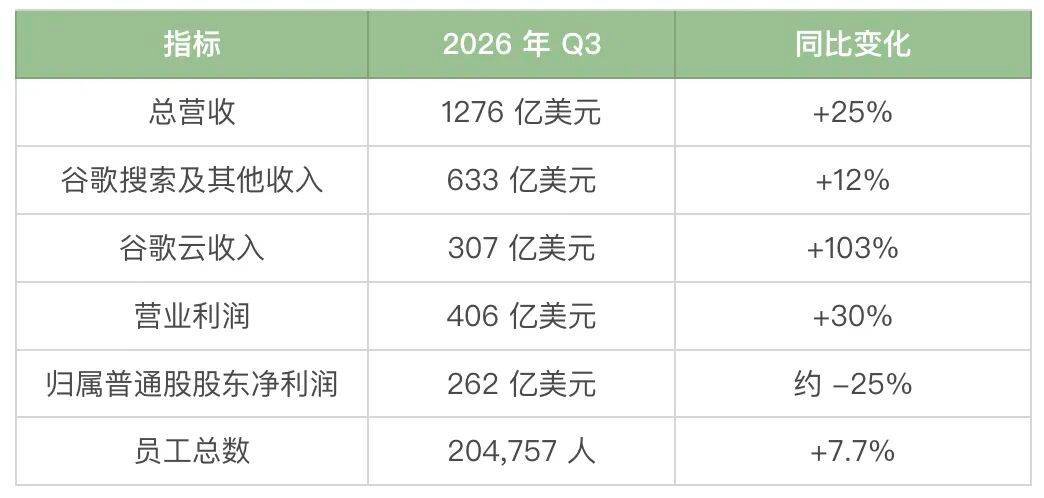
Alphabet’s third quarter, reported on 28 October, showed revenue of USD 127.6 billion, up 25 per cent. Google Cloud brought in USD 30.7 billion against USD 15.2 billion a year earlier, growth of 103 per cent, with operating profit of USD 11.1 billion against USD 3.6 billion.
Group operating profit reached USD 40.6 billion, up 30 per cent. Chief executive Sundar Pichai said the company is running at roughly USD 500 billion annualised, with a thirteenth consecutive quarter of double digit growth.
The cash flow is where it turns
Capital expenditure for 2026 is guided at USD 195 billion to USD 205 billion. The third quarter alone absorbed USD 51.4 billion, mostly servers, networking equipment and data centre construction.
Operating cash flow in the quarter was USD 42.3 billion. Free cash flow was negative USD 9.1 billion. Capital spending has overtaken the cash the business generates.
That is the context for the exits. Google’s statement to Reuters frames the programme as support for the next phase of work, aimed at staff who no longer fit the company’s pace or direction. It has run in parts of the United States and Britain since 2025, expanded to more countries in June, with decisions in mid-July and departures from August.
Switzerland is the tell. It is a major European engineering centre with about 5,000 staff. The programme covers several business units there and excludes Google DeepMind entirely. In one team of about 50 people, at least four accepted.
Where the money is going instead
Hiring has not stopped. It has moved. AI and cloud teams remain the priority while older business lines are offered severance.
Demis Hassabis framed the productivity side of it bluntly, saying that in future one person may be able to do the work of ten.

The arithmetic is uncomfortable for anyone reading this as efficiency. A company that spends USD 51.4 billion in a quarter on infrastructure, and still hands out exit packages, is reallocating rather than retrenching. The people leaving are not being replaced by cheaper people. They are being replaced by compute.
For suppliers, that is demand. For the labour market in five countries, it is a signal that the AI transition inside large tech firms is no longer theoretical. Headcount becomes the shock absorber for a capital budget.
Editor’s note: This is an adapted translation of the original Sohu Tech report. It has been trimmed and restructured for readability for an international business audience. The full original (in Chinese) is at https://www.sohu.com/a/1097608179_355140.