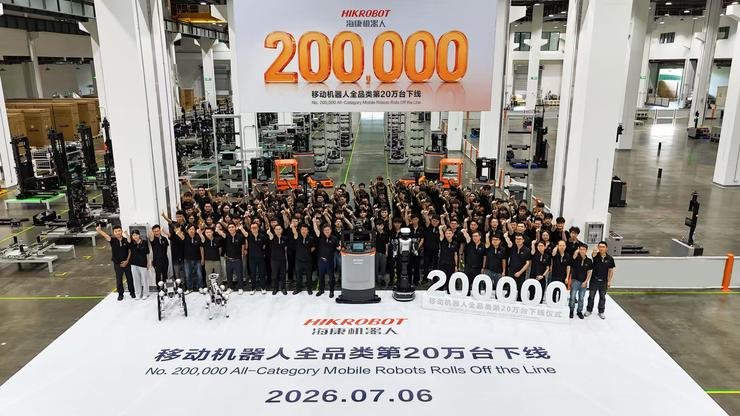
On 6 July 2026, as a fork-lift robot rolled off the line, Hikrobot formally announced that cumulative output across all its mobile-robot categories had passed 200,000 units. It took the company only two years to go from its 100,000th unit in May 2024 to the second hundred thousand. By the latest count from the Mobile Robot Industry Alliance, Hikrobot held the global number-one market share for mobile robots in 2025.
From technology to standards: the system behind the scale
Scale in mobile robots is not just capacity. It is the accumulated result of long-term investment in technology, product, scenario and industry standards. Hikrobot’s path runs from early product lines, latent, fork-lift and omni-directional fork robots, to a safety controller that earned the world’s first SIL3 certificate, an omni-directional fork robot that took China’s first full-directive CE certificate, and the fourth-generation Smart Base platform. Its core software architecture has iterated four times, from early warehouse dispatch to a low-code intelligent platform with mixed scheduling, and its control, algorithm and perception are all self-developed.
On standards, Hikrobot has led or taken part in more than 37 mobile-robot standards. In June 2026 the national standard Logistics Robot Information System General Technical Specification, which it led, won Zhejiang’s major standards-innovation award, the first systematic global standard for logistics-robot informatisation.
Scenario depth: the market foundation for scale
As of April 2026 Hikrobot had served more than 20,000 customers across over 1,000 niche scenarios, covering automotive, 3C electronics, photovoltaics, lithium batteries, retail, pharma, tobacco and apparel. At FAW-Toyota it deployed more than 2,000 mobile robots, the first single-factory deployment above 1,000 in the auto sector. At Changan’s smart factory, 687 robots lifted manufacturing efficiency by 20 per cent and cut line cost by 20 per cent. In new energy it has shipped more than 10,000 units across over 500 lithium projects.
An ecosystem against fragmentation
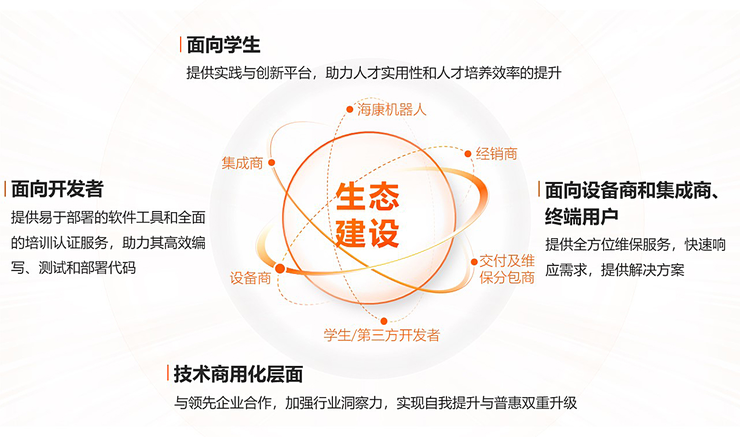
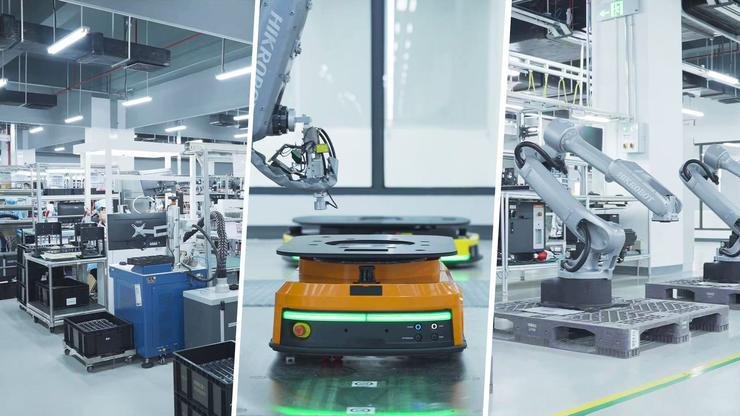
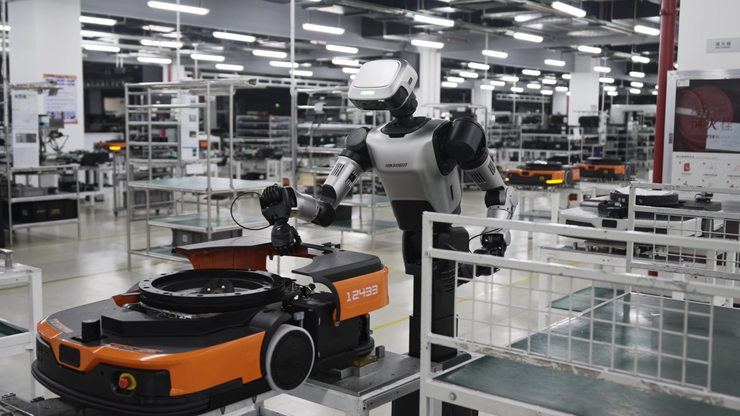
Since launching its ecosystem strategy in 2020, Hikrobot has gathered more than 500 partners and trained over 200,000 engineers across machine vision, mobile robots and joint robots. In its 200-acre Tonglu science park, mobile robots, machine vision and joint robots already run deep eye-hand-foot coordination on the line, supporting annual capacity of 75,000 mobile robots, 5 million vision products and 20,000 joint robots. The slogan has shifted from machines assisting people to robots building robots.
Editor’s note: This is an adapted translation of the original LeiPhone report. It has been trimmed and restructured for readability for an international business audience.