In April 2025 Elon Musk predicted on X that robots would surpass good human surgeons within a few years and beat the very best within five. Most people treated it as another founder posting. One research group decided to test it properly.
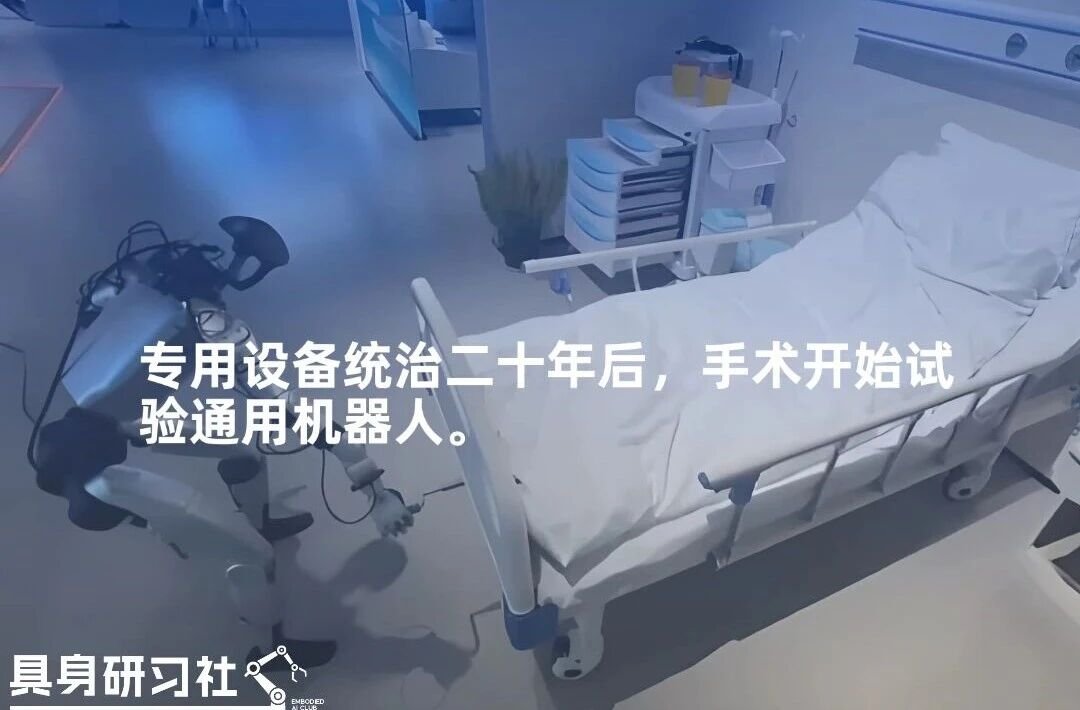
Rather more than a year later, in July 2026, Nature published a paper from a team at the University of California, San Diego. Surgeons teleoperated a Unitree G1 humanoid robot through two laparoscopic gallbladder removals on live pigs. It is the first time anyone has used a general purpose humanoid robot to complete the main steps of a standard laparoscopic procedure on a living subject.
Liang Zekai, the paper’s first and corresponding author and a doctoral student at UC San Diego, was candid about the trigger. The team already had a line of humanoid medical research running, and Musk’s post was the direct prompt to push it into surgery.
Why the comparison landed so hard
The paper drew attention fast, and the reason is arithmetic. A Unitree G1 starts below 20,000 dollars and occupies less floor space than an adult. A da Vinci or comparable dedicated surgical system takes up a large footprint and has cost well over a million dollars for years.
That contrast opened the imagination. A humanoid stationed in a remote region, a desert, a plateau, a battlefield, or eventually orbit, with the remote medicine problem simply solved.
Read the paper itself and the picture is more sober. The robot cannot operate autonomously. Every motion came from a surgeon through teleoperation. The procedure paused repeatedly for recalibration. The robot wore a precautionary safety harness throughout. The surgeons involved scored the system’s clinical readiness at a median of 2.5 out of 5.
What this operation really proves is narrower and more interesting. A general purpose humanoid platform has, for the first time, touched the threshold of a precision task like surgery, and part of the capability and method transfers to other machines. Whether the route goes anywhere depends on the limits of the body itself and on how fast the wider embodied intelligence industry moves.
The deliberate choice: change the software, not the robot
Liang told the interviewer that his group had been working with existing surgical robots and understood the constraint clearly. Current instruments and the whole operating theatre workflow are designed around the human body. Plenty of people were arguing about whether a humanoid could operate at all, he said. Rather than keep predicting, the team put one in a theatre, because a systematic result was needed.
The hardware changes were minimal. The team added an interface on the hands to hold instruments, then wrote software to convert a surgeon’s motion into commands the robot and the instruments could execute. Most of the work sat in low level system design. Controlling a surgical instrument and getting teleoperation to feel right took extensive tuning. In other words, the effort went into software capability rather than surgery on the machine, leaving the G1 intact as a general purpose robot.
The more fundamental choice came next. The team did not build dedicated instruments. They used wristed laparoscopic tools designed for human surgeons, in a standard operating theatre laid out for human workflow rather than a purpose-built space. That was deliberate. If we built our own powered instruments, Liang said, we would be back to the surgical robot approach.
They still built interfaces, measured instrument parameters and developed a dedicated control system. But compared with redesigning an entire machine, the specialised work concentrated in software and tool adaptation, which is the most direct expression of general purpose design.
Set the two routes side by side and the split is clear. Dedicated surgical robots such as da Vinci follow a medical device logic. Everything, hardware and software, is designed around the operation, with proprietary instruments and a matched theatre, buying precision and stability. The humanoid route runs on a general body plus task adaptation. The body is off the shelf and generic, and specialisation is supplied by algorithms, interfaces and software models. This operation is the first proof that the second approach can reach live animal experiments.
What broke, and why it matters
In the second procedure there was a small bile leak and bleeding from the liver bed, handled with suction and electrocautery before the operation continued.
Liang attributes this partly to the physical radius of the G1. The robot stands about 1.3 m with an arm span of roughly 450 mm, against a typical adult span of 1.6 to 1.8 m. Once the robot reaches the edge of its range it cannot extend further, and the surgeon’s view makes that hard to perceive, which produces unexpected motions.
Software can warn the surgeon that the arm is nearing its limit and can replan the robot’s movement, but it cannot close a gap in body size. Liang estimates that a humanoid closer to adult dimensions would resolve many of the current workspace problems, and that most of the teleoperation and instrument control methods already developed would transfer directly.
Precision is the second gap. On the bench, straight-line error was about 1.3 mm, while error on complex curved trajectories widened to roughly 10.4 mm. The team believes part of that comes from hand measurement and modelling of commercial instruments whose full manufacturing parameters are not public. Even with complete parameters, Liang notes, motor quality and control precision still set the ceiling.
Sterility is the third. No commercial humanoid has sterilisable components today, so the team simply fitted the robot with sterile gloves in the human style. Liang is blunt that engineering cannot solve this alone. Healthcare has to define the standard for a robot entering a sterile field before engineers can design to it.
Sterility is not the only gap. Approval pathways and liability allocation need the medical system and the industry to build standards together. Turning technical generality into social generality means walking the road every new class of medical device has walked.
The real driver is a staffing crisis
Humanoids in hospitals is not a curiosity-led research direction.
The structural driver is a global shortage of health workers. The World Health Organisation projects a gap of 11 million health workers by 2030, concentrated in low and middle income countries and worst in rural, remote and under-resourced areas.
Meanwhile dedicated surgical robots are shrinking and getting cheaper. In July this year Johnson and Johnson’s Ottava surgical robot received US regulatory clearance, integrating its arms into the operating table and cutting footprint by roughly half.
So smaller and cheaper should not be the humanoid pitch. The genuine difference is that one body crosses tasks that used to be separate, taking real pressure off clinical staff across several jobs rather than one.
Liang expects the first wave of hospital humanoid work to be transport, scope holding, retraction, equipment operation and examination support, which is also where a bipedal body earns its keep on stairs, obstacles and human-shaped environments. It is very hard right now to have one model do everything, he said. The realistic approach is a shared body and shared low level system, with different software models configured for different tasks.
General does not mean plug and play. New instruments need new control relationships, and new tasks need different models, data and safety rules. But if the low level manipulation, body control, software system and interface survive, the next task does not start from zero.
Cost belongs in that frame too. A G1 at tens of thousands of dollars is a low starting point, but once you add sterile design, safety redundancy, medical certification, maintenance and training, Liang admits the final figure is not yet calculable. The more you invest in detailed engineering, the higher the price goes. If one body can handle transport, equipment operation and surgical assistance at different hours, though, the equipment cost is shared across several jobs.
On Musk’s five year claim, Liang disagrees. Real autonomous surgery needs more than motion precision. It needs the robot to identify anatomy, handle the unexpected, and resolve medical liability. The realistic near-term applications remain in-hospital basic work, surgeon teleoperation and low risk surgical assistance.
He is rejecting the timetable, not the direction.
What the experiment leaves behind
This was not the arrival of a robot surgeon. It put surgery inside the task range of a general purpose humanoid for the first time.
What it leaves behind is not a modified robot. It is a method covering surgical instrument control, teleoperation and hospital workflow adaptation. When humanoids arrive with better dimensions, more precise motors and steadier control systems, those methods should transfer to the new body without rebuilding the stack. Running the other way, the millimetre precision, motion boundaries and long-run stability that surgery demands will push general purpose bodies towards professional grade.
Editor’s note: This is an adapted translation of the original OFweek report. It has been trimmed and restructured for readability for an international business audience.